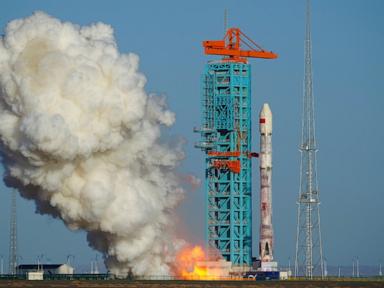
The headlines are predictable. The media is hyperventilating over China successfully bringing a rocket stage down to a concrete pad on home soil, treating it like a monumental leap forward in orbital mechanics. Everyone is rushing to declare that the space race is back on and that landing boosters on dirt is the ultimate proof of aerospace dominance.
They are missing the entire point.
I have watched companies burn through billions of dollars trying to recreate engineering milestones simply because they look good on a press release, ignoring whether those milestones make any fiscal or operational sense. Returning a booster to dry land rather than catching it mid-air or landing it on a drone ship out at sea is not a stroke of genius. It is a massive constraint masquerading as a triumph.
If your primary goal is to build a sustainable, high-frequency launch cadence, dragging a heavy, complex, high-velocity machine back to the exact piece of geography it lifted off from is a terrible idea. It is the aerospace equivalent of driving your car in reverse back into your garage instead of just pulling into a driveway that makes logistical sense.
Let us break down why this land-landing obsession is a regression, and why the people cheering for it do not understand how heavy-lift economics actually work.
The Physics and Geography Trap
To understand why landing on land is an anchor, you have to look at the energy state of a returning booster.
When a first stage separates from the rest of the rocket, it is traveling at hypersonic speeds thousands of miles downrange, miles above the Earth. It possesses an immense amount of kinetic and potential energy. To reverse that momentum and guide the stage back to the launch site, you have to spend an enormous amount of propellant executing a "boostback burn."
That fuel does not pay for itself. Every single kilogram of kerosene or methane you dedicate to turning the booster around and flying it back to land is a kilogram you cannot use to push a payload into orbit.
Imagine a scenario where you are running a logistics company, and every time you send a delivery truck across the country, you force the driver to turn around and drive back to the exact loading dock they started from, even if an empty return trip requires burning half their fuel capacity in reverse gear. You would go bankrupt in a month. Yet, in the space industry, people see a rocket touch down on a concrete slab and forget basic math.
Sea-based landing platforms, by contrast, meet the booster where the physics dictate it should land. They sit downrange along the natural trajectory of the flight path. The booster performs a much smaller burn to adjust its descent vector, preserving precious propellant margins for payload capacity.
China’s land recovery is a technical achievement, make no mistake. Controlling a multi-ton cylinder of metal and dropping it onto a designated target requires elite guidance, navigation, and control algorithms. But building a system that forces you to fight the laws of orbital mechanics just so you can park your hardware where the cameras can see it is a triumph of vanity over engineering efficiency.
The Reusability Mirage
Everyone loves to talk about reusability as the holy grail of spaceflight. But reusability is a means to an end, not the end itself. The goal is low-cost access to orbit. If refurbishing a landed booster costs more than building a brand new one, you haven't invented a revolution; you've invented an expensive hobby.
When a rocket stage lands on a concrete pad, it slams down with thousands of pounds of force onto a static surface. The shock loads transferred through the landing legs and the airframe are brutal. Concrete does not yield. It absorbs zero energy. Every single shockwave from touchdown reverberates straight back into the structural joints, the propellant tanks, and the engine bells.
Compare that to a mobile ocean platform equipped with dampening systems or a dynamic catch architecture. A landing environment that introduces compliance—that allows for minor lateral adjustments or shock absorption—drastically reduces structural fatigue.
When you land on solid earth, you also invite massive safety and logistical friction. You need massive clear zones, hazardous material mitigation systems near populated regions, and stringent environmental approvals for every single test and landing profile. If an anomaly occurs, you are dropping thousands of pounds of unspent propellant and shrapnel directly onto your domestic infrastructure.
Ocean recovery moves the risk away from civilian populations. It decouples launch operations from geographical bottlenecks. A drone ship can sail to wherever the optimal recovery zone is located based on the specific inclination of the mission. A concrete pad welded into the earth is stationary, stubborn, and profoundly inflexible.
Why The Copycat Playbook Fails
The root cause of this land-landing obsession is imitation. For years, aerospace agencies and private startups watched SpaceX achieve vertical landing milestones. Early on, SpaceX utilized land-based pads like Landing Zone 1 at Cape Canaveral.
What the casual observer forgets is that SpaceX used those land pads because they were legally and operationally constrained by the U.S. Air Force and regulatory bodies at the time. They could not easily secure permits for autonomous ocean drones in the Atlantic until they proved the technology could work on dry land first. Land recovery was a stepping stone, a sandbox phase, a proof-of-concept necessity.
Treating it as the final destination is a category error.
China's recent success proves they have mastered the control loops required to guide a booster back to a precise coordinate. Their software is maturing rapidly. But instead of using that capability to leapfrog straight to efficient, high-cadence ocean and downrange recovery architectures, they are institutionalizing a method that inherently limits payload mass fractions and locks their launch infrastructure into rigid geographical corridors.
If you are designing a launch provider to fly twenty times a year, land pads work fine. If you are trying to build an industrial base capable of launching hundreds of heavy missions to support orbital constellations, lunar supply chains, and deep-space infrastructure, land-landing is a dead end.
The Unspoken Trade-Offs
Let us look at the data that the press releases leave out.
- Propellant Penalty: A boostback burn eats up roughly 15 to 25 percent of a stage's total propellant capacity depending on the trajectory. That is a direct hit to your payload mass to orbit.
- Structural Fatigue: Rigid concrete pads maximize peak impact loads, increasing the inspection and non-destructive testing overhead required during refurbishment.
- Cadence Restrictions: Launching and landing at the same or adjacent facilities creates an operational bottleneck. You cannot clear the range for another launch while a booster is coming down or being offloaded on your primary property.
- Regulatory Vulnerability: Domestic land recovery keeps your program entirely hostage to local airspace closures, environmental pushback, and public safety mandates.
None of this means China’s aerospace engineers are incompetent. On the contrary, executing a propulsive landing on land demonstrates a high degree of technical competence. But competence in execution does not excuse a flawed strategic architecture.
Stop Cheering For The Wrong Metric
The next time you see a video of a rocket booster gracefully dropping out of the sky and settling onto a pad with a puff of smoke, ignore the emotional rush. Ask the hard questions.
How much payload capacity did they sacrifice to bring that booster back home instead of letting it land downrange? How much did it cost to reinforce that pad and build the surrounding safety infrastructure? How many days of turnaround time does that concrete landing add to their maintenance schedule?
The future of heavy-lift logistics does not belong to the agency that can park a rocket in its own backyard. It belongs to the system that can harvest orbital assets efficiently, scale flight cadence without domestic safety risks, and squeeze every ounce of performance out of the physics rather than fighting them for a photo op.
They brought the rocket home. Now they have to figure out how to outgrow it.