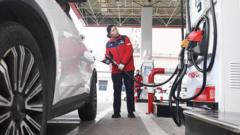
China’s National Development and Reform Commission (NDRC) just made a move that caught global energy analysts off guard. For years, the mechanism for setting domestic fuel prices in the world’s second-largest economy felt like clockwork. Global crude goes up, the pump price in Beijing and Shanghai follows. But the latest announcement breaks that cycle. The government is intentionally dialing back on scheduled fuel price hikes. This isn’t just a minor administrative tweak. It’s a calculated political and economic buffer designed to keep the wheels of the Chinese economy turning without crushing the average commuter or logistics firm.
If you’ve been tracking Brent crude or WTI lately, you know the pressure is real. Supply chains are tight, and geopolitical tension usually translates directly to a thinner wallet at the gas station. China normally adjusts retail prices every 10 working days to reflect these global shifts. Not this time. By choosing to "reduce the burden" on drivers, the NDRC is signaling that internal stability now outweighs the standard market-linkage logic. It’s a fascinating pivot.
The math behind the price freeze
Most people don't realize how rigid the Chinese fuel pricing system actually is. The NDRC uses a floor and a ceiling. When international crude stays between $40 and $130 a barrel, domestic prices move in tandem. If it drops below $40, they stop cutting prices to prevent "excessive consumption." If it goes above $130, they stop raising them to protect consumers.
Right now, we aren't at that $130 ceiling. We're in the messy middle. Under normal rules, a hike was due. However, the NDRC stepped in to keep the increase significantly lower than what the math suggested. They’re basically eating the difference. Or, more accurately, they're asking state-owned giants like Sinopec and PetroChina to shoulder the weight. It’s a strategy to keep inflation in check. When gas stays cheaper, shipping stays cheaper. When shipping stays cheaper, the price of your groceries doesn't spike.
Why the sudden mercy for drivers
You have to look at the broader picture of the Chinese middle class right now. Consumer confidence hasn't been great. Post-pandemic recovery has been a bit of a slog, and the property market—where most Chinese families keep their wealth—is still shaky. The last thing the authorities want is a disgruntled populace staring at a 10% jump in their commuting costs.
Small business owners are the ones really feeling the pinch. I'm talking about the delivery drivers, the independent truckers, and the factory owners who rely on diesel. For a guy running a small fleet of delivery vans in Shenzhen, a few cents a liter is the difference between profit and a loss. By capping these hikes, the government is essentially providing an unofficial stimulus package. It’s a direct injection of liquidity into the pockets of the working class.
The ripple effect on global oil markets
China is the world’s largest importer of crude oil. When they change how they price fuel at home, it sends ripples through the global market. If the government keeps prices artificially low, demand stays high. Usually, high prices act as a natural brake on consumption. People drive less. They take the train.
By shielding 1.4 billion people from the full force of global price spikes, China is effectively propping up global oil demand. This creates a bit of a paradox. The very move intended to "reduce the burden" on local drivers might actually keep global oil prices higher for longer because Chinese demand isn't dropping off the way it would in a completely free-market environment. It’s a bold gamble on domestic stability over global price equilibrium.
What this means for the green energy transition
There's an elephant in the room here. China is also the world leader in Electric Vehicle (EV) adoption. You’d think they’d want high gas prices to push more people toward brands like BYD or NIO. But the transition isn't instantaneous. Millions of people still drive internal combustion engines. They can't just go out and buy a new EV because gas went up 20 cents this week.
The government is walking a tightrope. They want you to buy an EV eventually, but they don't want you to go broke driving your current car today. This price "dial back" shows a pragmatic side of Chinese policy that often gets overlooked. They’re willing to pause their long-term environmental goals if the short-term economic pain becomes too acute. It’s about survival and steady growth.
How state oil giants handle the hit
You might wonder how companies like PetroChina feel about this. Honestly? They don't have much of a choice. These are state-owned enterprises (SOEs). Their primary job isn't just to make a profit; it's to serve the national interest. When the NDRC says "hold the line," they hold the line.
Of course, they aren't just losing money for fun. The government often compensates these firms through tax breaks or direct subsidies later on. It’s a shell game of sorts. The cost doesn't disappear; it just moves from the driver’s pocket to the state’s balance sheet. This is the "hidden" cost of price stability that most casual observers miss.
What you should do next
If you're a business owner with any exposure to Chinese logistics, don't assume these low prices will last forever. This is a temporary buffer, not a permanent change in reality. Use this window of relative price stability to optimize your routes or look into hybrid fleet options. The "burden" has been reduced for now, but the global energy market is still a volatile beast.
Watch the $130 barrel mark. If crude starts creeping toward that level, expect even more aggressive intervention from the NDRC. For the rest of us, it’s a clear reminder that in the world’s largest oil-importing nation, the price at the pump is as much a political tool as it is an economic one. Keep your eyes on the 10-day adjustment windows. The next few months will tell us exactly how much "burden" the Chinese government is willing to carry on its own shoulders.