Everybody is panicking about the wrong thing. Every time a shadow crosses a map, travel agents salivate, hotels triple their rates, and otherwise rational adults buy cheap cardboard glasses to stare straight up at a gray London drizzle.
Let us get one painful truth out of the way immediately. London is a terrible place to watch a solar eclipse. Recently making waves in this space: Inside the European Border Control Crisis Threatening Summer Travel.
If you are hunting for when and where to see a solar eclipse in London, you are asking a fundamentally broken question. You are looking for a calendar date and a coordinate in a city famous for meteorological stubbornness, hoping that cosmic alignment will pierce through a thick, persistent blanket of stratocumulus clouds. It will not.
I have watched tourists blow thousands of pounds booking rooftop bars in Shoreditch and Southwark for celestial events that resulted in nothing more than a slightly dimmer shade of slate gray. They paid for an atmospheric marvel and received a cloudy Tuesday afternoon with a side of eye strain. More insights into this topic are detailed by Condé Nast Traveler.
Stop treating astronomy like a sightseeing tour.
The Geography of Disappointment
The lazy consensus among travel bloggers and casual stargazers is that any eclipse visible from a major capital is a major event. This is mathematically and optically absurd.
London experiences partial solar eclipses, not total ones. There is a massive, life-altering difference between the two, yet the mainstream media reports them with the exact same hyperventilating enthusiasm.
During a total solar eclipse, the moon completely obscures the sun. The corona flashes, the temperature drops, nocturnal animals panic, and the sky turns an eerie, bruised indigo. It lasts for precious minutes, and it changes you.
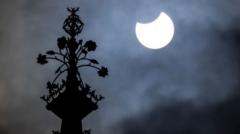
During a partial solar eclipse in London, say, an 85% occultation, what actually happens? The ambient light dims slightly. It looks precisely like a heavy industrial smog or a very thick cloud cover rolling in from the North Sea. Unless you are holding specialized solar filter glasses to your face, you will not even notice it occurred. You will walk right past it on your way to Pret a Manger.
Yet, articles flood the internet giving you precise timings down to the minute: Watch the partial phase begin at 10:08 AM! Peak obstruction at 11:15 AM!
Why? To capture search traffic. Not to give you an experience.
The Cloud Cover Factor You Are Ignoring
Let us talk about British meteorology, a topic that humbles even the best forecasting models.
London has an average of roughly 1,500 hours of sunshine per year. That breaks down to roughly 40% of daylight hours actually being clear. The rest? Gray, overcast, damp, or drizzly.
When you pin your hopes on a specific minute for a celestial alignment over the River Thames, you are gambling against a house that wins six out of ten times.
I have seen corporate teams spend weeks planning viewing parties around rare astronomical alignments, only for a rogue cumulus cloud to sit directly overhead for the exact three minutes of peak obscuration. The crowd stares upward. The cloud mocks them. Everyone goes back inside to drink tepid prosecco in an office breakout room.
If you want to see a solar eclipse, you do not check the ephemeris for London. You check the climatology of the Atacama Desert or the rural stretches of Spain and the United States. You pack a passport, not a brolly.
The Problem With Partiality
Let us look at the physics. Human eyes are remarkably adept at adjusting to ambient light. Our pupils dilate and contract automatically, compensating for vast shifts in luminosity.
When 80% of the sun is blocked by the moon, your brain does not perceive pitch blackness. It perceives an overcast day in November. Your visual cortex normalizes the shift. Without totality, the psychological impact is zero. You get none of the primal, spine-tingling awe that drives eclipse chasers across oceans.
Instead, you get a mild optical curiosity that requires protective eyewear to look at directly, meaning you are staring through a tiny dark filter at essentially nothing while standing on a windy bridge in Zone 1.
The obsession with urban eclipse viewing is a triumph of marketing over reality. It preys on the modern desire to check boxes. I was there. I saw the event. But you didn't see an eclipse. You saw a slightly darker cloud.
What You Should Do Instead
If you find yourself in London when an eclipse is scheduled, do not book a restaurant terrace. Do not buy a high-end solar telescope. Do not rearrange your working day.
Do this instead:
- Ignore the hype. Treat the event like a routine meteorological footnote.
- Watch the live streams. NASA, the European Space Agency, and high-altitude observatories broadcast totality with zero cloud interference, zero light pollution, and zero travel costs.
- Save your money for totality. If you genuinely want to experience a solar eclipse, allocate your travel budget toward the path of totality somewhere with a statistically high probability of clear skies. Go to Mexico. Go to Texas. Go to northern Spain for the upcoming 2026 or 2027 paths.
Chasing a partial eclipse in London is like flying to the Sahara Desert to watch it rain for two minutes.
The cosmos does not owe you a spectacle just because you happen to live in a postcode with a tube station. Accept the limitations of your geography, stop falling for calendar-driven clickbait, and wait for the real thing.
Or keep standing on Westminster Bridge staring at a gray cloud. It is your time to waste.