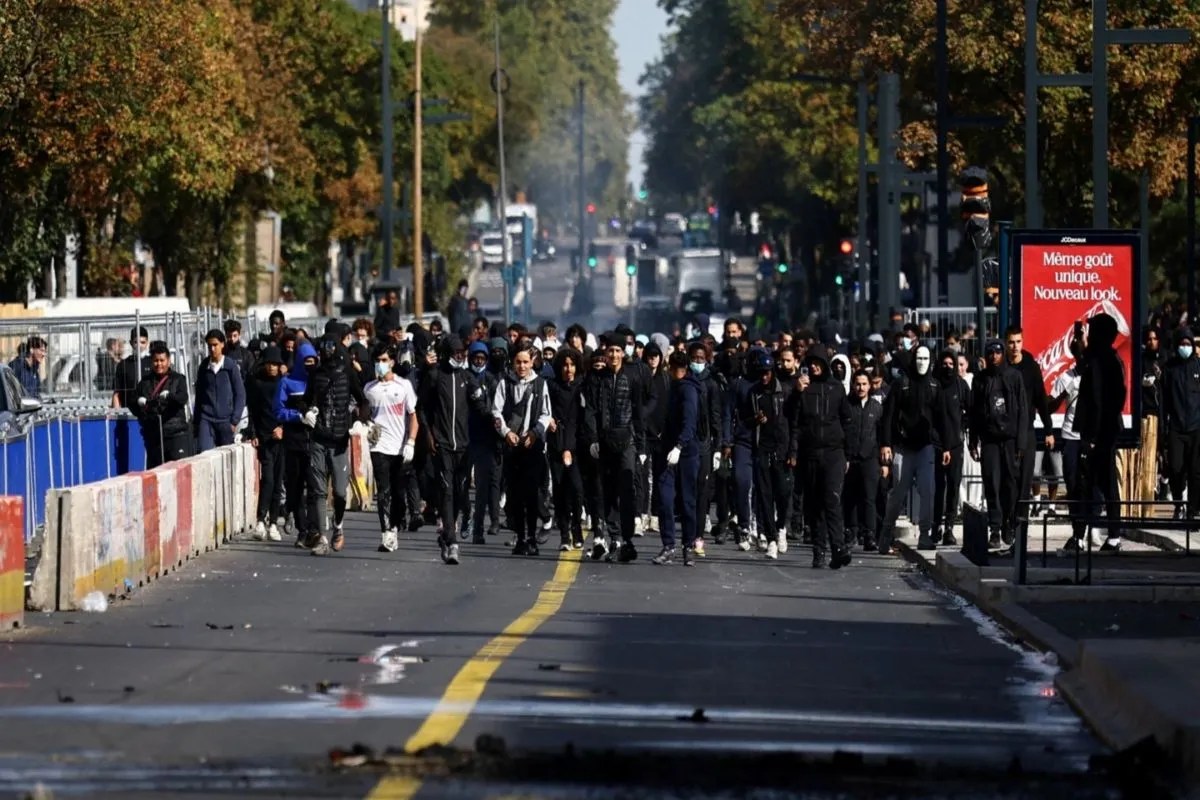
The morning air in Paris usually smells of roasting chicory, wet asphalt, and the sharp, chemical tang of fresh ink on cheap newsprint. On that particular morning, however, the air tasted of copper and burning rubber.
Consider a sixteen-year-old girl standing outside her lycée in the 11th arrondissement. Let us call her Camille. Her fingers are jammed deep into the pockets of an oversized wool coat that has seen three winters too many. Her breath plumed in the grey dawn as she watched a plastic desk chair—one of fifty dragged out from the second-floor classrooms—burn fiercely in the middle of the boulevard. The flames licked at the peeling paint of a public bus stop, casting a flickering, jaundiced orange glow across the faces of a hundred teenagers who should have been conjugating irregular French verbs.
They were not conjugating. They were screaming.
Across France, the classroom doors were locked from the outside. Not by administrative decree, but by human will. Heavy iron chains, padlocked with thick brass bindings bought from local hardware stores the night before, bound the wrought-iron gates of hundreds of secondary schools shut. Inside, chalk sat untouched in its groove. Outside, the pavement belonged to youth.
To understand why a nation famed for its breakfast pastries and quiet intellectualism suddenly transformed into a theater of smoke and shouting, you have to look past the breaking news tickers. You have to look at the math of modern survival.
The spark that lit the fuse was not some grand, sweeping ideological manifesto. It was far more banal, and therefore far more dangerous. It was about the future. Or, more accurately, the systemic, quiet theft of it. When the government announced sweeping structural reforms to the educational pipeline—modifying the baccalauréat tracking system and tightening university access metrics—they treated numbers on a spreadsheet like equations on a blackboard. They forgot that human beings bleed when you press too hard.
For months, the hallways of French high schools had hummed with a low-frequency panic. Students like Camille knew the script. Graduate, face a constricted job market, watch the cost of rent in any major city outpace any entry-level salary by a factor of three, and accept that your generation would live worse than your parents. That is a heavy thing to carry in a backpack alongside dog-eared copies of Camus.
Then came the flashpoint. The policy shifts meant immediate stratification. It meant doors slamming shut before you even had a chance to knock.
So the kids fought back with the only currency they had: disruption.
By 8:00 AM, the blockade at Camille's school was complete. By 9:00 AM, the riot police—the notorious compagnies républicaines de sécurité, or CRS—had arrived. They moved with a heavy, mechanical precision, clad in midnight-blue armor that made them look less like guardians of the peace and more like deep-sea divers dropped onto a dry, hostile planet.
Then came the sound. A sharp, cracking pop that rattled the stained glass of nearby apartment buildings.
Tear gas.
The first canister landed ten feet from Camille. The gas did not just sting the eyes; it felt like inhaling shards of hot glass. The crowd surged backward, a living, breathing organism of wool, nylon, and raw panic. Coughing, weeping, stumbling over discarded school bags, the students scattered into side alleys. But they did not go home. You cannot go home when home feels like a waiting room for a dead-end life. They regrouped three blocks over, eyes streaming, scarves pulled high over their noses, chanting slogans that echoed off the Haussmann facades.
“A bas, à bas, la réforme!”
Down with the reform. Down with the architects of a future that felt like a trap.
This is the hidden cost of administrative arrogance. When people feel that the social contract has been shredded, they do not write sternly worded letters to their deputies. They take to the streets. They burn plastic chairs. They force the world to smell the smoke of their frustration because they are terrified that otherwise, nobody will ever notice they are burning alive inside.
As the afternoon shadows lengthened across the Place de la République, the fires burned low to glowing embers of ash. Sirens wailed in the distance, a constant, abrasive soundtrack to a fractured city. Camille sat on a concrete curb, wiping her stinging eyes with a dirty sleeve, her phone buzzing incessantly in her pocket with frantic texts from her mother.
She did not answer. She looked down the boulevard, past the lines of helmeted police, past the shattered glass glittering like diamonds on the wet street.
The chalk was still sitting in the classroom, waiting for a lesson that nobody wanted to teach, and nobody wanted to learn.



