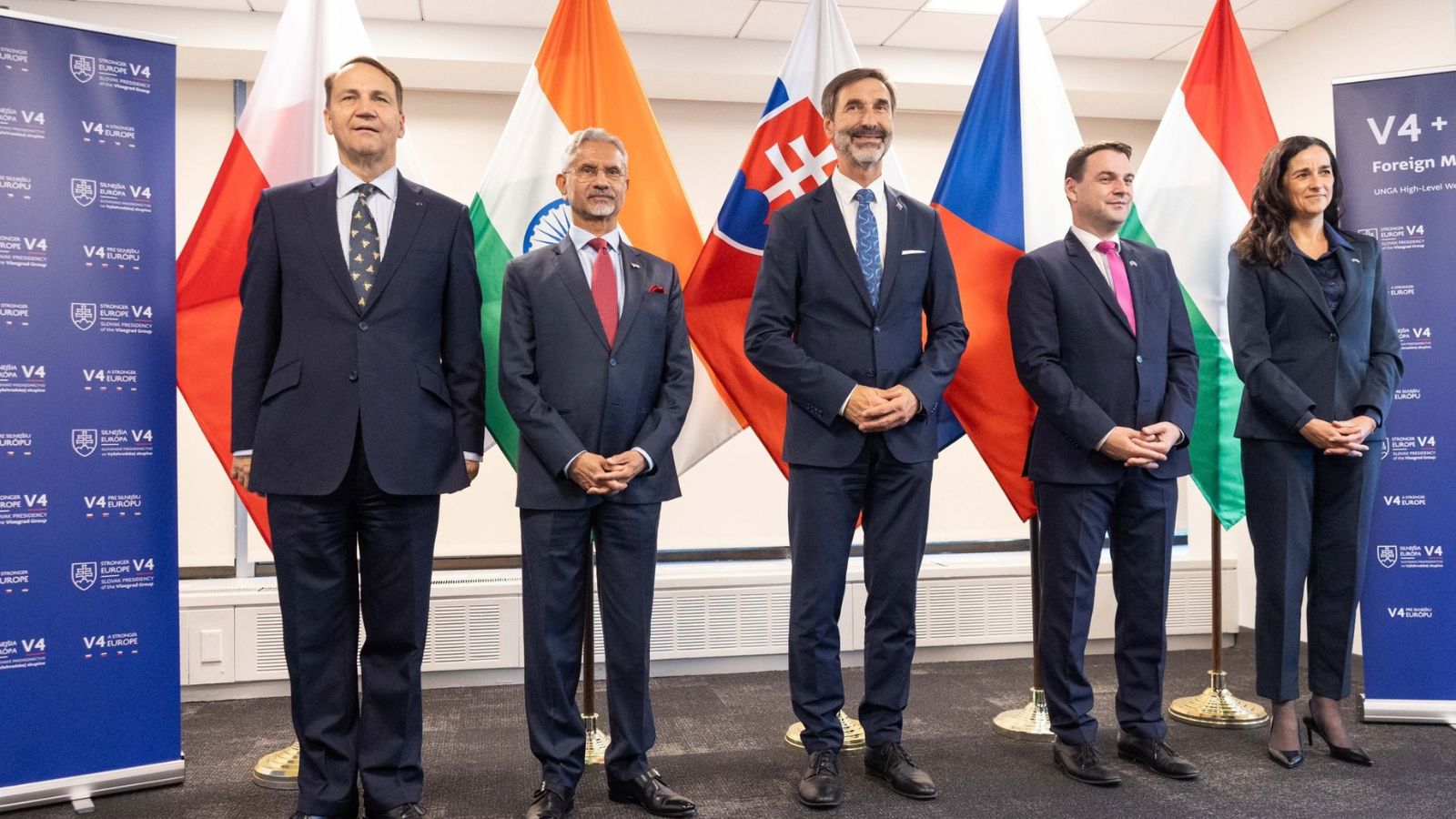
For decades, New Delhi’s European diplomatic playbook has suffered from a chronic case of tunnel vision. Capitals like Berlin, Paris, and London dominated the foreign policy whiteboard, while the dynamic economic corridors of Central Europe were treated as secondary diplomatic real estate. That conventional wisdom shifted decisively on the sidelines of the United Nations General Assembly, where India and the Visegrád Group—Poland, Hungary, the Czech Republic, and Slovakia—convened for their first-ever structured ministerial dialogue.
The headline grabber from the New York summit was immediate and sharp: the V4 bloc collectively endorsed India’s bid for a permanent seat on the United Nations Security Council. Yet, looking past the predictable diplomatic pleasantries reveals a much deeper, more calculated realignment. This is not merely about an expanded UN charter or empty seats in Manhattan boardrooms. It is an industrial, technological, and strategic hedge against an increasingly unstable Eurasian security architecture.
The Arithmetic of Central European Leverage
To understand why the V4 endorsement matters, one must examine the actual weight of the bloc. Combined, Poland, Hungary, the Czech Republic, and Slovakia represent an economic powerhouse sitting right in the industrial heartland of Europe. Their manufacturing sectors are tightly integrated with Western Europe, yet they retain independent political trajectories that frequently rattle Brussels.
For New Delhi, securing this endorsement provides a unified European sub-bloc backing its multilateral ambitions. While the G4 configuration—comprising India, Brazil, Germany, and Japan—has long campaigned for structural reform of the UN Security Council, progress has flatlined due to entrenched opposition from existing permanent members. Central European backing chips away at the narrative that developing world ambitions lack resonance inside industrialized Western economies.
The mechanism agreed upon by External Affairs Minister S. Jaishankar and his V4 counterparts goes beyond symbolic posturing. Both sides committed to institutionalizing the relationship through annual foreign ministers' meetings and the creation of a dedicated annual business forum. Diplomatic communiqués are easy to draft; binding supply chains and joint technology development are far harder to fake.
Beyond Trade: The Defence and Technology Equation
The structural core of the V4-India framework rests on sectors where Central Europe holds distinct competitive advantages. Consider the defence sector. Historically, parts of Central Europe maintained heavy manufacturing and military-technical ties that predate the collapse of the Soviet Union. As India accelerates its domestic defense manufacturing under "Make in India" mandates, specialized European component manufacturers and engineering firms offer alternatives to traditional Western defense primes.
Furthermore, technology cooperation is no longer a one-way street of software outsourcing. The Czech Republic and Poland harbor thriving deep-tech, automotive engineering, and aerospace sub-components industries. When foreign ministers discuss connectivity and innovation, they are addressing the acute need to diversify supply chains away from geopolitical single points of failure.
In a hypothetical scenario involving advanced manufacturing components for electric vehicles or specialized industrial robotics, Central European firms provide high-specification engineering at a cost structure that undercuts Western European competitors. Indian industrial conglomerates have recognized this arbitrage window. What was missing was the political umbrella to de-risk investments and scale up bilateral commercial registries. The V4 format acts precisely as that umbrella.
The Migration and Mobility Bottleneck
No realistic assessment of India-Central Europe relations can ignore the friction points, particularly regarding labor mobility and visa regimes. Central European economies face acute demographic contractions and labor shortages across manufacturing, IT, and healthcare sectors. At the same time, Indian students and skilled professionals look to Europe as an alternative to tightening North American immigration markets.
During the New York talks, mobility and people-to-people ties made it onto the official agenda. However, bridging this gap requires cutting through layers of bureaucratic inertia. Central European states maintain strict national migration postures, often shaped by internal European Union politics. For the business forum to yield genuine results, administrative hurdles surrounding credential recognition and work visas must be dismantled. If the framework fails to streamline professional mobility, it risks becoming another diplomatic talking shop with zero footprint on the ground.
Navigating the Global South Divide
Another quiet subtext of the V4 alignment is the ongoing diplomatic tug-of-war over the Global South. Central European nations find themselves uniquely positioned to understand the complexities of European security—particularly given their immediate proximity to the conflict in Ukraine—while maintaining pragmatic trade ties across the globe.
India’s independent foreign policy stance, characterized by refusing to bow to Western pressure regarding Russian energy purchases while simultaneously expanding security dialogues in the Indo-Pacific, has earned quiet respect in capitals like Prague and Budapest. By backing India’s UNSC bid, the V4 acknowledges a fundamental geopolitical reality: the future architecture of international security cannot be managed solely through a Eurocentric lens.
The test for this new partnership will not be measured by what is said at the next ministerial summit, but by whether mid-tier industrial firms in Warsaw or Bratislava begin joint ventures with tech startups in Bengaluru and Pune. The diplomatic scaffolding is erected; the burden now shifts entirely to the ministries of commerce and private sector executors to turn political goodwill into economic muscle.