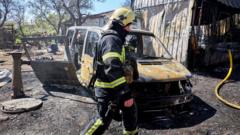
Victory Day serves as a high-stakes symbolic anchor in the Russo-Ukrainian war, transforming a historical commemoration into a focal point for informational warfare and tactical posturing. The reported failure of the May 9 ceasefire is not a random breakdown of communication but a predictable outcome of the Asymmetric Incentive Structure governing both belligerents. In this environment, a ceasefire carries higher political costs than military benefits, as both Moscow and Kyiv view temporary pauses through the lens of domestic legitimacy and international optics rather than genuine de-escalation.
The Mechanics of Symbolic Conflict
Victory Day—commemorating the defeat of Nazi Germany—functions as a dual-use instrument of statecraft. For the Russian Federation, the holiday is the primary pillar of social cohesion and historical continuity. For Ukraine, the date has been reframed as a point of divergence, emphasizing a European-aligned "Day of Remembrance and Victory over Nazism." Building on this theme, you can find more in: The Sound of a Breaking Horizon.
The breakdown of a ceasefire on this specific date operates under the Logic of Delegitimization. If one side can credibly accuse the other of violating a truce during a period of high historical sanctity, they achieve a "moral force multiplier." This objective often outweighs the tactical advantages of a 24-hour cessation of hostilities.
The Three Pillars of Ceasefire Instability
The failure to maintain a ceasefire in the current operational environment stems from three specific structural bottlenecks: Observers at USA Today have also weighed in on this matter.
- The Information Verification Gap: Without independent, third-party observers with real-time access to the zero line, "breach" remains a subjective term. Every localized skirmish or artillery exchange is instantly weaponized as a "coordinated violation" by state media apparatuses.
- The Combat Momentum Constraint: In high-intensity positional warfare, stopping artillery or drone operations for 24 hours creates a "reset window" that the opposing side can exploit for rotation or fortification. Neither command structure is willing to risk an enemy breakthrough for the sake of a symbolic gesture.
- The Domestic Audience Mandate: For the Kremlin, a quiet front on Victory Day could be interpreted as weakness or a lack of control. For Kyiv, honoring a Russian-initiated pause would validate Moscow’s historical narrative. Consequently, active engagement becomes a requirement for maintaining the internal political "War Footing."
Quantifying the Breach Reciprocity
The cycle of accusation follows a specific kinetic-rhetorical pattern. When an engagement occurs, the response follows a three-stage escalation:
- Detection and Documentation: Local commanders report incoming fire. In the modern theater, this is supplemented by FPV drone footage or electronic warfare (EW) signal logs.
- Narrative Framing: Centralized communication hubs (such as the Russian Ministry of Defense or the Ukrainian General Staff) release statements that frame the localized event as a systemic betrayal of the truce.
- Kinetic Retaliation: The "defensive" response usually involves an increase in fire volume to "suppress" the violator, which the other side then documents as the initial breach.
This creates a Feedback Loop of Justification where the act of defending against a perceived violation becomes the very proof the opponent needs to claim a breach occurred.
Tactical Realities vs Political Optics
The discrepancy between frontline reports and official communiqués often reveals the "Command-Reality Disconnect." At the tactical level, a ceasefire is rarely a binary state.
The Friction of the Zero Line
Small-unit actions—reconnaissance by fire, sniper engagements, or automated turret systems—often operate on a hair-trigger. A single nervous platoon leader can trigger a chain reaction across a sector. When these localized frictions occur on Victory Day, they are elevated from tactical noise to strategic signals.
The Attrition Function
The war has transitioned into a war of attrition where the Cost per Kilometer is measured in high volumes of 155mm and 152mm shells. A ceasefire disrupts the "rhythm of suppression" required to keep the enemy in their bunkers. If Russia or Ukraine pauses their battery fire, the opponent gains the ability to clear mines, repair trenches, or move logistics hubs closer to the front. The military cost of a pause is thus a direct function of the vulnerability it creates.
The Strategic Utility of Recrimination
Accusations of ceasefire violations serve a specific function in international diplomacy. For Ukraine, documenting Russian breaches reinforces the "Unreliable Narrator" status of the Kremlin to Western backers, ensuring the continued flow of military aid. For Russia, claiming Ukrainian violations serves to paint Kyiv as "uncontrollable" or "radicalized" to neutral parties in the Global South.
The specific timing of these accusations on May 9 ensures maximum visibility. The global media cycle is already primed to cover Moscow’s Red Square parade; a simultaneous report of a "broken truce" ensures that the combat narrative competes with the ceremonial narrative.
Constraints of Modern Monitoring
Traditional ceasefire monitoring relied on human observers (e.g., OSCE SMM). In the current conflict, the following factors make objective verification nearly impossible:
- Drone Proliferation: The sky is saturated with loitering munitions. A drone strike is difficult to attribute if the craft is downed or its signal is jammed, leading to "anonymous" breaches that both sides can disavow or blame on the other.
- Deep Strike Capabilities: Missile and long-range drone strikes on infrastructure far from the front line are often excluded from local ceasefire definitions by one side while being cited as major violations by the other.
- Electronic Warfare Saturation: The inability of neutral parties to operate in a high-EW environment means there is no "digital witness" to corroborate the timing of the first shot.
Strategic Forecast: The Permeability of Future Truces
The Victory Day breach confirms that temporary, symbolic ceasefires in the Russo-Ukrainian theater are obsolete. For a truce to hold, it must move beyond symbolic dates and meet three criteria:
- Geographic Sectoring: Ceasefires must be localized to specific corridors (e.g., grain shipments or prisoner exchanges) rather than general front-line pauses.
- Mechanized Verification: Integration of satellite telemetry and non-aligned drone monitoring to provide a "ground truth" that bypasses state-controlled media.
- Mutual Vulnerability: A truce only holds when both sides calculate that the risk of being attacked during the pause is lower than the political cost of continuing the fight.
The current trajectory indicates that Victory Day will remain a period of heightened kinetic activity rather than a window for diplomacy. Command structures will continue to prioritize tactical readiness over symbolic restraint, as the internal logic of the conflict demands constant demonstration of force to maintain leverage. Expect future "holiday truces" to be met with preemptive strikes, as both sides attempt to "break" the truce before the opponent can use it to reorganize.


