Dawn arrives differently over Lake Ontario.
It does not break with a trumpet blast or a neat corporate decree. Instead, it bleeds through the heavy, grey mist rising off the freshwater, catching the rusted edges of an old freighter docked near Kingston, turning the water the color of hammered tin. For generations, people here lived by a simple truth: the geography beneath our feet and the water stretching to the horizon belonged to history. They belonged to the Mississauga people who called it Ontario—the lake of shining waters. They belonged to the French cartographers who scrawled rough approximations onto parchment by candlelight. They belonged to no single man, and certainly no single administration. You might also find this similar story useful: The Structural Reality of Venezuelan Oil Extraction Economics.
Then came Tuesday.
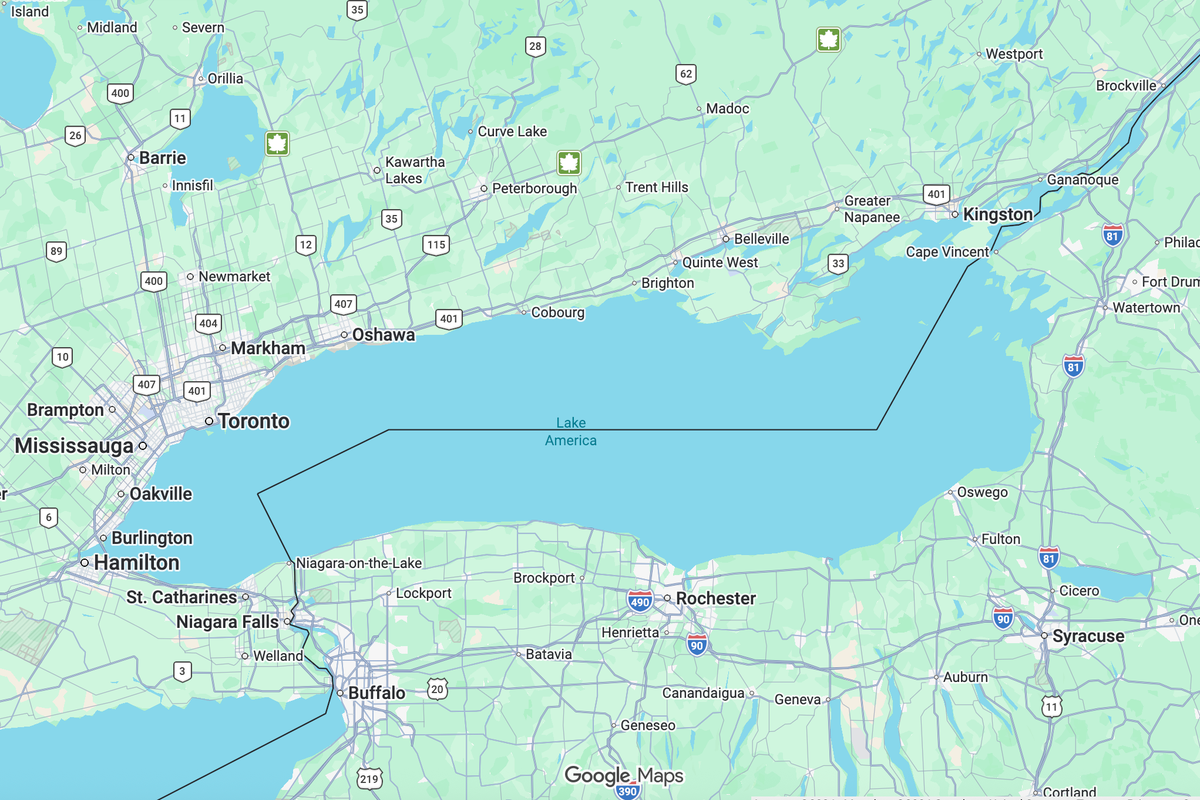
Sarah stands in her kitchen in Rochester, gripping a mug of black coffee that has long since gone cold. Her phone hums on the scarred oak table. She looks down at the glowing rectangle of her screen, her thumb swiping casually to check the morning commute. She opens Google Maps. As reported in recent reports by The Guardian, the results are worth noting.
She freezes.
The blue expanse that has anchored her city for her entire life, the vast inland sea where her grandfather taught her to cast a line for smallmouth bass, bears a startling new label.
Lake America.
Not an update. Not a glitch. A permanent, digitized mandate rendered in clean, sans-serif Helvetica.
Panic is a quiet thing. It does not always scream. Sometimes it arrives as a software patch.
To understand why a digital map changing a name can feel like an assault, you have to understand how we navigate modern reality. We no longer look at the stars. We no longer consult dog-eared road atlases folded into awkward squares in the glove box. We outsource our perception of the physical world to algorithms maintained by a handful of trillion-dollar corporations headquartered thousands of miles away. When the algorithm blinks, reality shifts.
The story behind that sudden shift on millions of screens is as absurd as it is alarming. Rumors had swirled for weeks in political corridors. A populist push, a sudden administrative demand, an obscure bureaucratic lever pulled by allies of Donald Trump seeking to rebrand foundational American landmarks in a nationalist image. The target was supposed to be symbolic. Yet symbols have teeth.
Google, navigating the treacherous waters of political pressure and corporate survival, reportedly folded. They bent the knee.
Type the coordinates into the search bar. The digital ink dries instantly. Ontario, a name older than the nation itself, is scrubbed away. Replaced by a heavy-handed, performative nationalism that reduces a living ecosystem into a political bumper sticker.
Consider what happens next: the erosion of objective truth by convenience.
We live in an era where convenience is the ultimate anesthetic. We trade our data for speed, our privacy for accessibility, and quietly, our shared reality for curated digital feeds. But geography was supposed to be different. Maps were the last neutral ground. A mountain is a mountain because gravity says so. A lake is a lake because water pools in the basin.
When a private tech monopoly alters a landmark name overnight to appease a political faction, the contract is broken.
Think about Elena, a commercial fisherman whose family has worked these waters out of Port Dalhousie for four decades. She does not care about Silicon Valley boardrooms or Washington press briefings. She cares about the thermocline. She cares about the wind shifting from the northwest. She looks at her marine navigation systems—synced, as most modern systems are, to commercial mapping APIs—and sees the insult glowing on her console.
It is an erasure.
History is not a whiteboard. You cannot simply wipe away centuries of indigenous heritage, Canadian-American shared stewardship, and ecological identity because an algorithm received a memo from a political operative.
The outcry was immediate, fierce, and entirely predictable. Canadian officials erupted in outrage, pointing out that half the lake belongs to their sovereign territory. Environmental groups shook their heads in exhaustion, wondering how conservation efforts are supposed to focus on saving a dying fishery when the people drawing the maps cannot even agree on what to call the water.
Yet the corporate response was deafeningly silent. A spokesperson issued a vague, bloodless statement about "routine regional updates" and "reflecting local nomenclature."
Local nomenclature.
Nobody in Rochester calls it Lake America. Nobody in Toronto calls it Lake America. The only place this name exists is inside the sterile server farms of a tech giant desperately trying to stay on the right side of whoever holds power today.
This is the hidden cost of our digital dependency. We have handed the keys to our shared perception over to entities that answer to shareholders and political pressure rather than truth or community. Today it is a lake. Tomorrow it is a border. Next week it is the historical record of an election, an atrocity, a climate disaster.
If you can change the name of a massive body of water with a keystroke, you can change anything.
Sarah sets her mug down. The coffee has formed a dark ring on the wood. She looks back at her phone, watching the glowing blue pixels mocking her heritage. She does not tap the screen to report the error. She knows it won't matter. The algorithm has already spoken.
Outside her window, the real water rolls against the shore, cold, indifferent, and ancient, waiting for the digital empires to pass.