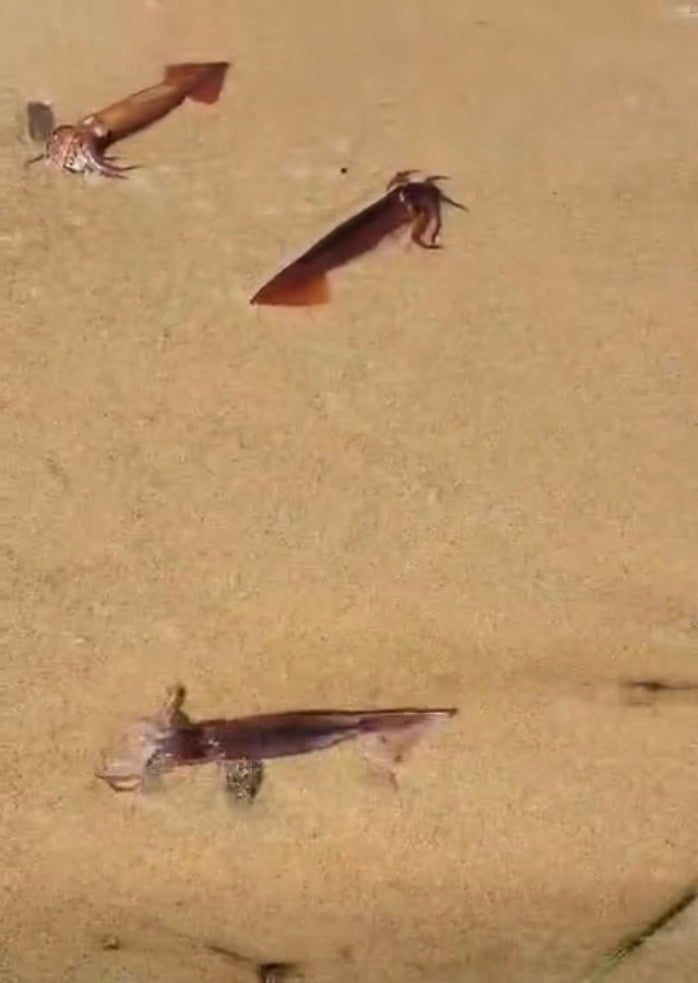
Thousands of market squid are rotting on the beaches of Cape Cod, and the internet is doing exactly what you expect it to do.
The doom-scrolling eco-influencers are weeping about the end of days. The local news stations are running B-roll of slimy tentacles with somber voiceovers. The lazy consensus has already solidified: this is a tragic climate anomaly, a stark warning about warming oceans, and a sign that humanity has broken the Atlantic.
It is a neat, comforting narrative. It gives people a clear villain to hate and an easy emotion to process.
It is also completely wrong.
What we are witnessing on the shores of Cape Cod is not an unprecedented ecological catastrophe driven by anthropogenic climate change. It is something far more brutal, beautiful, and baseline: a massive, highly successful reproductive slaughterhouse that has been functioning perfectly for millennia.
If you are looking at a beach covered in dead squid and seeing a tragedy, you do not understand marine biology. You are projecting human morality onto an ecosystem that operates on raw, efficient mathematics.
The Myth of the Ecological Tragedy
The mainstream media loves a body count. When thousands of Doryteuthis pealeii (longfin inshore squid) or Doryteuthis opalescens (market squid) wash up on a beach, the immediate assumption is that something went horribly wrong.
"The water must have suffered a sudden temperature drop," the pundits claim. "An algal bloom must have choked them out," say the armchair biologists.
Let us dismantle the premise entirely. Nothing went wrong. For these squid, everything went exactly according to plan.
Cephalopods are semelparous organisms. That is the academic term for a brutal evolutionary strategy: they breed once, and then they die. They do not age gracefully. They do not retire to the deep ocean. Their entire existence is a high-stakes, single-generation sprint.
Imagine a scenario where an organism invests every single calorie of its somatic reserve into a single, explosive reproductive event. Once the eggs are fertilized and anchored to the seafloor, the adult squid experience rapid, systemic senescence. Their cellular structure degrades. Their immune systems collapse. They become zombies swimming in circles, waiting for the current to push them wherever it pleases.
When a massive school of squid enters the shallow waters of Cape Cod to spawn, they are entering a biological dead end. They mate in a frenzy, deposit their egg capsules, and then their bodies literally shut down. The fact that thousands of them washed up on the beach at the same time does not mean the ocean is broken; it means the spawning event was massively successful. A huge body count on the sand is actually proof of a thriving, high-density population offshore.
Stop Asking the Wrong Questions About Mass Strandings
If you look at the "People Also Ask" sections on search engines during these events, the queries are agonizingly naive:
- How can we save the stranded squid on Cape Cod?
- What toxic chemical caused the squid to wash ashore?
- Are the Cape Cod squid safe to eat?
These questions are fundamentally flawed because they assume a healthy animal was struck down by an external force.
You cannot "save" these squid. Throwing a post-spawning semelparous cephalopod back into the surf is like putting a dead battery back into a flashlight and hoping it shines. Their internal clocks have hit zero.
As for the search for a toxic smoking gun or a climate scapegoat, it ignores decades of historical data. Marine biologists have documented mass cephalopod strandings for centuries, long before industrial carbon emissions began altering global chemistry.
I have spent years tracking how coastal narratives get warped by data cherry-picking. I have watched local conservation groups burn through hundreds of thousands of dollars in grant money trying to "analyze coastal stressors" during a routine stranding event, ignoring the fundamental life history of the species they claim to protect. It is institutional performance art.
The Real Environmental Danger is Our Obsession with Clean Beaches
Here is the counter-intuitive reality that nobody wants to admit: the worst thing we can do for the Cape Cod ecosystem is to "clean up" these carcasses to satisfy the aesthetic sensibilities of tourists and oceanfront property owners.
When thousands of squid rot on a beach, humans smell a nuisance. The local ecosystem sees a massive, localized injection of high-grade nutrients.
The Nutrient Cascade of a Stranding Event
| Beneficiary | Mechanism | Ecological Outcome |
|---|---|---|
| Terrestrial Scavengers | Gulls, foxes, and crabs consume the immediate biomass. | Drastic spike in local scavenger reproductive success. |
| Intertidal Microorganisms | Fungi and bacteria break down the soft tissue. | Rapid enrichment of the sandy substrate with bioavailable nitrogen. |
| Benthic Invertebrates | High tides pull decomposing organic matter back into the surf zone. | Fuel for the next generation of filter feeders and detritivores. |
By treating a mass stranding like an oil spill, municipalities disrupt a critical nutrient conveyor belt that links the pelagic zone to the terrestrial shoreline. We are sanitizing nature because the reality of wild ecosystems—which are defined by mass death and decay—makes us uncomfortable.
The Hypocrisy of the Climate Narrative
Why is the media so eager to blame climate change for a completely natural biological cycle? Because nuance does not generate clicks, and structural doom sells ads.
If a journalist acknowledges that squid have been dying en masse on beaches for ten thousand years, there is no story. There is no villain. There is just the cold, indifferent machinery of evolution. But if you can tie those dead tentacles to a record-breaking summer heatwave or a shifting Gulf Stream, you have a headline that fits neatly into the modern apocalyptic zeitgeist.
This lazy correlation does a profound disservice to actual climate science. When we cry wolf over natural biological phenomena, we lose the authority to speak on genuine ecological crises. We train the public to look at every dead fish, every fallen tree, and every muddy tide through a single, hyper-simplified lens.
Let us look at the hard data from the National Oceanic and Atmospheric Administration (NOAA). Longfin squid populations in the Northwest Atlantic are not in a climate-induced tailspin. They are notoriously volatile, yes, because their short lifespans (usually less than a year) make them highly sensitive to minor seasonal shifts, but the biomass remains resilient. They are an incredibly adaptable weed species of the ocean. They thrive in chaos.
Embrace the Meat Grinder
The ocean is not a pristine, static aquarium that human activity has suddenly disrupted. It is a violent, high-turnover engine driven by species that treat individual life as entirely disposable.
The market squid of Cape Cod did not die because you forgot to recycle your plastic bottle. They died because they fulfilled their singular evolutionary purpose. They swam into the shallows, they passed on their genetic code, and they exited the stage to make room for the millions of paralarvae that will hatch from the seafloor in a few weeks.
Stop looking for a tragedy in the sand. Stop demanding that scientists find a way to fix a system that isn't broken.
Walk down to the beach, plug your nose against the stench of decomposing protein, and realize you are looking at the ecosystem functioning exactly as it was designed. Nature is not a peaceful garden; it is a meat grinder. And right now, on Cape Cod, the gears are turning perfectly.



:max_bytes(150000):strip_icc():focal(665x0:667x2)/gettyimages-50733149-2000-8b129a2475974982a915418ce92a73d8.jpg)