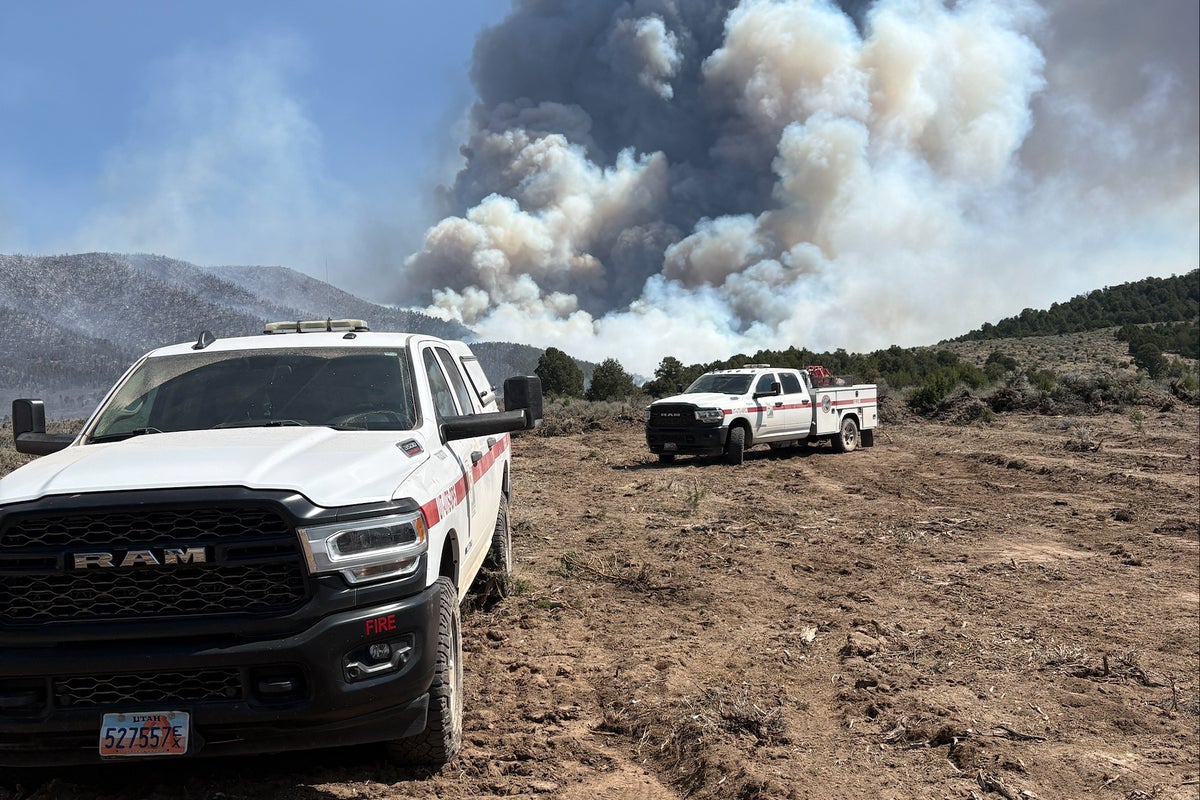
Every summer, a familiar script plays out across the American West. Governors stand before smoking backdrops, meteorologists point to deep purple drought maps, and news anchors read off escalating containment statistics. The narrative is comforting in its simplicity. Nature, supercharged by an unrelenting combination of heat, wind, and dry timber, has simply become too volatile to tame.
This explanation is a convenient shield for systemic institutional failure.
While the physical ingredients of the current crisis are undeniable, attributing the destruction of Western communities solely to meteorological bad luck ignores a more uncomfortable reality. The wildfire crisis ravaging the region is primarily an infrastructure and policy disaster disguised as a natural phenomenon. For decades, federal land management practices, upside-down utility incentives, and a reactive funding model have guaranteed that when the wind kicks up, communities will burn. We are not just witnessing a historic streak of bad weather. We are watching the catastrophic bill for a century of structural negligence come due.
The Mathematical Collapse of Public Lands Management
For over a century, federal policy treated every forest fire as an enemy to be instantly eradicated. This aggressive suppression strategy successfully kept landscapes green in the short term, but it systematically altered the ecology of Western forests. By removing the frequent, low-intensity ground fires that historically cleared out underbrush, agencies allowed forests to grow unnaturally dense. Today, these public lands hold a massive surplus of flammable biomass, transforming pristine ecosystems into giant tinderboxes waiting for a spark.
Fixing this requires massive, aggressive fuel reduction programs. Instead, the country is moving backward.
A deep look into recent land management data reveals a terrifying trend line. In 2025, the United States Forest Service treated roughly 35 percent fewer acres for hazardous fuels than it did the previous year. This massive drop in prescribed burns, mechanical thinning, and brush clearing hit critical states like Montana, Oregon, Idaho, and California at the worst possible moment. Bureaucratic delays, narrowing windows of safe weather conditions, and shifting political priorities left millions of acres of dangerous fuel untouched right before a historic spring drought.
When federal agencies pull back on clearing out dead timber, the margin of error for local communities vanishes. The math becomes brutal. Between 2014 and 2023, fire management agencies across all levels of government saw a 131 percent increase in total area burned compared to the late twentieth-century average. Over that same period, inflation-adjusted fire suppression spending skyrocketed by 268 percent.
We are spending unprecedented billions of dollars to fight fires after they break out, while starving the programs designed to prevent them from becoming catastrophic in the first place. This reactive approach is unsustainable. Modeling projections indicate that if current warming trends and fuel accumulation patterns hold, federal land burned will increase by another 80 percent by mid-century. The economic burden of chasing these fires across a neglected landscape is on track to bankrupt regional conservation budgets long before the timber runs out.
The Twisted Economics of the Power Grid
When high winds collide with parched vegetation, the electrical grid frequently transforms from a public service into an ignition source. High-voltage lines sway, tree branches make contact with uninsulated wires, and aging transformers throw sparks into dry grass. The immediate response from major investor-owned utilities has been a mix of emergency power shutoffs and promises to bury thousands of miles of lines underground.
This strategy is not entirely driven by public safety. It is driven by corporate profit margins.
To understand why the grid remains so dangerous, one must follow the money through the regulatory bodies that govern public utilities. In the United States, investor-owned utilities operate under a system that ties profit directly to capital expenditure. They do not make money on the electricity they sell. Instead, they earn a guaranteed rate of return on the physical infrastructure they build and own.
Burying power lines underground is incredibly slow and astronomically expensive. For example, a recent wildfire mitigation plan in Colorado carried an approved budget of $200 million just to bury 50 miles of power lines. That amounts to a staggering upfront capital cost of roughly $4 million per mile. Because these massive capital investments are financed over 25 to 30 years, utility customers shoulder the ultimate burden through decades of compounding rate hikes.
For a regulated utility, a multi-billion-dollar undergrounding project is a guaranteed financial win. For the homeowner facing an immediate wildfire threat, it is an agonizingly slow process that may take decades to reach their neighborhood.
Traditional Undergrounding vs. Decentralized Microgrids

[Traditional Undergrounding]
Cost: ~$4 Million per Mile
Timeline: Decades for regional scale
Utility Impact: Maximizes corporate capital assets and ratepayer debt
Resilience: High for buried lines, zero backup for broader grid failure

[Decentralized Microgrids]
Cost: Comparable funds equip 7,500+ homes with solar/storage
Timeline: Months to deploy locally
Utility Impact: Empowers local communities, bypasses corporate asset-stacking
Resilience: Enables continuous operation during emergency power shutoffs
The alternative is faster and far more flexible, yet it threatens the traditional utility business model. That alternative is the widespread deployment of decentralized microgrids. By pairing localized solar generation with intelligent battery storage systems, individual communities can safely disconnect from the main grid during periods of extreme fire danger. If a utility needs to shut off power to a vulnerable transmission line because of 70-mile-per-hour winds, a microgrid-enabled town stays online.
Instead of spending $200 million on 50 miles of buried cable, that same pool of capital could equip up to 15,000 homes with 48 hours of resilient backup power. This approach removes the existential threat of utility-caused ignitions while protecting vulnerable populations from extended blackouts. Yet, because decentralized batteries and residential solar arrays do not add to the utility's own asset base, corporate executives consistently lobby against them. They choose slow, high-profit infrastructure over rapid, life-saving deployment.
The Insurance Market Real Estate Mirage
The systemic failure of the Western wildfire strategy extends far beyond the forest line and the power grid. It is actively dismantling the financial foundations of the housing market. For decades, developers built sprawling suburban subdivisions deeper into the wildland-urban interface, ignoring the predictable cycle of fire. Mortgage lenders approved these loans because insurance companies were always there to absorb the risk.
That foundational assumption has evaporated.
The financial fallout from recent disasters has permanently altered the calculations of global reinsurance firms. The catastrophic Los Angeles wildfires of January 2025 drove an estimated $53 billion in overall economic losses, with private insurers on the hook for roughly $40 billion. Losses of this magnitude are forcing a rapid, uncoordinated retreat from high-risk zones.
Major insurance carriers are no longer just raising premiums. They are canceling policies entirely and exiting entire states.
When private insurance disappears, homeowners are forced onto state-backed insurance programs of last resort. These state pools were designed to handle a tiny fraction of the market, not entire zip codes. They offer minimal coverage at exorbitant prices, creating a massive hidden tax on Western homeownership. As coverage becomes unaffordable, home values in fire-prone zones face an inevitable downward correction.
This creates a dangerous feedback loop for local governments. When property values drop, property tax revenues plummet. This decline in revenue starves the exact municipal budgets needed to fund local fire departments, emergency management systems, and community-level clearing programs. The financial system that enabled the rapid expansion of Western communities is now actively accelerating their vulnerability.
Moving Past the Reactive Paradigm
The definition of insanity in wildfire management is continuing to dump trillions of dollars into reactive suppression while ignoring the institutional structures that fuel the flames. The current approach treats every fire season like an unexpected surprise, ignoring the clear signals sent by compounding droughts and structural decay.
A hard pivot is required.
First, federal funding structures must be legally decoupled from emergency fire suppression. The Forest Service cannot effectively manage public lands when its long-term mitigation budgets are repeatedly raided to pay for active firefighting efforts. The agency needs a permanent, legally protected stream of capital dedicated exclusively to aggressive fuel reduction, completely separate from emergency disaster funds.
Second, state public utility commissions must rewrite the rules of utility profitability. Regulated monopolies should no longer be allowed to earn a premium on incredibly slow, gold-plated infrastructure projects when faster, cheaper decentralized alternatives exist. Utilities should be penalized for failing to hit immediate mitigation targets and rewarded for helping communities build independent, microgrid-driven resilience.
Finally, local zoning laws must face reality. The era of permitting endless suburban sprawl into dense, fire-prone timber must end. If a municipality chooses to approve a new development in a high-hazard zone, it must be legally required to mandate strict, non-combustible building materials and permanent, community-funded defensible space.
The Western wildfire crisis will not be solved by waiting for the rain. It will be solved by dismantling the broken policies and misaligned financial incentives that leave our communities defenseless before the wind ever starts to blow.


