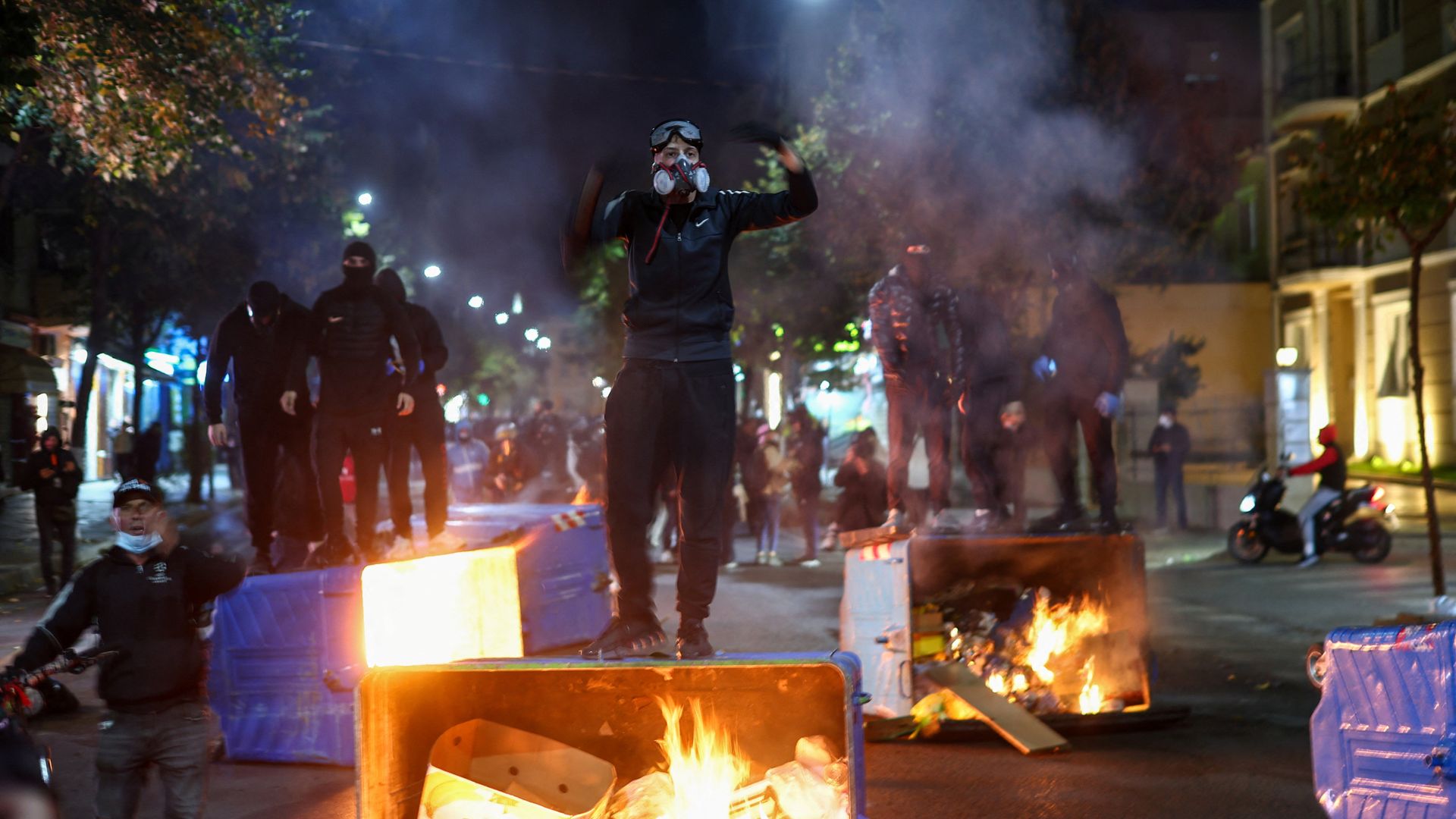
Smoke rises. Tear gas drifts. A headline screams about chaos in the streets. And the wire-service playbook kicks in right on schedule.
Read the standard coverage of protests in Albania and you already know the script before finishing the second paragraph. Angry citizens march. Molotov cocktails fly. Riot police swing batons. A correspondent drops a line about "democratic backsliding" or "deepening polarization," then wraps up with a polite nod toward European Union integration.
It is lazy. It is predictable. Worse, it gets the mechanics backward.
When protesters set fire to government buildings in Tirana and clash with riot police, outside observers treat the arson as a sudden breakdown of order. In reality, it is often a predictable symptom of a system whose normal pressure-release valves have rusted shut.
The Lazy Consensus Around Street Fury
Standard reporting treats street violence as an aberration. A functioning state has courts, elections, parliament, and media; when people throw petrol bombs at ministries, the story gets framed as mob rule colliding with institutional authority.
That framing misses the structural reality of post-communist Balkan politics. Institutions on paper are not the same thing as institutions in practice. Over more than three decades since the collapse of Enver Hoxha's totalitarian regime, Albania has built impressive-looking state architecture—constitutional courts, anti-corruption agencies, electoral commissions, parliamentary committees—while leaving informal networks of patronage, party loyalty, and concentrated executive power remarkably intact.
When citizens feel that ballots do not alter outcomes, courts move at the speed of political convenience, and accountability stops right below the top tier, the street stops being an alternative to politics. It becomes the only channel that registers on the Richter scale.
That does not make throwing a firebomb smart, legal, or harmless. It does make treating the fire itself as the root cause a failure of analysis.
What People Actually Get Wrong About Albanian Protests
Whenever unrest flares in Tirana, the same questions pop up in search bars and cable panels alike. Most of them start from a flawed premise.
- "Why are Albanians suddenly turning violent over politics?" Violence in Albanian street protests is rarely "sudden." Political clashes, boycotts, and fiery demonstrations have recurred across administrations for years. Treating each flare-up as a bolt from the blue ignores a multi-decade pattern of zero-sum political combat where losing an election or a judicial battle feels like losing everything.
- "Are these protests a sign that democracy is collapsing?" Collapse implies a healthy baseline falling apart. A more accurate diagnosis is chronic friction between formal democratic rules and entrenched political cartels. Street rage can erode public trust further, yet it also exposes grievances that polite press releases bury.
- "Do violent clashes force governments to resign?" Rarely on their own. Governments usually fall from a mix of elite defections, economic shock, prosecutorial pressure, or sustained non-violent mobilization—not from a single night of scorched doors and broken glass. In fact, arson often hands the ruling party a gift: the chance to cast itself as the defender of law and order.
The Mechanics of Street Escalation
To understand why clashes with riot police escalate so fast, look at the incentives on both sides of the cordon.
For protest organizers and opposition figures, peaceful rallies have a brutal problem: diminishing returns. If ten thousand people walk down the boulevard, chant slogans, listen to speeches, and go home without a scratch, the evening news gives the story ninety seconds and moves on to weather and football. Escalation buys attention. A burning facade forces foreign embassies, international monitors, and domestic swing voters to look.
For the state, riot police are the visible edge of regime preservation. Officers on the line face flying stones, fireworks, and petrol bombs while following chain-of-command orders from political appointees. When tear gas and water cannons come out, the state is asserting monopoly control over public space. Yet every heavy-handed charge also generates footage that fuels the next wave of anger.
Political scientist Sidney Tarrow and sociologist Charles Tilly spent decades analyzing contentious politics and showed that mobilization spikes when grievances meet perceived opportunity or acute threat. In Albania, threat perception runs high on both sides. Ruling factions fear losing power and facing legal exposure; opposition movements fear permanent marginalization in a system tilted toward incumbents.
Imagine a scenario where a major political figure or ally is indicted by special prosecutors, or an election result is hotly disputed. Within hours, loyalists mobilize, rival narratives flood social media, and a core of hardened demonstrators pushes toward ministry entrances. Even if ninety percent of the crowd wants a peaceful show of force, the ten percent bringing fireworks and fuel dictate the images beamed across Europe.
Battle Scars From Watching Systems Misread Pressure
I have spent years analyzing political risk, institutional reform, and public-sector breakdowns across volatile markets. I have watched governments and corporate boards alike blow millions of dollars misreading street anger because they confused quiet streets with stability.
One pattern shows up again and again. Decision-makers look at GDP numbers, credit ratings, or diplomatic communiques and assume the lid is on tight. They treat warnings about judicial capture, selective prosecution, or cost-of-living squeeze as "noise" from chronic complainers. Then a spark hits dry tinder, buildings burn, and everyone acts shocked.
The opposite mistake happens just as often: assuming every fiery protest is a revolution in waiting. It usually is not. Most of the time, the state holds, clean-up crews sweep the ash by morning, and the underlying political standoff grinds on.
Let us be candid about the downside of taking a contrarian view here. If you argue that arson and clashes reflect deep structural dysfunction rather than mere hooliganism, critics will accuse you of excusing violence. You are not. A Molotov cocktail can injure a young conscript or a bystander just as easily as it damages a stone facade. Public property belongs to taxpayers, not to whichever faction is currently furious.
There is another risk in looking past the immediate violence toward deeper systemic causes: over-interpreting every clash as grand historical destiny. Sometimes young men throw stones because they are angry, bored, manipulated by party operatives, or caught in the adrenaline of a crowd. Reducing every thrown object to a master plan is just another form of lazy storytelling.
| Common Coverage Framing | What It Misses | Practical Consequence |
|---|---|---|
| Protests erupt out of nowhere | Long-standing friction in institutions and trust | Misjudges how fast tensions can return |
| Riot police vs. angry mob | Strategic incentives of organizers, state, and agitators | Overstates either "lawless chaos" or "imminent collapse" |
| Arson equals political leverage | Arson often helps incumbents claim the order mantle | Mistakes loud headlines for real policy change |
| EU integration solves everything | Domestic patronage and rule-of-law gaps run deep | Sets unrealistic timelines for institutional reform |
What Actually Moves the Needle After the Smoke Clears
If you care about stability, investment, or genuine reform in Albania—rather than just harvesting dramatic clips—stop obsessing over who threw the first bottle and start tracking three harder indicators.
First, watch the courts and anti-corruption prosecutors, not the evening news scuffles. Street clashes grab eyeballs, yet independent investigations into high-level graft and abuse of office do far more long-term damage to entrenched power networks than a scorched doorway ever will.
Second, separate crowd size from coalition breadth. A noisy clash involving partisan militants looks fierce on camera, but durable political shifts require broader social pressure that crosses rigid party lines. When ordinary citizens who stay away from tear gas start withholding trust and votes, incumbents feel real heat.
Third, if you manage capital, policy, or operations exposed to the region, build scenarios around institutional friction, not just binary peace-or-war outcomes. Contracts, regulatory timelines, and public procurement in environments with sharp executive-opposition polarization rarely fail in a single dramatic explosion. They erode through delays, disputed rulings, and sudden shifts in political leverage.
Burned doors get replaced. Scorched walls get painted. The real test starts the next morning, when the cameras pack up and the same unresolved power struggles remain standing in the daylight.