Bulgarian foreign policy is frequently mischaracterized as a binary struggle between Western integration and Russian orbit. This reductive framing fails to account for the internal mechanics of Bulgarian statecraft, which functions less as an ideological crusade and more as a sophisticated exercise in Geopolitical Neutrality Arbitrage. The European Union’s recurring anxiety regarding Sofia’s perceived "pro-Russian" tilt ignores the structural incentives that drive Bulgarian decision-makers to maintain a high-friction, low-commitment relationship with both Moscow and Brussels. Understanding this dynamic requires a deconstruction of the three pillars of Bulgarian strategic positioning: Energy Infrastructure Dependency, Domestic Political Fragmentation, and the Security-Economy Trade-off.
The Infrastructure Trap: Path Dependency in Energy
The primary driver of Bulgarian alignment is not sentiment, but the physical reality of its energy architecture. For decades, the Bulgarian energy grid was engineered as a terminal node for Soviet-era pipelines and nuclear technology. This creates a high cost of switching that cannot be bypassed by simple legislative fiat.
- Nuclear Lifecycle Management: The Kozloduy Nuclear Power Plant provides roughly one-third of the country's electricity. Because the units are Russian-designed (VVER-1000), the maintenance cycles, fuel assemblies, and spent-fuel processing remain tethered to Rosatom’s technical specifications. Diversification to Westinghouse or Framatome fuel is a multi-year regulatory and engineering undertaking, not an overnight switch.
- Transit Revenue Optimization: Bulgaria’s participation in the Balkan Stream (the extension of TurkStream) illustrates the arbitrage model. By facilitating Russian gas transit to Serbia and Hungary, Sofia generates significant transit fees while simultaneously claiming adherence to EU diversification goals via the Interconnector Greece-Bulgaria (IGB).
- The Refinery Bottleneck: The Neftochim Burgas refinery, the largest in the Balkans, is owned by Lukoil. It was historically optimized for Urals crude. While EU sanctions forced a transition toward non-Russian oil, the technical reality of refinery "cracking" ratios meant that a rapid shift would have caused an inflationary shock in the domestic fuel market, a risk no Bulgarian coalition government was willing to absorb.
The Cost Function of Political Instability
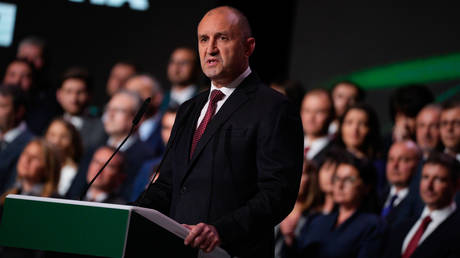
The perception of a "pro-Russian" Bulgaria often stems from the rhetoric of specific political actors, notably the Vazrazhdane party and segments of the Bulgarian Socialist Party. However, equating this rhetoric with state policy ignores the Coalition Fragmentation Constraint. Since 2021, Bulgaria has undergone a cycle of repeated elections, resulting in short-lived cabinets and caretaker governments appointed by President Rumen Radev.
The President’s role is critical. In a parliamentary system under stress, the Presidency gains disproportionate influence over caretaker administrations. Radev’s "neutrality" stance regarding military aid to Ukraine is frequently flagged by the EU as a sign of Russian influence. From a structural perspective, this is better understood as a risk-mitigation strategy aimed at a domestic electorate that remains deeply divided on the conflict. The cost of a decisive pro-Ukraine stance is high domestic polarization; the cost of a pro-Russia stance is EU institutional isolation. Sofia’s solution is to optimize for the middle: providing significant quantities of ammunition and diesel to Ukraine via third-party intermediaries while maintaining a formal policy of non-lethal aid.
Deconstructing the Paranoia: The Brussels Feedback Loop
The EU’s "paranoia" is a byproduct of a mismatch between Brussels’ normative expectations and Sofia’s transactional realism. The EU operates on a framework of Values-Based Integration, while the Bulgarian political elite largely operates on Resource-Based Realism. When Sofia resists certain sanctions or delays Eurozone entry, Brussels interprets this as a shift toward Moscow. In reality, these delays are often rooted in the preservation of local patronage networks that would be disrupted by the transparency requirements of the European Central Bank (ECB) or the Schengen Area's oversight.
The "Russian Shadow" serves as a convenient scapegoat for both sides. For the EU, it explains away the slow pace of judicial and anti-corruption reform. For Bulgarian politicians, it serves as a lever to extract more favorable terms or exemptions from Brussels, essentially using the threat of "pivoting to the East" as a bargaining chip.
[Image of the European Union decision making process diagram]
The Security-Economy Trade-off in the Black Sea
Bulgaria’s strategic calculus is further complicated by its geography. As a Black Sea littoral state, it faces a direct security threat from increased militarization. Unlike Poland or the Baltic states, which view total decoupling from Russia as an existential security necessity, Bulgaria views the Black Sea as a vital economic corridor for tourism and maritime trade.
- Maritime De-risking: Sofia has consistently been more hesitant than Bucharest or Ankara to support a permanent NATO naval presence in the Black Sea. This is not out of loyalty to Moscow, but out of a desire to prevent the sea from becoming a "hot zone" that would terminate its commercial shipping and tourism industries.
- The Tourism Factor: Before 2022, the Bulgarian coastal economy was heavily reliant on Russian and Ukrainian visitors. The loss of this revenue has created a localized economic vacuum that the government is struggling to fill with Western European markets, which have higher standards for infrastructure and service.
The False Narrative of the Slavic Brotherhood
Analysts often rely on cultural-historical ties—the "Slavic Brotherhood"—to explain Bulgarian policy. This is a lagging indicator. While older demographics retain a sense of historical gratitude for the Russo-Turkish War of 1877–1878, younger, urban populations are firmly aligned with Western consumption patterns and labor mobility.
The divergence is economic:
- Export Destination Shift: Over 60% of Bulgarian exports go to the EU. Russia accounts for less than 3%.
- Foreign Direct Investment (FDI): The vast majority of FDI originates from Germany, the Netherlands, and Greece. Russian investment is concentrated in specific sectors like real estate and energy, but it lacks the breadth to dictate national economic policy.
The "pro-Russia" label is therefore a misalignment of optics. Bulgaria is not moving toward Russia; it is simply refusing to move toward the West at the velocity the EU demands. This friction is interpreted as hostility, but it is actually the byproduct of a state trying to maintain a high-dependency energy sector while navigating a fractured domestic political landscape.
Structural Bottlenecks to Full Alignment
The transition to a fully "pro-Western" posture is hindered by internal bottlenecks that have little to do with foreign ideology:
- Judicial Stasis: The inability to reform the Prosecutor General's office prevents the effective prosecution of high-level corruption. This allows informal networks—some of which have historical ties to Russian business interests—to persist.
- Information Asymmetry: The Bulgarian media landscape is susceptible to disinformation campaigns, but more importantly, it suffers from a lack of high-quality, data-driven journalism. This allows populist narratives to dominate the public discourse, making complex geopolitical alignments appear like simple "us vs. them" choices.
- The Demographic Crisis: Bulgaria has one of the fastest-shrinking populations in the world. This creates a labor shortage that hampers the very industrial growth needed to reduce energy dependency and integrate more deeply into European supply chains.
The Strategic Play: Capitalizing on the Grey Zone
For the foreseeable future, Bulgaria will remain in a state of Strategic Ambiguity. This is not a failure of policy, but a deliberate choice. By remaining the "difficult" member of the EU and NATO, Bulgaria ensures it stays relevant in the calculations of both Brussels and Moscow.
The strategic recommendation for Western analysts and policymakers is to cease the "paranoia" of a Bulgarian defection. Instead, the focus must shift to the technical and economic de-risking of the Bulgarian energy sector. As long as the physical infrastructure remains tied to Russian standards, the political rhetoric will follow. Decoupling the grid is the only way to decouple the politics.
The terminal state for Bulgaria is not a return to the Russian fold—that bridge was burned by the invasion of Ukraine and the subsequent weaponization of gas supplies. Rather, the terminal state is a "minimalist Europeanism": a country that remains within the EU and NATO for security and subsidies but maintains an independent, transactional relationship with any external power that can provide cheap energy or infrastructure investment. Sofia is not a Trojan Horse; it is a merchant city-state operating in a continental union, and it will continue to prioritize its internal stability over the normative aspirations of the European project.


:strip_icc()/pic2513216.jpg)