Picture a sailor stranded in the middle of the Pacific Ocean on a pitch-black, moonless night, staring up at a canopy of pinpricks without a compass, a sextant, or a coastline in sight.
To survive, that sailor has to guess where the currents are pulling the boat simply by squinting at the waves slapping against the hull. For centuries, that was the exact predicament of every human being on Earth. We were adrift on a rocky speck inside a sprawling, violent spiral of stars, trying to deduce the shape of the forest while trapped inside the bark of a single tree. We looked up at the Milky Way—that ghostly, spilled-milk smear stretching across dark summer skies—and we made educated guesses. We drew flat maps of a three-dimensional ocean. We didn't know where we came from, we didn't know what had collided with us in the dark, and we certainly didn't know where the current was dragging us next.
Then, on a crisp December morning in 2013, Europe launched a silver-and-black cylinder into the freezing vacuum of space.
They named it Gaia.
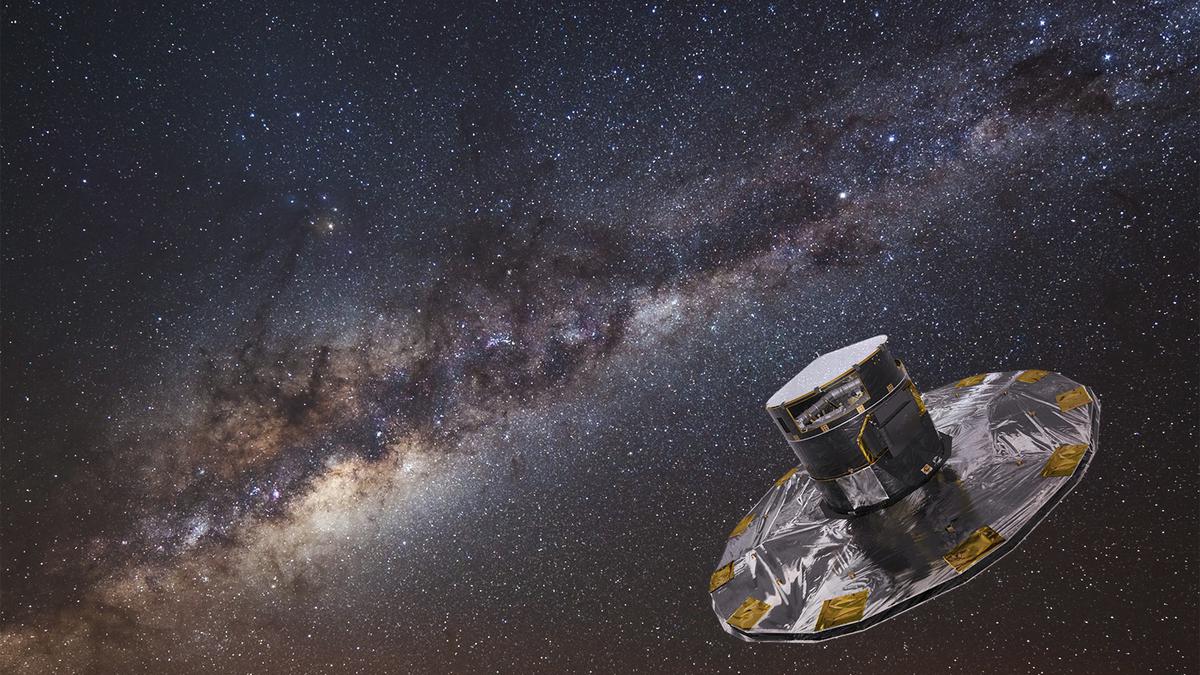
If you read standard aerospace summaries, you will be told that the European Space Agency’s Gaia mission is an astrometric observatory designed to chart a three-dimensional map of our galaxy. That is factually true, and it is also entirely bloodless. Calling Gaia a "mapping mission" is like calling the invention of the microscope "a glass-polishing project." What engineers actually built, parked nearly a million miles from Earth at a gravitational sweet spot called Lagrange Point 2, is a billion-pixel time machine. Over more than a decade of silent, spinning vigilance—before its thrusters finally ran dry of cold gas in early 2025—Gaia cured humanity of its cosmic amnesia.
The Audacity of Measuring a Hair from a Thousand Miles Away
To understand why astronomers wept when Gaia’s data began pouring back to Earth, you have to understand the sheer, agonizing difficulty of measuring depth in the dark.
Hold your thumb out at arm's length and close your left eye. Now switch to your right eye. Your thumb appears to jump against the background wall. That apparent shift is called parallax, and it is the only way our brains—and our telescopes—perceive distance. Because Earth orbits the Sun, our vantage point shifts by about 186 million miles every six months. If you photograph a nearby star in January and again in July, it will appear to wobble slightly against the vastly more distant stars behind it.
The math is simple. The execution is a nightmare.
Stars are so unfathomably far away that their parallax wobble is microscopic. Measuring the position of a star with the precision required to map the Milky Way is the equivalent of standing in New York City, looking at a human hair held up by someone in Los Angeles, and measuring the width of that hair. Before Gaia, our best space-based catalog, the Hipparcos mission of the 1990s, managed to measure roughly 118,000 stars. It was a triumph of its era, yet in a galaxy housing hundreds of billions of suns, 118,000 stars is barely a handful of sand scooped from an endless beach.
Consider a hypothetical astronomer—let’s call her Elena—sitting in a dimly lit control room in Darmstadt, Germany, back in 2014. On her monitor, raw telemetry trickles down from a spacecraft spinning slowly like a top, once every six hours. Gaia doesn't point at pretty nebulas or zoom in on colorful explosions like the Hubble or James Webb telescopes. It is a relentless, unblinking surveyor. Equipped with two telescopes pointing in different directions and a massive, one-billion-pixel camera—the largest ever flown in space at the time—Gaia sweeps the sky over and over, logging the exact position, brightness, color, and motion of every point of light that crosses its field of view.
Elena watches the numbers stack up. Ten million stars. A hundred million. Eventually, nearly two billion stars.
For the first time in human history, we weren't looking at a flat photograph glued to the dome of the night sky. We were watching the universe breathe in four dimensions: three dimensions of space, and the fourth dimension of velocity. By tracking how fast each star was moving across the sky—and using onboard spectrometers to measure whether those stars were rushing toward us or fleeing away—Gaia handed Elena and the rest of humanity a cosmic rewind button.
The Ghost in the Galactic Machine
Once you know where two billion stars are and how fast they are moving, you don't just have a map. You have a forensic crime scene.
For decades, the prevailing textbook wisdom suggested that the Milky Way was a relatively serene, stately giant that had quietly assembled itself billions of years ago and settled into middle-aged tranquility. Gaia shattered that comforting illusion within months of its second major data release in 2018.
When scientists took Gaia's velocity measurements and ran the clock backward, they noticed something bizarre. Millions of stars in our cosmic neighborhood weren't orbiting the center of the galaxy in neat, orderly circles like horses on a carousel. Instead, a massive swarm of stars was plunging through the galactic disk on wild, elongated, eccentric paths, moving almost backward relative to the rest of the galaxy.
It was a smoking gun.
Roughly ten billion years ago, when our infant galaxy was still finding its footing, the Milky Way suffered a catastrophic head-on collision. Another dwarf galaxy—a massive stellar city containing billions of stars of its own—slammed straight into us. Astronomers named this ghostly intruder Gaia-Enceladus (also known as the Gaia Sausage, owing to the distinctive shape its stars form when plotted on a velocity chart). The impact was so violent that it shattered the dwarf galaxy, scattering its stars across the Milky Way's halo and puffing up our galaxy's central disk like a bruised cheek.
Wait. Think about what that means for you, sitting wherever you are right now, reading these words.
The Milky Way is not a pristine island universe. It is a cannibal. It grew massive by devouring its neighbors, and the stars of those dead galaxies are still swimming right past our solar system today, disguised as ordinary points of light. Without Gaia’s absurdly precise measurements of stellar chemistry and motion, those ancient immigrants were completely invisible to us.
And the collisions didn't stop ten billion years ago.
As astronomers dug deeper into Gaia's third data release in 2022, they discovered ripples—literal waves sloshing through the disk of the Milky Way like rings spreading across a pond after someone tosses a heavy stone into the water. By measuring the vertical bobbing motion of millions of stars, researchers traced those ripples to a much more recent trespasser: the Sagittarius dwarf galaxy. Over the last few billion years, this smaller satellite galaxy has repeatedly plunged straight through the disk of the Milky Way like a bullet piercing a sheet of paper.
One of those cosmic body-slams occurred roughly five billion years ago—right around the exact time our own Sun and Earth were condensing out of a collapsing cloud of gas and dust. It is entirely possible, supported by growing dynamic evidence, that the gravitational shockwave from that galactic collision compressed the gas clouds in our corner of space, triggering the birth of the Sun. You exist, in a very real astrophysical sense, because two galaxies crashed into each other in the dark.
The Quiet Revolution in Our Own Backyard
It is easy to get lost in billions of years and millions of light-years, to let the numbers wash over you until they lose all human scale. Let’s bring this down to earth.
Imagine an astrophysicist—let's call him Marcus—studying the local neighborhood within a few hundred light-years of Earth. Marcus isn't looking for ancient galactic crashes; he is trying to find worlds that might harbor life, and asteroids that might end ours.
Before Gaia, hunting for exoplanets—planets orbiting distant stars—was plagued by a frustrating blind spot. Astronomers usually spot exoplanets by watching a star dim slightly when a planet passes in front of it. But how big is that planet? You can only know if you know the exact size of the star itself. And you can only know the true size of a star if you know its exact distance. A massive, bright star far away looks identical in a telescope to a small, dim star close by.
Gaia eliminated the guesswork. By pinning down the exact distances to nearly two billion stars, Gaia forced astronomers to recalculate the sizes of thousands of known exoplanets overnight. Some "Earth-sized" worlds turned out to be bloated, uninhabitable gas giants; others turned out to be rocky worlds sitting squarely in the temperate zones of their suns. Even better, Gaia began spotting planets directly through astrometry—detecting the tiny, rhythmic gravitational tug a massive planet exerts on its parent star, causing the star to wobble in space as the two dance around a shared center of gravity.
Then there is the matter of our own survival.
Our solar system is littered with hundreds of thousands of tumbling boulders—asteroids left over from the violent construction of the planets. Most stay safely penned up in the main belt between Mars and Jupiter, while others cross Earth's orbit, carrying the potential for civilization-ending impact. To predict whether a newly discovered space rock will hit Earth fifty years from now, astronomers have to track its path across the background stars over several nights.
If your background map of the stars is slightly skewed, your prediction of the asteroid's path will be skewed, too. Gaia’s ultra-precise star catalog handed planetary defense teams an airtight ruler. When an asteroid passes in front of a star mapped by Gaia, astronomers can measure its shadow down to the kilometer, refining its orbit with a precision that was pure fantasy a decade ago. Even the most mundane, unglamorous utility of this spacecraft acts as an invisible shield over our heads.
What Happens When the Eyes Close?
Nothing in space lasts forever.
To keep Gaia spinning smoothly and pointing with surgical accuracy, the spacecraft carried tanks of cold nitrogen gas, firing micro-thrusters that emitted puffs weaker than the weight of a single snowflake landing on your palm. For more than eleven years—more than double its planned five-year lifespan—Gaia scanned the sky, capturing over three trillion individual observations.
By early 2025, the cold gas tanks finally approached empty. Mission controllers in Darmstadt executed a series of final engineering tests—turning the spacecraft toward the Sun to study how its instruments degraded over a decade of cosmic radiation—before gently firing its remaining fuel to push Gaia out of Lagrange Point 2 and into a safe, permanent retirement orbit around the Sun. On March 27, 2025, engineers sent the final commands to switch off its transmitters. Gaia went dark.
If you feel a sudden pang of sadness at the thought of a machine going silent in the dark, you aren't alone. We humanize our explorers because they carry our curiosity into places our fragile bodies can never go.
Yet calling Gaia's retirement "the end" misses the entire point of what it accomplished. When a telescope closes its shutter, the science doesn't stop; in many ways, it only begins. Every observation Gaia recorded between 2014 and 2025 sits locked inside massive data archives on Earth, waiting to be cleaned, cross-referenced, and decoded. The fourth major data release—spanning five and a half years of continuous observations—and the massive, legacy fifth data release encompassing the entire decade-long mission will keep astronomers busy well into the 2030s and 2040s.
In those terabytes of stored light, thousands of undiscovered exoplanets are waiting to be pulled from the noise. Hidden black holes—silent, stellar-mass monsters that emit no light of their own, betraying their presence only by yanking their companion stars into frantic orbits—are already being dragged into the daylight. Just prior to its retirement, Gaia's data revealed Gaia BH3, a dormant black hole thirty-three times more massive than our Sun lurking just 2,000 light-years from Earth, practically on our cosmic doorstep. Nobody knew it was there until Gaia noticed a single star wobbling around nothing at all.
The Mirror Held Up to the Dark
Let's be honest about what it feels like to look at Gaia’s final, full-sky portrait of the Milky Way.
At first glance, it is terrifying. The sheer scale of two billion suns packed into a spinning, warping, cannibalistic disk makes human history look like a brief spark struck in a hurricane. Empires rise and crumble in the time it takes a single photon of light to cross a fraction of one spiral arm.
But stay with that image a little longer, and the terror shifts into something else entirely.
For all of evolutionary history, human beings were creatures bound to the dirt, navigating by landmarks we could touch and horizons we could walk toward. When we finally lifted our eyes to the dark, we were profoundly lost. In the span of a single human lifetime, we built a machine with mirrors polished to atomic perfection, parked it a million miles beyond the Moon, and taught it to measure the width of a human hair across a continent. We took a chaotic blizzard of two billion lights and turned it into a biography—our biography.
Somewhere out there right now, far beyond the orbit of the Moon, a dead aluminum cylinder is tumbling silently through the black, its sensors cold and its radio mute, while down on Earth, the species that built it finally knows where it stands in the universe.