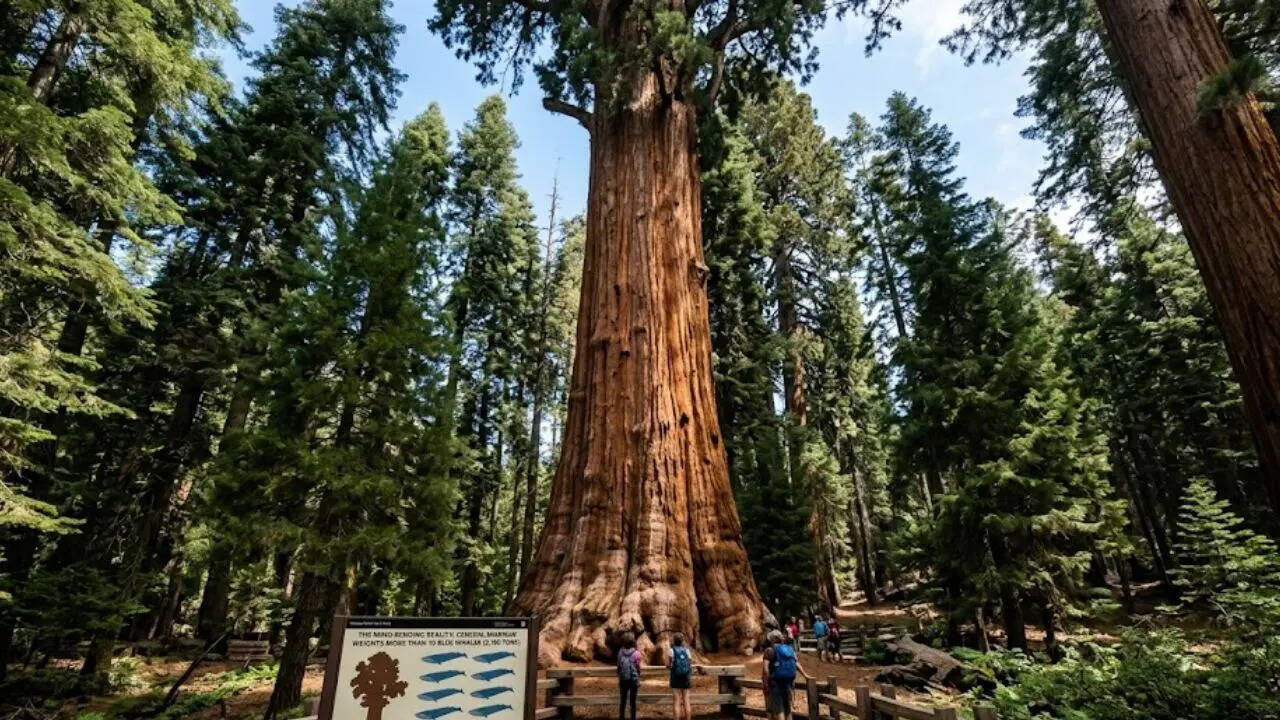
The General Sherman tree stands as a biological impossibility. Located in the Giant Forest of Sequoia National Park, this single organism contains an estimated 52,500 cubic feet of wood. To put that in perspective, the tree’s mass exceeds 2.7 million pounds, a figure that makes the comparison to a pod of blue whales feel less like a metaphor and more like a heavy industrial audit. While casual observers focus on the sheer height of these giants, the real story lies in the crushing physics of their existence and the increasingly fragile ecosystem that allows such immense weight to remain upright.
The Architecture of Giants
A Giant Sequoia (Sequendron giganteum) is not merely a tall tree. It is a hydraulic engineering marvel. These trees are massive because they have mastered the art of vertical transport. Every single day, a mature sequoia must lift hundreds of gallons of water from the soil to its highest needles, nearly 300 feet in the air. This isn't achieved through a mechanical pump but through a process called capillary action and transpiration pull, utilizing the physical properties of water molecules to defy gravity.
The bark of a sequoia can be up to two feet thick. This isn't just for show. It is a fibrous, cinnamon-colored armor that contains almost no flammable resin. Instead, it is packed with tannins that repel insects and rot. This allows the tree to survive for millennia—many specimens are over 2,000 years old—effectively outlasting the very concept of modern civilization.
The Fire Paradox
For decades, the United States Forest Service followed a policy of total fire suppression. They thought they were protecting the park. They were actually killing it. We now know that Giant Sequoias are serotinous, meaning their cones require the intense heat of a fire to open and release seeds. Without fire, the forest floor becomes choked with shade-tolerant white firs that prevent sequoia seedlings from reaching the mineral soil and sunlight they need to grow.
Furthermore, fire clears the underbrush. Without regular, low-intensity burns, the "fuel load" on the forest floor builds up to dangerous levels. When a fire finally does break out in these conditions, it isn't a healthy, clearing burn. It becomes a crown fire. These infernos are hot enough to jump into the canopy, killing even the oldest, most resilient giants that survived dozens of smaller fires over the centuries. In the 2020 and 2021 fire seasons alone, it is estimated that between 13% and 19% of the world’s entire population of large Giant Sequoias perished.
Structural Failures and the Root System
Despite their massive weight, sequoias have no taproot. They do not anchor themselves deep into the bedrock. Instead, they rely on a shallow, spreading mat of roots that rarely goes deeper than six feet but can extend out over 100 feet from the trunk. This root system interlocks with the roots of neighboring trees, creating a subterranean web that helps the entire grove stay standing during heavy snows and high winds.
When you walk through the Giant Forest, the ground feels soft. This is "duff," a thick layer of needles and organic matter. When tourists venture off the paved trails, they compress this soil. This seemingly minor action crushes the delicate feeder roots just inches below the surface, starving the tree of oxygen and water. A tree that weighs as much as a small freighter can be brought down by the cumulative footsteps of a few thousand well-meaning visitors.
The Hydrological Crisis
The weight of a sequoia is largely water weight. The Sierra Nevada snowpack acts as a slow-release battery for these groves. As the snow melts throughout the spring and summer, it provides a steady trickle of moisture to the shallow roots. However, shifting climate patterns are turning that snow into rain. Rain runs off quickly; it doesn't soak in.
In 2014, during a severe multi-year drought, scientists observed something never seen before in recorded history: Giant Sequoias shedding their needles to conserve water. It was a visual signal of physiological stress. While these trees have survived dry spells for two thousand years, the speed of current temperature increases is testing the limits of their internal plumbing. If the water column in the xylem snaps due to extreme tension, the tree suffers an embolism. Once enough of these "air bubbles" form, the tree’s cooling and feeding system fails, and it dies standing up.
The Logistics of Maintenance
Managing Sequoia National Park is an exercise in heavy lifting. When a giant falls across a road, you don't just call a tow truck. Crews must use massive crosscut saws or specialized chainsaws to section the trunk, often spending days just to clear a single path. These fallen logs are left in place whenever possible because they provide vital habitat for local fauna and return nutrients to the soil over several centuries.
Vital Statistics of the General Sherman
| Metric | Measurement |
|---|---|
| Height | 275 feet (83 meters) |
| Diameter at Base | 36 feet (11 meters) |
| Estimated Weight | 1,385 tons |
| Estimated Age | 2,200 years |
| Annual Growth | Enough wood to make a 60-foot tree |
The Industry of Observation
The park isn't just a biological preserve; it’s a massive economic engine for the region. The challenge for the National Park Service is balancing the $150 million+ in annual visitor spending with the biological needs of a species that thrives on isolation and fire. We are currently in a period of aggressive intervention. This includes "prescribed burns" where rangers intentionally set fires under strictly controlled conditions to mimic natural cycles.
It also involves "hand-thinning" of smaller trees. Crews go in with saws to manually remove the "ladder fuels" that would allow a ground fire to climb into the sequoia's crown. It is dangerous, expensive, and physically exhausting work. It is the only way to ensure that the giants we see today are still standing for the next generation.
The reality of Sequoia National Park is that it is no longer a self-sustaining wilderness. It is a managed landscape. The giants are resilient, but they are not invincible. Every pound of wood in the General Sherman is a testament to two millennia of survival, but its future depends entirely on our ability to manage the very elements—fire and water—that we spent the last century trying to control.
Stop looking at the height. Look at the scars on the bark. Those black char marks are not signs of damage; they are the fingerprints of a tree that has learned how to live with the heat. The real threat isn't the fire it has already survived, but the climate it hasn't yet faced.