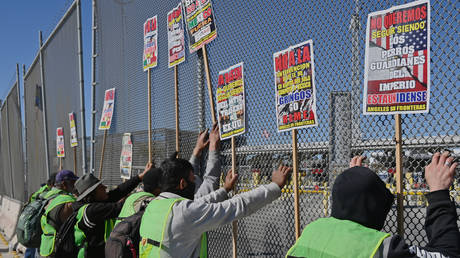
The American asylum system is dead. On June 25, 2026, the White House formalised what border advocates and immigration attorneys had been witnessing in the mud and dust of the southern border for eighteen months. White House policy advisor Stephen Miller stood before reporters and delivered the final eulogy for a multi-decade humanitarian framework, stating plainly that the country's doors are now closed fully to asylum seekers. This was not a mere rhetorical flourish for the evening news broadcast. It was the declaration of a structural reality engineered through a series of sweeping executive actions, coordinated international pressures, and a series of judicial victories that have fundamentally transformed the legal architecture of the United States.
The immediate catalyst for this formal pronouncement was a pair of dramatic 6-3 decisions handed down by the Supreme Court. In the matters of Mullin v. Al Otro Lado and Mullin v. Doe, the conservative majority dismantled the legal foundations that kept the border technically open to those fleeing persecution. For decades, the statutory understanding of federal immigration law dictated that any individual who set foot on American soil, or arrived at a port of entry, possessed the legal right to request a screening for a well-founded fear of persecution. That understanding has been erased. The highest court in the land has granted the executive branch near-total authority to physically block, turn away, and summarily deport migrants before they can even utter the words that would trigger an asylum hearing. Don't forget to check out our previous coverage on this related article.
The Legal Architecture of Exclusion
The transformation did not happen in a vacuum. It was the culmination of an aggressive strategy initiated on January 20, 2025, when the administration invoked Section 212(f) of the Immigration and Nationality Act. This specific provision grants the president broad authority to suspend the entry of foreign nationals if their arrival is deemed detrimental to the interests of the nation. Past administrations used this tool with a degree of surgical precision, targeting specific regimes or restricted classes of travelers. The current White House applied it like a sledgehammer, declaring the ongoing migrant arrivals a state of domestic invasion. By categorising migration as a hostile incursory force rather than a humanitarian phenomenon, the administration successfully bypassed the administrative hurdles that typically tie up immigration policies in federal courtrooms for years.
The legal logic deployed by the administration hinges on a radical reinterpretation of what it means to arrive in America. Writing for the majority in Mullin v. Al Otro Lado, Justice Samuel Alito illustrated this shift with a stark domestic analogy, writing that a guest does not arrive in a house when he knocks on the front door. The ruling explicitly allows federal authorities to implement a policy known as metering on an unprecedented scale. Under this system, Customs and Border Protection officers physically block the international bridges and border boundary lines, refusing to let individuals step onto the literal pavement of U.S. ports of entry. Because they are prevented from crossing the threshold, they are legally deemed never to have arrived, meaning the statutory protections of the asylum process do not apply to them. To read more about the background of this, Reuters provides an in-depth breakdown.
The dissent from the bench was unusually raw. Justice Sonia Sotomayor took the rare step of reading her dissent aloud, asserting that the majority opinion tragically extinguishes the light of the torch of the Statue of Liberty. She argued that the court had essentially blessed an executive coup against the express intent of Congress, which had codified the obligations of the 1951 Refugee Convention into domestic law via the Refugee Act of 1980. The clash on the bench reflects a deeper institutional shift. The judiciary is no longer acting as a check on executive border enforcement, but rather as an accelerant, clearing away decades of legal precedents to allow for a total operational shutdown.
The Shutdown Machinery in Motion
The operational reality on the ground is stark, efficient, and increasingly automated. Immediately following the Supreme Court decisions, the Department of Homeland Security terminated the CBP One mobile application. This app had served as the primary digital mechanism for asylum seekers to log their data and secure processing appointments at official ports of entry. With the deletion of the app and the cancellation of all existing appointments, the remaining legal pathways disappeared overnight. Migrants who had spent months waiting in dangerous northern Mexican border towns like Reynosa, Matamoros, and Tijuana found their digital profiles wiped out and their hopes of an orderly legal interview extinguished.
At the same time, the administration ordered the immediate reinstatement of the Migrant Protection Protocols, widely recognized as the Remain in Mexico program. The operational goals of this policy extend far beyond merely changing the location of the asylum hearings. By forcing applicants to wait out their legal proceedings inside Mexico, the United States effectively transfers the human and logistical costs of the migration crisis southward. The results are entirely predictable. Massive, informal encampments have expanded across the northern tier of Mexico, where organized criminal syndicates treat the stranded migrant populations as a highly lucrative revenue stream through kidnapping, extortion, and human trafficking.
+------------------------------------------------------------+
|             THE RESTRUCTURED BORDER BARRIER                |
+------------------------------------------------------------+
|  [Mexico Territory]                                        |
|  Migrants stranded in informal border camps                |
|  ↓                                                         |
|  [The Physical Border Line]                                |
|  CBP Metering Detachments / National Guard Deployment      |
|  ↓                                                         |
|  [The Threshold Gate]                                      |
|  CBP One App: TERMINATED                                   |
|  Categorical Parole: TERMINATED                            |
|  ↓                                                         |
|  [United States Territory]                                 |
|  Immediate Expedited Removal / Zero Asylum Screening       |
+------------------------------------------------------------+
The administrative assault was not limited to those arriving at the physical border line. Through the second ruling, Mullin v. Doe, the administration secured the authority to dismantle Temporary Protected Status for approximately 350,000 nationals from countries experiencing severe armed conflict or environmental collapse, specifically targeting long-term residents from Haiti and Syria. This program had historically provided a temporary safe haven and work authorization for individuals whose home countries were deemed too dangerous for return. The Department of Homeland Security has already begun issuing stop-work orders and preparing logistical plans for large-scale repatriation flights. The message from Washington is systematic. Protection is no longer an option, regardless of how long an individual has lived, worked, or paid taxes within the American domestic economy.
The Disruption of the Humanitarian Network
The immediate casualties of this policy shift are not just the migrants themselves, but the vast infrastructure of non-governmental organizations, legal aid societies, and religious charities that have historically managed the human cost of border enforcement. For forty years, the United States relied on these entities to provide shelter, food, legal counseling, and transportation for individuals transitioning out of federal custody. The sudden implementation of the new executive orders has stripped these organizations of their functional purpose and their financial stability.
Federal funding for refugee resettlement and integration has been halted by executive decree. Shelters across West Texas, southern Arizona, and California are facing sudden closures as their rooms sit empty, not because the migration crisis has resolved, but because the human beings are being blocked miles away on the other side of an invisible legal line. Legal aid groups find themselves entirely locked out of federal facilities. The traditional work of an immigration attorney—preparing an applicant for a credible fear interview or compiling documentation of political persecution—has been rendered obsolete when the state refuses to conduct the interview in the first place.
This is a deliberate operational starvation of the humanitarian ecosystem. By defunding and restricting the groups that document border conditions, the administration has successfully decreased the visibility of enforcement operations. What occurs at the physical boundary line is now hidden behind layers of military deployments and restricted access zones. Journalists and human rights observers are routinely kept kilometers back from the areas where summary deportations are executed, creating an information vacuum where the only official narrative is the one broadcast from the White House press briefing room.
The Demographic and Macroeconomic Reckoning
While the political rhetoric surrounding the border shutdown focuses entirely on national security and sovereignty, economists are quietly tracking a completely different set of metrics. The United States is facing an unprecedented demographic shift. The domestic birth rate has dropped to historic lows, and the aging baby boomer generation is transitioning out of the active workforce at a pace that domestic labor replacement rates cannot match. For decades, foreign-born labor functioned as a critical demographic cushion, filling essential gaps in agricultural production, construction, hospitality, and healthcare infrastructure.
Data compiled by researchers like David Bier illustrates that the complete closure of the asylum system, combined with the termination of humanitarian parole programs for nationals from Venezuela, Nicaragua, Cuba, and Haiti, will accelerate the nation's descent toward a economic contraction. The agricultural sectors of California's Central Valley and the specialized farming regions of the American Midwest rely heavily on seasonal and undocumented labor that frequently regularizes through the asylum framework. Without this influx of able-bodied workers, processing plants are scaling back operations, fields are being left unharvested, and supply chains are fracturing.
+---------------------------------------------------------+
|      ECONOMIC AND DEMOGRAPHIC IMPACT PROJECTIONS        |
+---------------------------------------------------------+
| Sector            | Dependence on Migrant/Asylum Labor  |
+-------------------+-------------------------------------+
| Agriculture       | Critical seasonal workforce loss    |
| Construction      | Severe labor shortages in sunbelt   |
| Eldercare         | Rapid wage inflation, talent deficit|
| Food Processing   | Operations scaling down by 20-30%   |
+-------------------+-------------------------------------+
The crisis is particularly acute in the eldercare and healthcare support industries. As the American population ages, the demand for home health aides, nursing assistants, and residential facility staff has expanded. These are physically demanding, low-wage positions that domestic workers historically avoid. Foreign-born individuals, many navigating the long backlogs of the asylum or temporary status systems, filled these vacancies. By removing hundreds of thousands of legal workers through the termination of Temporary Protected Status and blocking any future entries, the administration is driving a massive labor shortage that will inevitably translate into soaring healthcare costs for ordinary families. It is a mathematical certainty that a nation cannot maintain an expanding economy while simultaneously executing a policy of zero population growth through immigration restriction.
The International Precedent and Global Fracturing
The consequences of the American border shutdown extend far beyond the domestic borders of the United States. For most of the post-Second World War era, Washington set the baseline for international refugee policy, using its adherence to humanitarian law as a diplomatic lever to encourage other nations to maintain stable borders and protect vulnerable minorities. That leverage has been surrendered. By explicitly violating the principle of non-refoulement—the international legal prohibition against returning refugees to countries where they face clear danger—the United States has signaled to the rest of the world that international treaties are entirely secondary to domestic political expediency.
Other nations are already following the American lead. Across Western Europe, Latin America, and East Asia, nationalist governments are citing the U.S. Supreme Court's rulings as a legal justification to implement their own variations of border metering and summary exclusions. The international asylum network is fracturing under the weight of this collective withdrawal. When the wealthiest and most powerful nation on earth declares its doors are closed, it removes the moral and diplomatic pressure on developing nations—which actually host the vast majority of the world's displaced persons—to keep their own borders open.
The result is a dangerous accumulation of displaced populations in geopolitical choke points. Colombia, Panama, and Mexico are transforming into permanent containment zones, holding millions of migrants who have nowhere left to move. These regions lack the institutional capacity, fiscal resources, or security frameworks to handle such massive concentrations of human beings. As these transit nations buckle under the pressure, the risk of regional political instability increases exponentially, creating a far more volatile national security environment for the United States than the one the border shutdown was originally designed to fix.
The Reality of the Enforced Line
The current administration has achieved its objective of creating a hard, unyielding border through a calculated combination of executive audacity and judicial alignment. The legal arguments have been won, the infrastructure of processing has been dismantled, and the political opposition has been largely outmaneuvered. But an objective analyst must look past the immediate policy declarations to see the unresolved friction beneath the surface.
Human migration is driven by fundamental structural pressures: systemic violence, economic collapse, environmental devastation, and political terror. These forces do not cease to exist simply because a court in Washington issues a 6-3 opinion or an advisor declares a door closed. The pressure along the southern line remains constant, building up behind a wall of legal exclusions and military deployments. The administration has successfully changed the legal category of the crisis, converting an administrative immigration challenge into a permanent humanitarian and diplomatic crisis on the Mexican side of the line. The doors may be closed, but the global instability driving people to knock on them is only accelerating.