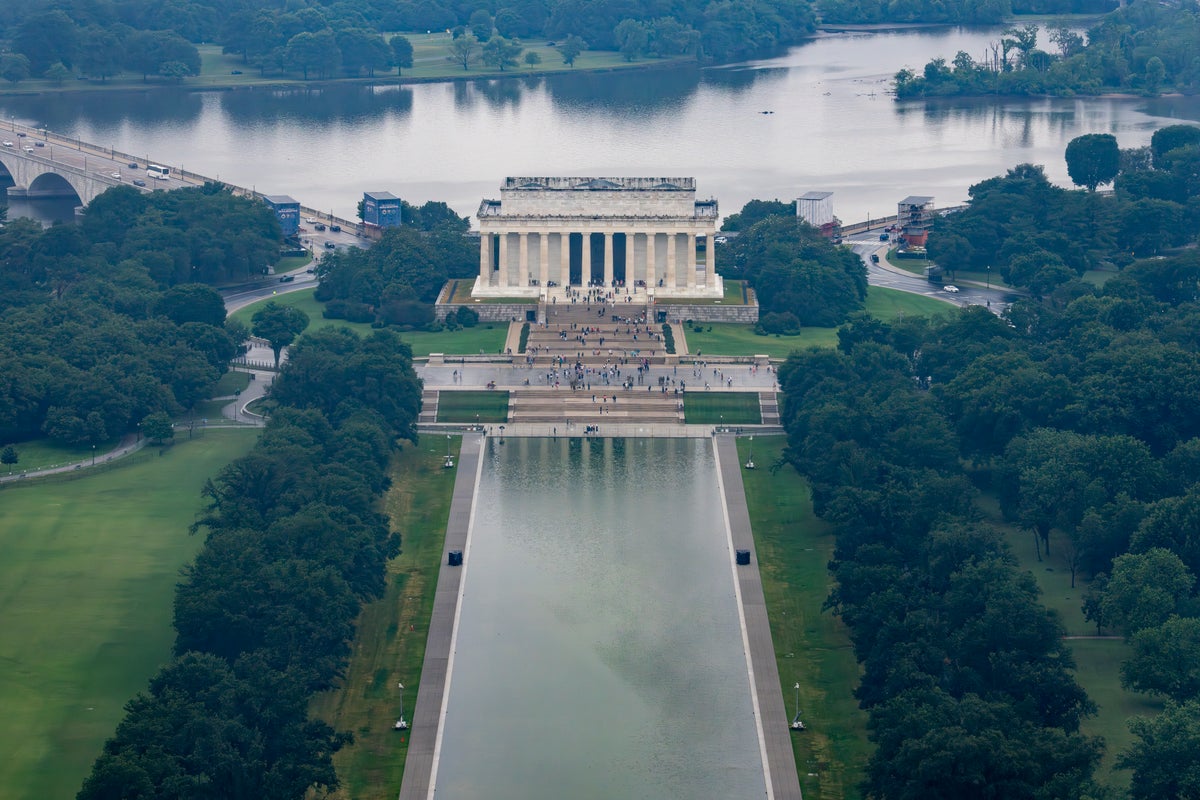
The Lincoln Memorial Reflecting Pool was supposed to be a shining monument of American exceptionalism in time for the nation’s 250th anniversary. Instead, it became a bright green, foul-smelling swamp. The $16.4 million renovation project, intended to coat the historic basin in an "American flag blue" finish, dissolved within days into an ecological and administrative disaster. While the official narrative blamed mysterious late-night vandals armed with razor blades and specialized fertilizers, the reality is far more mundane and damning. The high-tech water purification system installed to save the pool was fundamentally mismatched for the job, built by a politically connected contractor, and had never been successfully deployed on a open-air public pool of this scale.
Behind the political theater lies a story of rushed procurement, administrative hubris, and a total disregard for basic aquatic biology. The federal government bypassed standard oversight to award a $1.7 million contract for an unproven filtration system. They expected a quick cosmetic fix. What they received was a lesson in limnology that the National Park Service is still trying to clean up.
The Chemistry of a Manufactured Disaster
Algae is not a political statement. It is a biological certainty when you combine stagnant water, intense summer heat, and a sudden influx of nutrients.
When the basin was drained in the spring of 2026 for its hurried makeover, the concrete floor was coated in a heavy blue industrial sealant. The intent was to create a pristine, shimmering reflection of the sky. But the heavy machinery used during the inspection process, including the presidential motorcade itself, likely compromised the integrity of the freshly cured liner. When the water returned, so did the sun.
The Reflecting Pool holds more than six million gallons of water. It has an average depth of only two feet. This creates a massive surface area perfectly optimized to trap solar radiation. Within forty-eight hours of refilling, the water temperature spiked. Dormant cyanobacteria left inside the legacy supply lines woke up. They encountered a basin completely scrubbed of natural competitors but loaded with residual organic matter.
The growth was explosive. The water turned a thick, pea-soup green. To counter the sudden bloom, desperate park staff began dumping hundreds of gallons of industrial-grade hydrogen peroxide directly into the water. It was a short-term chemical hammer. The peroxide successfully oxidized the blue-green cyanobacteria, but it simultaneously stripped away the top layer of the new blue sealant. Chunks of the expensive coating began to delaminate, peeling off the floor and floating to the surface like dead skin. Even worse, the sudden destruction of the cyanobacteria cleared the way for a much tougher, more resilient strain of green algae that thrived in the peroxide-treated water.
The Nanobubble Illusion
To fix the crisis, the Department of the Interior pointed to its secret weapon. They had commissioned a specialized water-purification system from an Ohio-based company called Green Water Solutions, also operating under the name Greenwater Services. The technology relied on nanobubbler units. These devices are designed to inject millions of microscopic ozone bubbles into a body of water, suppressing phosphorus and destroying algal cells at the microscopic level.
The problem was that the technology had no track record in large, shallow, high-traffic municipal monuments.
Nanobubblers have shown success in contained industrial wastewater facilities and deep, shaded agricultural ponds. They fail when forced to compete with the sheer volume of ultraviolet light hitting a two-foot-deep concrete pan on the National Mall. For the ozone to work, it requires adequate contact time within a controlled water column. In the wide-open, wind-whipped environment of the Reflecting Pool, the gas dissipated far too quickly to achieve critical mass against the rapidly multiplying biomass.
Internal logs from the maintenance teams revealed an even deeper structural failure. The contract called for four industrial nanobubbler units to run continuously along the perimeter of the pool. In practice, the machines were plagued by mechanical breakdowns from the first week of operation. At any given time, one or two of the units were completely offline due to clogged intake valves and electrical overheating. The shallow water meant the pumps were constantly sucking in ambient debris, cherry blossom petals, and discarded trash from tourists, which choked the delicate internal mechanisms of the specialized machinery.
A Trail of No Bid Contracts
The failure of the technology cannot be separated from the method used to acquire it. Normal federal acquisition guidelines require rigorous competitive bidding, environmental impact assessments, and technical validations. None of that happened here.
The contract was fast-tracked under emergency declarations. Green Water Solutions is owned by John J. Cafaro, a prominent political donor with deep, long-standing ties to the administration. The firm had zero experience managing large-scale national monuments or historic water features. Yet, they were handed $1.7 million to deploy a proprietary technology that independent aquatic engineers had already warned was ill-suited for the specific hydrology of the National Mall.
At the same time, a $14.7 million contract to handle the waterproofing and painting went to Virginia-based Atlantic Industrial Coatings. This firm’s primary credential appeared to be a previous private commercial contract resurfacing a swimming pool at a golf resort owned by the president.
When a multi-million dollar public infrastructure project is treated like a residential pool renovation, failure is baked into the foundation. The thin blue membrane applied to the concrete was rated for standard municipal use, not the unique structural stresses of a century-old concrete monument built on shifting tidal flats. The moment the chemical treatments began to interact with the improperly cured sealant, the entire system unraveled.
The Vandals of Convenience
As the public embarrassment grew, the official explanation shifted from technical difficulties to criminal sabotage. A narrative emerged on social media and official briefings claiming that organized leftist activists had infiltrated the security perimeter, slashed the pool liner with utility knives, and poured bags of commercial fertilizer into the water to feed the algae.
Fencing went up. Security cameras were installed. The U.S. Park Police increased patrols, eventually arresting six individuals and citing several others.
A closer look at the police blotter tells a different story. The individuals arrested were not eco-terrorists carrying industrial chemistry kits. They were mostly tourists and local residents who had stepped into the shallow water or reached in to touch the giant, floating sheets of blue paint that were already peeling off the bottom of the pool. One arrestee noted he was merely pulling a loose fragment of the blue plastic out of curiosity before being swarmed by officers.
The administration claimed that a massive three-hundred-and-fifty-foot gash had been carved into the pool's floor by vandals. Forensic engineers who examined the site before it was drained for a second time noted that what looked like clean cuts were actually classic delamination tears. When water gets underneath an unbonded industrial coating, the pressure creates long, straight splits as the material stretches and bursts. It is an engineering failure, not a crime scene.
The Long Road to Real Remediation
The Reflecting Pool has always had an uneasy relationship with nature. Ever since its completion in 1922, the basin has required constant vigilance to prevent stagnation. The underlying issue is that the pool lacks a natural flow-through system; it is essentially a massive concrete bathtub sitting under the humid Washington summer sun.
Previous administrations attempted structural fixes, including a major overhaul in 2012 that connected the pool to the nearby Tidal Basin to allow for better water circulation and filtration. That system was far from perfect, but it relied on proven mechanical filtration and high-volume water movement. The decision to abandon that approach in favor of a cosmetic paint job and unproven nanobubbler units was driven by aesthetics rather than engineering.
The cost to taxpayers is still climbing. Draining a six-million-gallon pool is not a simple task. It disrupts the local water table and costs tens of thousands of dollars in municipal water fees every time the basin must be refilled. The current plan to strip the ruined sealant, repair the cracked concrete, and re-engineer the filtration system will likely push the total cost of this single renovation past the $20 million mark.
The lesson here is one that the federal procurement system seems determined to learn the hard way over and over again. You cannot bypass the laws of physics or biology through political appointments and public relations campaigns. Microscopic organisms do not care about no-bid contracts or anniversary celebrations. They simply seek out the best environment to multiply, and the newly renovated Reflecting Pool provided them with the ultimate sanctuary.
The bright blue oasis promised to the public remains an unattainable illusion, buried under layers of green scum and corporate incompetence.
For an ongoing look into how these issues are being managed on the ground, this news report detailing the political fallout and repair efforts highlights the direct impact on the National Mall infrastructure.