Blaming a 1918 cyclone for the death of Queensland’s Kuridala copper town is convenient, tidy, and completely wrong. While the storm did tear through the region in early 1918 and severely damage the Hampden Cloncurry Copper Mines smelter, the weather was merely the final push on an already teetering industrial house of cards. Kuridala died because of a toxic convergence of post-World War I commodity price collapses, punishing rail freight economics, and the exhaustion of high-grade sulfide ores that made the remote outback operation financially impossible to sustain.
History books love a single, dramatic villain. A raging tropical cyclone slamming into the dusty plains of northwest Queensland makes for a much better story than balance sheet insolvency or metallurgical bottlenecks. Yet if you look at the corporate ledgers and mining wardens' reports from the Cloncurry mineral field between 1910 and 1925, a vastly different picture emerges. The town of Kuridala—once a roaring industrial metropolis of over 2,000 souls complete with four hotels, two banks, a hospital, and a railway terminus—was built on a wartime bubble that was destined to pop the moment the guns fell silent in Europe.
The Illusion of Infinite Copper in the Cloncurry Field
To understand why a single weather event could supposedly wipe a major mining center off the map, you first have to understand how Kuridala came to exist in the first place. Discovered in 1884 by prospector Henry Douglas and originally named Hampden, the deposit sat roughly 65 kilometers south of Cloncurry in some of the most unforgiving terrain in Australia. For two decades, the mine languished. Transporting ore by bullock wagon and camel train across hundreds of kilometers of sun-baked scrub to the coast at Townsville ate up every penny of potential profit.
Everything changed in 1906 when Melbourne-based financiers, backed by heavy British capital, formed the Hampden Cloncurry Copper Mines Limited. They saw what the early prospectors couldn't afford to build. They lobbied the Queensland government to extend the Great Northern Railway from Cloncurry down to Hampden, a line that finally opened in 1910. Simultaneously, they constructed a massive smelting plant right on site.
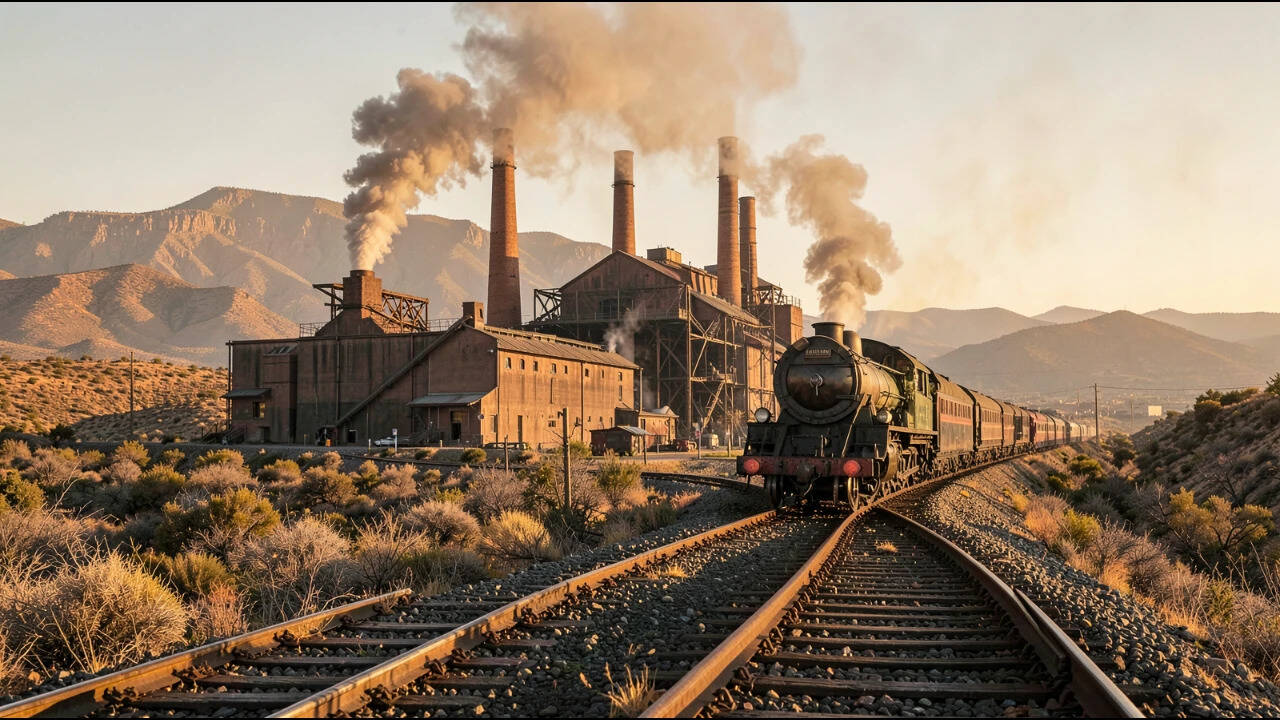
The smelter was an engineering marvel for the remote outback. It featured blast furnaces, converters, and a towering chimney stack that belched sulfur smoke across the spinifex plains, signaling prosperity to anyone within twenty miles. With rail access secured and local smelting capacity online, the town was officially renamed Kuridala in 1913 to avoid confusion with another Hampden in Queensland.
By 1914, Kuridala was booming. Then came the First World War, and copper suddenly became one of the most strategic metals on earth. Every shell casing, telegraph wire, and naval fitting required vast quantities of refined copper. The British Ministry of Munitions locked in contracts for Australian output at astronomical prices, pushing copper well above 100 pounds sterling per ton. Money flooded into Kuridala. The company expanded its smelting capacity, acquired surrounding leases like the Duchess, Trekelano, and Answer mines, and paid out handsome dividends to shareholders in Melbourne and London.
Beneath the surface, however, the geology was already turning against them. The richest deposits at Kuridala were secondary enriched zones near the water table—high-grade copper ores that were cheap to mine and easy to smelt. As the shafts sank deeper into the primary sulfide zones, the ore grades began to drop steadily. You had to haul twice as much rock to the surface to get the same amount of blister copper, all while paying wartime wages to a fiercely unionized workforce.
What Actually Happened When the 1918 Storm Hit
In January and March of 1918, ferocious cyclonic systems swept across North Queensland. While the coastal cities of Mackay and Innisfail bore the brunt of the historic storm surges and catastrophic loss of life, the remnants of these massive weather systems pushed deep inland, dumping torrential rain and unleashing violent gales across the Cloncurry district.
The impact on Kuridala was immediate and severe. Outback mining infrastructure was built for heat and drought, not sustained cyclonic winds and flash flooding. The gale-force gusts tore the corrugated iron sheeting off the main smelter buildings, damaged the flues and ancillary structures, and knocked out power and water supply lines. Heavy rains flooded open-cut workings and overwhelmed the underground pumping stations, bringing ore extraction to a grinding halt.
Competitor narratives and casual local histories often stop right here. They paint a scene where the storm wrecked the smelter, the company threw up its hands, and the town immediately withered away. That is a gross distortion of the timeline.
In reality, the company repaired the storm damage. The furnaces were relit. Smelting operations resumed later in 1918 because wartime demand for copper was still raging, and the profit margins—even on declining ore grades—remained high enough to justify the repair bills. A cyclone can tear off a roof and flood a shaft, but it cannot destroy an ore body. If the underlying economics of Kuridala had been sound, the 1918 cyclone would have been remembered as nothing more than an expensive operational hiccup, the kind of seasonal hazard that mines in northern Australia deal with every decade.
The Real Executioner Was the Armistice of November 1918
The true death blow to Kuridala did not arrive on the winds of a tropical storm. It arrived via telegraph wire on November 11, 1918.
When World War I ended, the global copper market fell off a cliff. Overnight, the British government canceled its wartime munitions contracts. Worse still, the Allied powers were sitting on massive stockpiles of scrap copper, unspent ammunition, and raw ingots that dumped onto the open market just as industrial demand contracted. Within months, the price of copper collapsed by nearly half, plummeting from over 110 pounds per ton down toward 60 pounds per ton.
For a low-cost producer located near a deep-water port, a 45 percent price drop is a painful recession. For an isolated inland smelter in northwest Queensland, it is a death sentence.
The Tyranny of Distance and Coal
Kuridala suffered from a fatal structural flaw that no amount of engineering could fix. While the mine had copper ore, it had no local supply of coking coal or coke to fuel its blast furnaces. Every single ton of coke required to keep the Kuridala smelter burning had to be hauled by rail over 750 kilometers inland from the coastal port of Townsville, originating from coalfields even further south.
Once the blister copper was produced at Kuridala, it then had to be loaded back onto trains and hauled 750 kilometers back to Townsville, loaded onto coastal steamers, and shipped to refineries in New South Wales or overseas. During the war, high copper prices masked this absurd logistical penalty. After November 1918, the math turned ruthless.
At the exact moment copper prices crashed, the cost of everything Kuridala needed to operate went up. Post-war inflation drove up the price of coal, timber for underground mine supports, explosives, and steel rails. The Queensland Government Railways, facing its own post-war deficits, hiked freight rates across the Great Northern line.
| Economic Factor | Wartime Peak (1916-1917) | Post-War Reality (1919-1920) | Operational Impact on Kuridala |
|---|---|---|---|
| Copper Price | 115-130 GBP per ton | 60-75 GBP per ton | Revenue per ton of blister copper cut nearly in half |
| Ore Grade | 8% to 12% copper (enriched zones) | 4% to 6% copper (deep sulfides) | Required double the mining and smelting volume for same output |
| Coke & Rail Freight | Subsidized/absorbed by high margins | Sharp tariff increases by state rail | Smelting costs exceeded the market value of the metal produced |
| Labor Relations | High wages tolerated to keep output flowing | Bitter strikes over wage cuts and conditions | Prolonged shutdowns drained remaining corporate cash reserves |
Labor Unrest and the Smelter Shutdown of 1920
By 1919, Hampden Cloncurry Copper Mines Limited was bleeding cash. Management tried to squeeze costs out of the operation, which immediately put them on a collision course with the Australian Workers' Union. The miners in Kuridala lived in brutal conditions—scorching summer temperatures exceeding 45 degrees Celsius, endemic typhoid and dust-related lung diseases, and isolation that made basic groceries wildly expensive. They had zero appetite for wage reductions.
Strikes erupted across the Cloncurry field. When the smelter wasn't shut down due to a lack of coal caused by maritime strikes on the coast, it was shut down by local industrial disputes at the pithead.
In late 1920, the company finally did the math that it had been trying to avoid since the cyclone two years prior. Running the Kuridala smelter was no longer merely unprofitable; every ton of copper poured from the converters was actively destroying shareholder equity. In December 1920, management blew out the blast furnaces for the last time. The smelter went cold.
Once the smelter shut down, the surrounding satellite mines in the district lost their only local processing facility. Shipping raw, unconcentrated ore all the way to the coast by rail was completely out of the question. Without the smelter, the entire regional network collapsed like a row of dominoes.
How a Town Vanishes Into the Spinifex
The dismantling of Kuridala was swift, unsentimental, and remarkably thorough. Unlike modern ghost towns where concrete foundations and steel headframes are abandoned to rust where they stand, early twentieth-century mining towns were treated as salvage yards.
Between 1921 and 1926, as it became clear that copper prices would not return to wartime highs and that the company had no intention of restarting the furnaces, the population packed up and left. Most moved west to a brand-new discovery made by John Campbell Miles in 1923—a place called Mount Isa, which would go on to become one of the richest lead-zinc-silver-copper mines in the world.
Salvage crews moved into Kuridala and stripped the site down to the dirt. The massive boilers, engines, converters, and structural steel from the smelter were unbolted, loaded onto flatcars, and railed away to other mining fields. Even the houses were dismantled. In outback Queensland, timber and corrugated iron were precious commodities; entire cottages, shops, and hotel bars were jacked up, put on railway trucks, and reassembled in Cloncurry, Mount Isa, or Townsville.
By the early 1930s, the railway line from Cloncurry to Kuridala was pulled up so the steel rails could be reused elsewhere. The official town status evaporated. Today, if you drive down the rough dirt tracks south of Cloncurry, you won't find dilapidated saloons or wooden boardwalks. You will find a few crumbling concrete engine beds, scattered slag heaps glistening black in the sun, a lonely cemetery, and the famous brick chimney stack standing solitary against the horizon—a monument not to a storm, but to the brutal laws of commodity economics.
Why Getting the History Right Matters for Modern Mining
Treating Kuridala’s demise as a freak weather accident is more than just sloppy journalism; it obscures one of the most important lessons in resource extraction.
Every mining boom creates temporary towns that look permanent. Investors, politicians, and workers convince themselves that high commodity prices are the new normal, building massive fixed infrastructure on the back of geopolitical spikes or temporary supply shortages. When the cycle turns—whether it is copper in 1918, nickel in the 2020s, or lithium during a battery glut—the operations that survive are never the ones with the best press releases. They are the ones at the bottom of the global cost curve.
Kuridala was a high-cost, logistically disadvantaged producer propped up by a world war. The 1918 cyclone damaged its roofs and flooded its shafts, forcing the company to spend capital it desperately needed for the lean years ahead. When peace broke out and copper prices cratered, there was no financial buffer left to absorb the shock.
If you want to know whether a modern mining town or industrial project will survive the next decade, ignore the weather forecast and look at the freight rates, the energy costs, and the grade of the ore still left in the ground.


