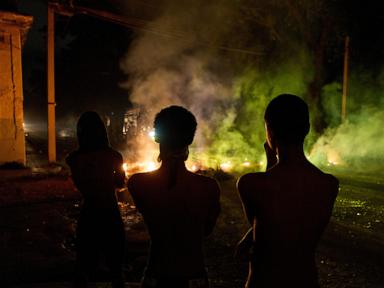
Cuba is currently experiencing a catastrophic failure of its national electrical system that has moved far beyond a routine blackout. This is not merely a technical glitch or a localized failure in the eastern provinces; it is the physical manifestation of a state-run energy monopoly reaching its terminal velocity. When the Antonio Guiteras power plant—the island’s largest and most critical energy node—went offline unexpectedly, it triggered a domino effect that the aging, brittle infrastructure could not absorb. The result is a nation of 11 million people plunged into darkness, facing a crisis that exposes the systemic decay of a grid held together by little more than hope and improvised repairs.
To understand why the lights went out and why they aren't coming back on easily, one must look past the official government rhetoric. The Cuban electrical grid is a relic. It relies on massive, Soviet-era thermal power plants that have long exceeded their operational lifespans. These facilities require specialized parts and constant maintenance that the Cuban state simply cannot afford. When one major gear in this machine fails, the load is shifted to other, equally fragile plants. They, in turn, overheat or suffer mechanical breakdowns under the sudden stress, leading to a total system collapse.
The Engineering of a Modern Disaster
The collapse began with an "imbalance" between supply and demand, a dry engineering term for a terrifying reality. In a healthy power grid, frequency is maintained at a steady rate to ensure stability. If demand suddenly spikes or a major generator trips, the frequency drops. If it drops too far, the entire system must shut down to prevent the physical destruction of the turbines.
Cuba’s problem is that it has no "spinning reserve." In most countries, backup plants sit idle but ready, capable of jumping into action within minutes. In Cuba, every functioning megawatt is already being pushed into the lines just to keep the fans spinning in Havana. There is no margin for error. When the Antonio Guiteras plant failed, there was no safety net. The frequency plummeted, and the protective relays did exactly what they were programmed to do: they disconnected the rest of the country to save the hardware.
The Fuel Paradox
Even if the plants were in pristine condition, they would still be starving. Cuba’s energy strategy is heavily dependent on imported fuel, primarily from Venezuela and Russia. However, Venezuela’s own economic struggles have led to a sharp decrease in the volume of subsidized oil sent to the island. Russia, preoccupied with its own geopolitical entanglements, has not filled the gap with the consistency required to run a national economy.
The state has attempted to patch this hole using "distributed generation"—essentially thousands of small diesel generators scattered across the country. While this sounds like a smart, decentralized approach, it is an economic nightmare. These small units are far less efficient than large thermal plants. They consume massive amounts of expensive diesel fuel, which must be transported by truck to remote locations, further straining a logistics network already crippled by a lack of tires, batteries, and fuel for the trucks themselves.
The Failure of the Floating Solution
In recent years, the Cuban government turned to Turkish company Karadeniz Holding to lease "powerships"—massive floating power plants anchored in Cuban harbors. These ships provide a significant chunk of the island's electricity, but they are a temporary bandage, not a cure.
- Cost: These ships require payment in hard currency, something the Cuban central bank is perpetually short on.
- Integration: Injecting power from a ship into a decaying onshore substation is inefficient. Much of the energy is lost as heat in the aging copper wires of the national transmission line.
- Dependency: Relying on foreign-owned assets for base-load power means the sovereign grid is no longer truly sovereign.
The reliance on these ships highlights a grim reality: the Cuban state has effectively given up on rebuilding its own domestic generation capacity. The capital investment required to modernize the 15% to 20% of the grid that is currently non-functional is estimated in the billions. In an economy shrinking under the weight of inflation and low productivity, that money does not exist.
A Systemic Lack of Maintenance
Investigative looks into the Ministry of Energy and Mines reveal a pattern of "emergency-only" maintenance. In a standard utility environment, a thermal plant undergoes a major overhaul every few years. In Cuba, these overhauls are postponed indefinitely. Engineers are forced to "cannibalize" parts from one defunct unit to keep another running for a few more weeks.
This creates a cycle of diminishing returns. Each time a plant is patched up rather than repaired, its reliability rating drops. The workers at these plants are often highly skilled and deeply dedicated, but they are fighting a war against physics with no ammunition. They are operating high-pressure steam systems and massive rotating turbines that were designed for a world that no longer exists.
The Impact on the Eastern Provinces
While Havana is often shielded from the worst of the blackouts to prevent social unrest, the eastern provinces like Santiago de Cuba and Holguín bear the brunt of the failure. The geography of the island makes power transmission difficult. The majority of the generation capacity is in the west and center, while the east sits at the end of long, poorly maintained transmission lines.
When the grid is stressed, the "load shedding" starts at the edges. For citizens in the east, electricity has become a luxury rather than a utility. They might receive four hours of power for every twelve hours of darkness. This isn't just an inconvenience; it is a public health crisis. Food rots in non-functional refrigerators. Water pumps, which require electricity to move water to rooftop tanks, sit idle. Hospitals are forced to rely on aging backup generators that often fail after a few hours of continuous use.
The Renewable Energy Myth
The Cuban government often points to solar and wind as the future of the island’s energy independence. While Cuba has an abundance of sun, the transition to renewables is stalled by the same lack of capital affecting the rest of the sector. Installing vast arrays of solar panels requires an upfront investment that pays off over decades. Cuba needs power today, not in ten years.
Furthermore, solar power is intermittent. Without massive battery storage systems—which are incredibly expensive and technically complex to maintain in a tropical environment—solar cannot replace the "base load" provided by thermal plants. You cannot run a heavy industrial factory or a municipal water system on a cloudy afternoon without a massive storage buffer that Cuba simply hasn't built.
The Economic Death Spiral
The blackouts are both a symptom and a cause of economic collapse. Without reliable power, businesses cannot operate. Without businesses, there is no tax revenue. Without revenue, the state cannot buy fuel or parts for the power plants.
We are witnessing a feedback loop that is difficult to break. The government’s recent move to increase fuel prices by over 400% was an attempt to stabilize the economy, but it has only served to drive inflation higher, making the purchase of international energy supplies even more difficult. The "informal market" now dictates the price of everything from bread to batteries, and the state's official exchange rate is largely ignored by everyone except the government itself.
The Social Breaking Point
History shows that prolonged utility failures are often the catalyst for social upheaval. When people cannot feed their children or sleep in the stifling heat because the fans won't turn, the ideological arguments of the state lose their potency. The 2021 protests were largely fueled by frustration over blackouts and food shortages. The current total collapse of the grid puts the government in its most precarious position in decades.
The authorities are aware of this. This is why they deploy "rapid response brigades" and increase police presence whenever the lights go out for more than a few hours. But you cannot police a dark city forever. The psychological toll of living in a state of perpetual darkness is profound, leading to a "brain drain" as the youngest and most capable Cubans flee the island in record numbers, further depleting the workforce needed to fix the very problems they are escaping.
No Easy Way Back
Restarting a national grid from a "black start" is one of the most complex tasks an electrical engineer can face. It requires small, independent generators to provide the initial "spark" to start larger turbines, which then provide the power to start even larger ones. This must be done with surgical precision. If too much load is added too quickly, the system trips again, and you have to start over from zero.
In Cuba, this process is hampered by the fact that the communication systems used to coordinate the restart are also powered by the grid. If the cell towers and radios go down because their batteries are dead, coordinating a synchronized restart across 700 miles of island territory becomes nearly impossible.
The current situation is not a temporary setback. It is the end of an era for the centralized, state-controlled energy model in Cuba. The infrastructure is failing because it was never designed to be maintained under a permanent economic siege, and it was never modernized when the opportunity existed.
The lights may flick on briefly in some neighborhoods over the coming days, but the structural integrity of the grid is gone. The system is operating on "survival mode," where the goal is no longer to provide 24-hour power, but simply to prevent the total physical destruction of the remaining assets. Cuba is learning the hard way that a nation’s stability is only as strong as its transformer substations and its fuel tankers.
The silence of a darkened city is the loudest warning a government can receive.