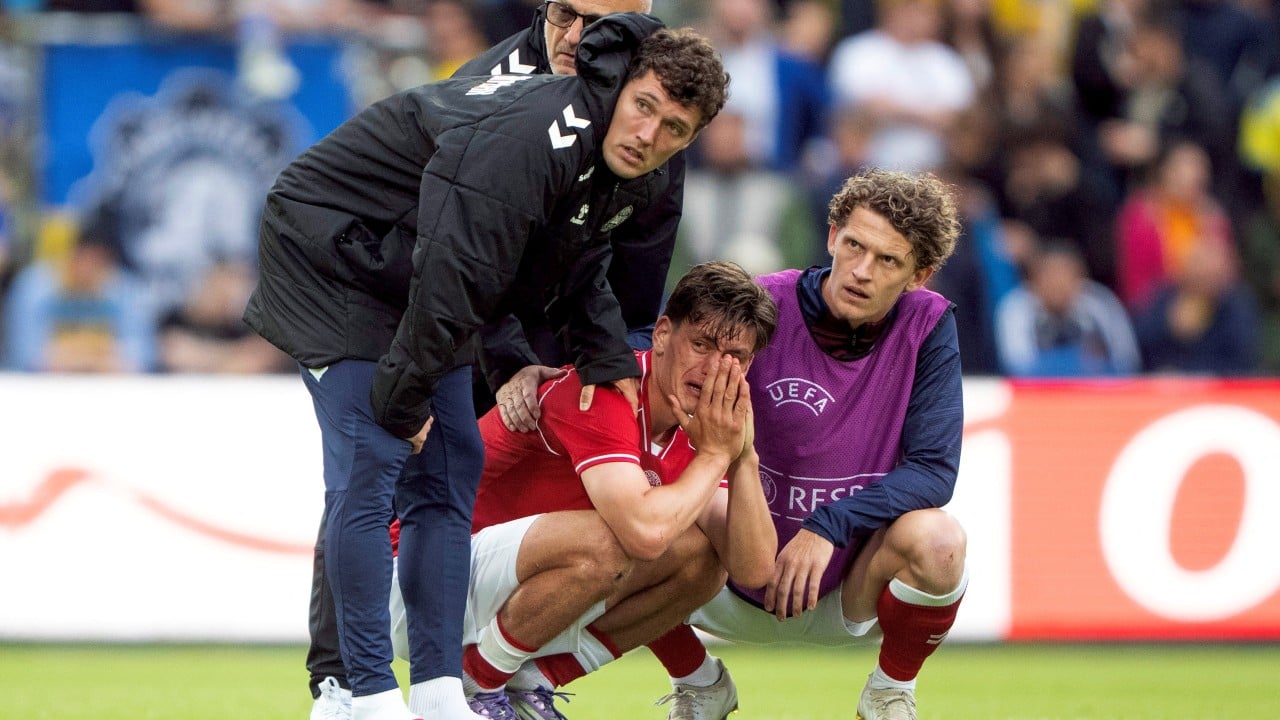
On June 12, 2021, Denmark midfielder Christian Eriksen suffered a sudden cardiac arrest on the pitch during a Euro 2020 match against Finland in Copenhagen. The world watched in horror as medical personnel performed chest compressions on a world-class athlete in his prime. Thanks to immediate defibrillation, Eriksen survived. While competing media outlets often mischaracterize the event as happening during a minor friendly, the reality is far more terrifying. This occurred at a major international tournament, exposing deep systemic vulnerabilities in elite sports medicine. The incident was not an isolated stroke of bad luck, but a stark warning about the physical toll of modern football scheduling and the fragile safety nets protecting these multi-million-dollar assets.
The survival of Christian Eriksen was a triumph of emergency execution, but it masked a uncomfortable reality. Football is pushing its players to the absolute brink of human endurance, and the governing bodies are looking the other way. Recently making news in this space: Why the Christian Eriksen Medical Scare Hits Differently This Time.
The Illusion of Perfect Athlete Health
We assume elite athletes are the healthiest people on the planet. They are not. They are finely tuned machines pushed to the edge of structural failure. The public often confuses peak physical conditioning with immunity from underlying cardiovascular anomalies.
Sudden cardiac death (SCD) is the leading cause of medical death in athletes. When an elite player collapses without contact, the culprit is almost always an underlying, undetected heart condition. These conditions typically fall into two categories. Genetic structural abnormalities, such as hypertrophic cardiomyopathy (HCM), cause the heart muscle to thicken abnormally. Alternatively, electrical issues like Long QT syndrome disrupt the heart's rhythm without showing any physical changes to the organ itself. Further insights regarding the matter are detailed by Yahoo Sports.
Definitively screening for these conditions is notoriously difficult. Elite footballers undergo rigorous medical evaluations, including electrocardiograms (ECGs) and echocardiograms. Yet, these diagnostic tools are not foolproof. An ECG is a snapshot in time. It captures the heart at rest, not necessarily when it is pumping at 180 beats per minute under intense psychological and physical stress. Some genetic anomalies remain dormant, completely invisible until a specific confluence of dehydration, electrolyte imbalance, and extreme exertion triggers a lethal arrhythmia.
To say Eriksen’s club or national medical teams missed something is an oversimplification that ignores medical reality. The current testing protocols catch many issues, but they cannot catch everything. The human heart remains a complex, unpredictable engine.
The Overloading of the Global Football Calendar
The elephant in the stadium is the relentless expansion of the football calendar. Players are playing too many games. The modern elite footballer is trapped in a grueling cycle of domestic leagues, continental club competitions, domestic cups, and international tournaments.
Consider the workload leading up to that fateful summer. The pandemic had compressed the 2020-2021 European football season into a frantic, hyper-congested schedule. Rest periods were slashed. Midweek games became the norm rather than the exception. Players were flying across continents with minimal time for physiological recovery.
Typical Elite Footballer Annual Workload:
- Domestic League: 38 matches
- Domestic Cups: 5-10 matches
- Continental Club (e.g., Champions League): 10-15 matches
- International Matches: 10-12 matches
- Total: 60+ high-intensity matches per year
When the body is chronically fatigued, the autonomic nervous system undergoes severe stress. Chronic fatigue alters heart rate variability and can exacerbate minor, underlying cardiac vulnerabilities that might otherwise never cause a problem. Governing bodies like FIFA and UEFA continue to introduce new tournament formats, expanding the Club World Cup and lengthening the Champions League. They are selling more television rights at the direct expense of player welfare.
The data from player unions like FIFPRO repeatedly warns that top-tier players are exceeding the safe thresholds for annual minutes played. Footballers are treated as infinite resources, but their bodies possess hard biological limits. Eriksen's collapse was a visceral manifestation of a system running too hot for too long.
The Pitchside Lottery of Emergency Response
Eriksen survived because he collapsed in a stadium equipped with top-tier medical infrastructure. The chain of survival functioned flawlessly. The referee stopped play within seconds. The team doctor initiated CPR immediately. The stadium medical crew arrived with an Automated External Defibrillator (AED) in less than two minutes.
This is not the reality for the vast majority of football matches played globally every weekend.
Away from the bright lights of the European Championships or the Premier League, player safety becomes a lottery. In lower professional leagues, semi-professional tiers, and grassroots youth football, the presence of an AED is far from guaranteed. Even when a device is present, there is often no one trained to use it under pressure.
Every minute that passes without defibrillation after a cardiac arrest reduces the chance of survival by roughly 10 percent. If Eriksen had collapsed on a training pitch in a lower division, or during a pre-season match at a remote facility lacking rapid-response infrastructure, the outcome likely would have been fatal.
The football industry celebrates Eriksen’s recovery as a miracle. Calling it a miracle abdicates responsibility. It was the direct result of immediate, high-quality medical intervention that is currently a luxury reserved only for the sport's elite.
The Internal Defibrillator and the Liability Battle
The medical solution that allowed Eriksen to return to professional football also exposed the fractured nature of sports governance and legal liability. Doctors implanted an Implantable Cardioverter-Defibrillator (ICD) in his chest. This device monitors his heart rhythm and delivers a shock if it detects a dangerous arrhythmia.
While the technology is miraculous, the rules governing its use are wildly inconsistent.
At the time of his collapse, Eriksen was playing for Inter Milan in Italy. Italian law maintains some of the strictest sports medicine regulations in the world. The country’s Cardio-Cadiological Protocol strictly prohibits athletes from competing in contact sports with an implanted ICD due to the risk of the device being damaged or dislodged by physical contact. Consequently, Inter Milan was forced to terminate his contract.
Yet, just months later, Eriksen signed with Brentford in the English Premier League, and later moved to Manchester United. The English Football Association does not have a blanket ban on ICDs. Instead, they leave the decision to an individual assessment by independent cardiologists and the player himself.
This regulatory disparity raises uncomfortable questions:
- Is Italy being overly cautious, or is England taking an unacceptable risk with player lives?
- Are commercial interests and a player's desire to compete overriding basic safety principles?
- Who bears the legal and moral responsibility if an athlete suffers another collapse on the pitch while cleared by one jurisdiction but banned by another?
There is no global consensus on this issue. The sport operates in a gray area where safety standards change depending on which border you cross.
Redefining the Duty of Care in Modern Sport
The discussion around cardiac incidents in sports must shift from reactive shock to proactive structural reform. Relying on emergency response after an athlete's heart stops is a flawed strategy.
Clubs must implement mandatory, continuous physiological monitoring. Wearable technology can track cardiac stress metrics, biomarker fluctuations, and recovery deficits in real-time during training. When a player shows signs of dangerous overtraining or autonomic dysfunction, they must be rested, regardless of the match's importance. This requires managers and executives to prioritize long-term health over short-term results.
Furthermore, the conversation must expand beyond the heart. The relentless schedule causes systemic breakdown, leading to severe joint injuries, muscular tears, and mental burnout. The football industry needs to establish mandatory, non-negotiable off-season rest windows. Squad sizes must be managed to distribute minutes more evenly across rosters, reducing the burden on star players.
The current trajectory is unsustainable. If the governing bodies continue to expand tournaments and demand more appearances from players without enforcing strict structural protections, more tragedies will occur on live television. The survival of one player should not be used to justify a system that endangers them all.