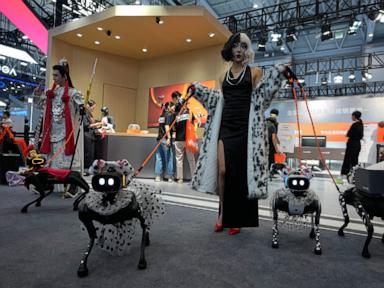
The floor of the 2026 World Robot Conference in Beijing is a high-gloss theater of the absurd. One booth features a humanoid unit playing ping-pong against a human, while another displays a mechanical arm struggling—and failing—to perform the basic task of folding a shirt. This is the current reality of the Chinese robotics sector. It is a industry caught between massive state-backed scale and the persistent, nagging inability to solve the most rudimentary physical challenges of the domestic sphere.
For years, the narrative has been that China is rapidly becoming the world’s robotics factory. The data supports this. Half of all industrial robots installed globally now reside within Chinese borders, largely servicing the automotive and electronics manufacturing titans. When you have a shrinking working-age population and the state is pouring billions in subsidies into the high-end manufacturing sector, you do not just get a slow transition to automation. You get a forced, frantic migration toward machines.
Yet, there is a disconnect between the showmanship in Beijing and the reality of commercial viability. Take the recent debut of companies like Unitree, which saw its stock valuation swing wildly upon its Shanghai entrance. These companies are betting their survival on a future where humanoids provide emotional companionship or specialized service. It is a risky wager. When a robot priced at over $24,000 can barely fold a piece of laundry, the path to consumer adoption remains blocked by a wall of incompetence.
The true goal here is not merely to build better machines. It is to survive a demographic winter. As the labor force ages and the costs of human workers climb, the Chinese state views robotics as the primary insurance policy against economic stagnation. If they can automate the assembly line fully, they can theoretically bypass the limitations of a declining population. This explains why roughly 40 percent of the net profits for some top-tier robotics firms are derived directly from government subsidies. They are being kept alive to fulfill a long-term strategic necessity rather than a market-driven one.
This push is increasingly isolated. The recent decision by the U.S. Federal Communications Commission to block imports of certain Chinese-made humanoid and quadruped robots—the so-called robot dogs—reveals the escalating tension surrounding this technology. Security concerns about data and potential surveillance are not just talking points; they are operational barriers that limit where these companies can sell their wares. If you cannot export your product to the largest markets, your growth is limited to the domestic bubble.
We must look at the human element that these machines claim to replace. For a decade, the industrial narrative has focused on efficiency, but the new frontier is "emotional care." Companies are marketing humanoids with synthetic faces and conversational AI, positioning them as companions. It is a pivot born of desperation. If they cannot make the robots work in the factory, they will try to sell them as friends in the living room. It is a harder sell, and arguably one that ignores the complexities of human interaction that code cannot replicate.
Consider the hypothetical scenario of a small-scale electronics plant in Shenzhen. Management decides to replace fifty assembly-line workers with a suite of new, locally sourced humanoid robots. On paper, the return on investment looks excellent. In practice, the downtime required for maintenance, the constant need for software patches to handle slight variations in component placement, and the high electricity draw turn that asset into a liability. The machines work until they encounter an edge case, at which point the entire production line grinds to a halt. This is the bottleneck that no amount of government funding can fix.
The geopolitical dimension adds another layer of friction. By cutting off access to certain global markets, the U.S. and its allies are forcing China to double down on its own internal ecosystem. This creates a feedback loop. Companies stop chasing global standards and instead optimize for the specific requirements of the state, focusing on what the government wants to see rather than what the market demands.
The most successful robots today are not the ones dancing on stage or playing ping-pong. They are the dull, repetitive machines bolting chassis together in the quiet hum of a factory. The moment these companies move away from that industrial utility and toward the "human" facade, they stumble. They are sacrificing reliable utility for the sake of a glossy, futuristic image that keeps investors and government officials happy.
The industry is currently in a state of artificial buoyancy. The sheer volume of products on display at events like the World Robot Conference masks the fact that the tech is still in its infancy. We are watching a giant build a foundation of shifting sand. While they are obsessed with making robots look and move like us, they have yet to prove that these machines can perform the essential labor required to justify their existence.
There is no shortcut to mastery in this field. You cannot subsidize your way into intelligence, and you cannot manufacture a breakthrough. As the hype cycles continue to churn, the true test will be how these companies hold up when the subsidies eventually thin and the realities of market performance take center stage. For now, the theater continues, and the robots remain trapped in a loop of performative gestures. Eventually, the music stops. One wonders what the companies will do when they are forced to produce something that actually works.