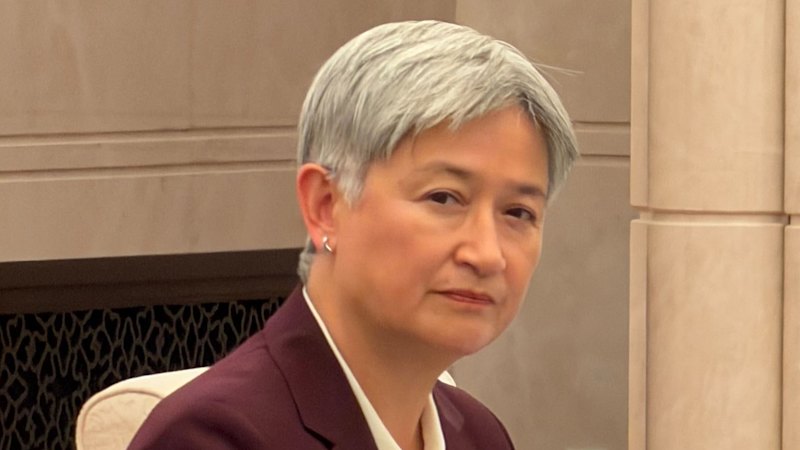
The recent confrontation in Canberra was not an accident of bad manners or a misunderstanding of protocol. When Chinese officials attempted to physically block and remove Australian journalists during a press event with Foreign Minister Penny Wong, they were executing a practiced doctrine of information control. This wasn't just a skirmish over a camera angle. It was a calculated display of extraterritorial censorship occurring on Australian soil. The intent was clear: to dictate the visual and narrative terms of a diplomatic engagement, even if it meant violating the sovereignty of the host nation's press freedoms.
For those who have tracked the evolution of the Chinese Communist Party’s "Great Outreach," the incident is a data point in a much larger, more aggressive pattern. Beijing no longer settles for managing the message at home. They now actively seek to export their domestic media restrictions to international stages. By physically obstructing reporters, they tested the boundaries of what a Western democracy will tolerate in the name of "stabilizing" a bilateral relationship.
Sovereignty Under the Lens
The mechanics of the disruption were blunt. As Penny Wong stood at the lectern, Chinese personnel positioned themselves to obscure the view of cameras and tried to usher specific journalists out of the room. This is a tactic often used within the borders of the People’s Republic to silence dissent, but seeing it deployed in the Australian Parliament House was a jarring reminder of the friction inherent in the current "thaw" between Canberra and Beijing.
Australia has spent the last year attempting to put a floor under its relationship with China. Trade sanctions are lifting, and the rhetoric has cooled. However, this incident exposes the fragile nature of that stability. China views diplomatic access as a privilege they control, while Australia views the presence of a free press as a non-negotiable component of its political architecture. When these two worldviews collide in a narrow hallway or a briefing room, the result is the physical theater we saw play out.
The Geography of Censorship
We have to look at the "why" behind the specific targets. The journalists being hassled weren't chosen at random. They represented outlets that have been consistently critical of Beijing’s human rights record and its regional maritime ambitions. By attempting to remove them, the visiting delegation was signaling that they believe they have the right to curate their audience, regardless of where they are on the map.
This isn't just about a single speech by Penny Wong. It’s about the precedent. If a foreign power can successfully dictate which local journalists are allowed to cover an event in Canberra, the concept of a "free press" becomes a hollowed-out shell. It becomes a managed press, operating under the silent veto of a foreign entity.
The Strategy of Physical Obstruction
The CCP’s approach to media management has shifted from passive-aggressive complaints to active physical interference. In the past, a disgruntled diplomat might issue a sternly worded letter or threaten to pull advertising from a state-aligned business. Today, the strategy is more visceral.
- Human Walls: Using bodies to block camera lenses or line-of-sight between a speaker and a reporter.
- Acoustic Interference: Speaking over reporters or creating noise to ruin audio recordings of sensitive questions.
- Credential Harassment: Demanding to see identification repeatedly to delay entry or cause a journalist to miss a key moment.
These aren't rogue actions by overzealous staffers. They are part of a coordinated effort to ensure that the only imagery that makes it back to the mainland—and to the global diaspora—is sanitized and compliant. The goal is to project an image of total harmony and respect, airbrushing out any hint of domestic or international tension.
Why Australia is the Testing Ground
Australia serves as a unique laboratory for this behavior. As a middle power with deep economic ties to China but a bedrock military alliance with the United States, Australia is constantly walking a tightrope. Beijing knows that Canberra is desperate to keep the trade doors open. This economic leverage provides a shield; the calculation is that the Australian government will prioritize the "big picture" of billions in iron ore and wine exports over the "small picture" of a few shoved journalists.
However, this calculation ignores the domestic political cost. Every time a Chinese official oversteps in Canberra, it fuels the narrative that Australia is compromising its values for cash. This creates a domestic backlash that actually makes it harder for Penny Wong to pursue the very stabilization she is seeking.
The Silence of Protocol
One of the most concerning aspects of these incidents is the delayed or muted response from host protocols. In many cases, the instinct of diplomatic staff is to smooth things over and avoid a "scene." This is exactly what the aggressor counts on.
When the Australian security and protocol teams do not immediately and forcefully reassert the rules of the house, it creates a vacuum. In that vacuum, the visiting delegation's rules become the default. Real power in these moments is held by whoever is willing to be the most disruptive. If the host is the only one playing by the rules of polite diplomacy, they have already lost the encounter.
A History of Pressure
This is far from the first time we’ve seen this play out. From the G20 summits to bilateral trade forums in Southeast Asia, the script is remarkably consistent. The visiting Chinese press corps is given total access, while local or international media deemed "unfriendly" are fenced off, shouted down, or physically barred.
We saw a version of this during the visit of Li Qiang, where the logistics of the media pool were micromanaged to an extraordinary degree. The pressure is constant and incremental. Each small concession—moving a camera back five feet, allowing an official to stand in front of a specific reporter—builds toward a reality where the press is no longer a watchdog, but a prop in a state-managed play.
Reasserting the Red Lines
If Australia and other Western democracies want to prevent this from becoming the new normal, the response cannot be confined to private "expressions of concern." There must be a public re-assertion of the rules of engagement.
Diplomacy requires compromise, but the physical safety and professional liberty of the press are not tradeable commodities. When an official from a foreign embassy puts their hands on a local journalist, that is a matter for law enforcement and formal diplomatic protest, not a quiet chat over coffee.
The core of the issue is that Beijing views the media as an arm of the state. They struggle to comprehend—or refuse to acknowledge—that in a country like Australia, the media is an independent entity. This fundamental disconnect means that these clashes will continue as long as Chinese officials feel empowered to act as though they are still within the "Great Firewall" while standing on foreign soil.
The Cost of Looking Away
The risk of ignoring these "minor" scuffles is a slow erosion of the public square. It starts with a blocked camera in a hallway. It moves to the exclusion of certain outlets from press conferences. It ends with a media environment where only the most "cooperative" voices are given the floor.
For the Australian government, the challenge is to prove that "stabilization" does not mean "submission." Penny Wong has frequently spoken about the need for a region that is "predictable" and where "sovereignty is respected." That sovereignty begins at the door of the press gallery.
The journalists in that room weren't just doing a job; they were exercising a constitutional function. By failing to protect them in real-time, the state sends a signal that its own citizens' rights are secondary to the comfort of a visiting dignitary. That is a dangerous message to send in a region where the battle for democratic norms is being fought every day.
Stop treating these incidents as isolated blunders and start seeing them as what they are: a deliberate test of national character. Beijing is waiting to see where the line is drawn. If Australia doesn't draw it clearly, the Chinese officials will keep moving it forward.
The next time a foreign official tries to block a lens or push a reporter in the halls of Parliament, the response should be immediate and public: the event stops until the interference ends.