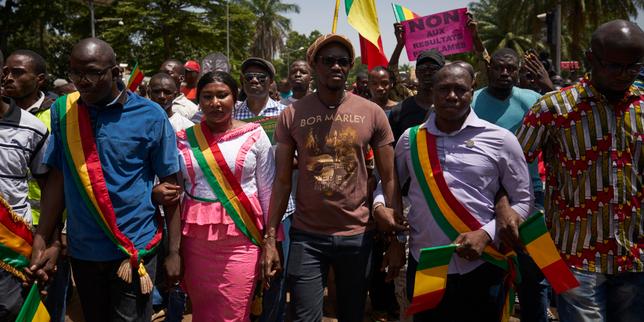
In the sweltering heat of a Bamako courtroom, the judicial machinery of Mali’s military government recently delivered a message that echoed far beyond the walls of the courthouse. Mohamed Youssouf Bathily, the influential radio and television personality known as Ras Bath, and Rokia Doumbia, the popular activist dubbed Rose Vie Chère, were each handed ten-year prison sentences, with three years suspended. They stand as the latest casualties in a systematic campaign to eliminate public dissent. The state labeled them a threat to the transition, a move that clarifies the current administration's strategy for maintaining power.
When a government identifies a radio host and a social media influencer as national security risks, it is not merely responding to specific allegations of criminality. It is drawing a perimeter around the acceptable boundaries of thought and speech. The prosecution’s argument, which hinged on the charge of association of malfaiteurs, or criminal conspiracy, attempted to frame their shared advocacy—specifically a 2023 broadcast discussing economic hardship—as an existential challenge to the state. This logic suggests that in the current Malian environment, to critique the price of basic commodities is to undermine the sovereign integrity of the government. You might also find this connected story useful: Why The Supreme Court Rejection Of Trump Is Actually A Masterclass In Long Term Litigation Strategy.
The courtroom appearance of Ras Bath served as a visual testament to the toll of this suppression. Observers noted his gaunt frame and exhausted features, a marked change for a figure who built his career on a combative and unyielding rhetorical style. He rose to prominence on the mantra of shocking the public into awareness, using platforms like his show Cartes sur table to dismantle the narratives of the political elite. By contrast, Rokia Doumbia operated within the digital sphere, channeling the frustrations of ordinary citizens struggling with inflation. Their collaboration was, for the authorities, a union of two distinct but equally dangerous channels of influence.
The state’s reliance on digital evidence, including WhatsApp exchanges, to establish this conspiracy reflects a shifting reality in regional governance. Authorities are increasingly focusing on the intersection of physical activism and online dissemination. By prosecuting individuals for what they say on social media or in broadcast studios, the government effectively deputizes the justice system to police the digital commons. This is not about the traditional definition of treason; it is about controlling the narrative in a country where the state is under intense pressure from external sanctions and internal instability. As highlighted in detailed coverage by Al Jazeera, the implications are widespread.
One must look closer at the prosecution’s candid admission during the trial that Ras Bath needed to be kept away from radio and social media. This statement exposes the true objective of the judicial process. It is a prophylactic measure. By removing influential voices from the public square, the government intends to insulate its transition strategy from the scrutiny that fueled previous popular movements. The history of Mali’s recent years is defined by the M5-RFP protest movement, which successfully pushed for the resignation of Ibrahim Boubacar Keïta. The current leadership, led by General Assimi Goïta, is intimately familiar with the power of such mobilization. Consequently, their response to dissent is not negotiation, but neutralization.
The legal framework used to secure these convictions reveals a rigid interpretation of state authority. Charges like atteinte au crédit de l’État, or harm to the credit of the state, provide a broad mandate for silence. They allow prosecutors to categorize any investigation into government performance as a malicious attack on the nation’s foundations. If a citizen claims that a policy has failed or that corruption is eroding social stability, they risk being framed as an enemy of the public order. This doctrine creates a chilling effect that extends to anyone considering a public statement on the nation’s trajectory.
Experts who have tracked the development of political crises in the Sahel for decades recognize this pattern. It is the consolidation of authority at the cost of democratic friction. A country in the midst of a transition often requires the pressure valve of open debate to address the inevitable failures of its governing institutions. When the valve is welded shut, the pressure does not dissipate; it accumulates. While the current leadership may believe that total information control ensures stability, the historical record suggests that the absence of a legitimate public forum eventually alienates even those who were initially indifferent.
The situation remains deeply volatile. With the promise of a return to civilian rule having already passed its expected deadline, the focus of the administration has shifted entirely toward survival. The judiciary has effectively become an instrument of political continuity. For the citizens who once looked to voices like Ras Bath for perspective, the environment is increasingly defined by the necessity of caution. The courtroom in Bamako did not just sentence two activists to prison; it solidified the standard for how the state will interact with its most vocal critics for the foreseeable future.
There is no sign that this restrictive approach will soften in the coming months. As the administration navigates the complex demands of security and regional isolation, its intolerance for dissent will likely harden. The reality for activists in Mali is now stark, and the cost of engagement has reached a point where only those prepared for total institutional confrontation choose to speak. The state has spoken, and in the silence that follows, the real, and potentially devastating, long-term consequences for the nation’s social contract begin to manifest.