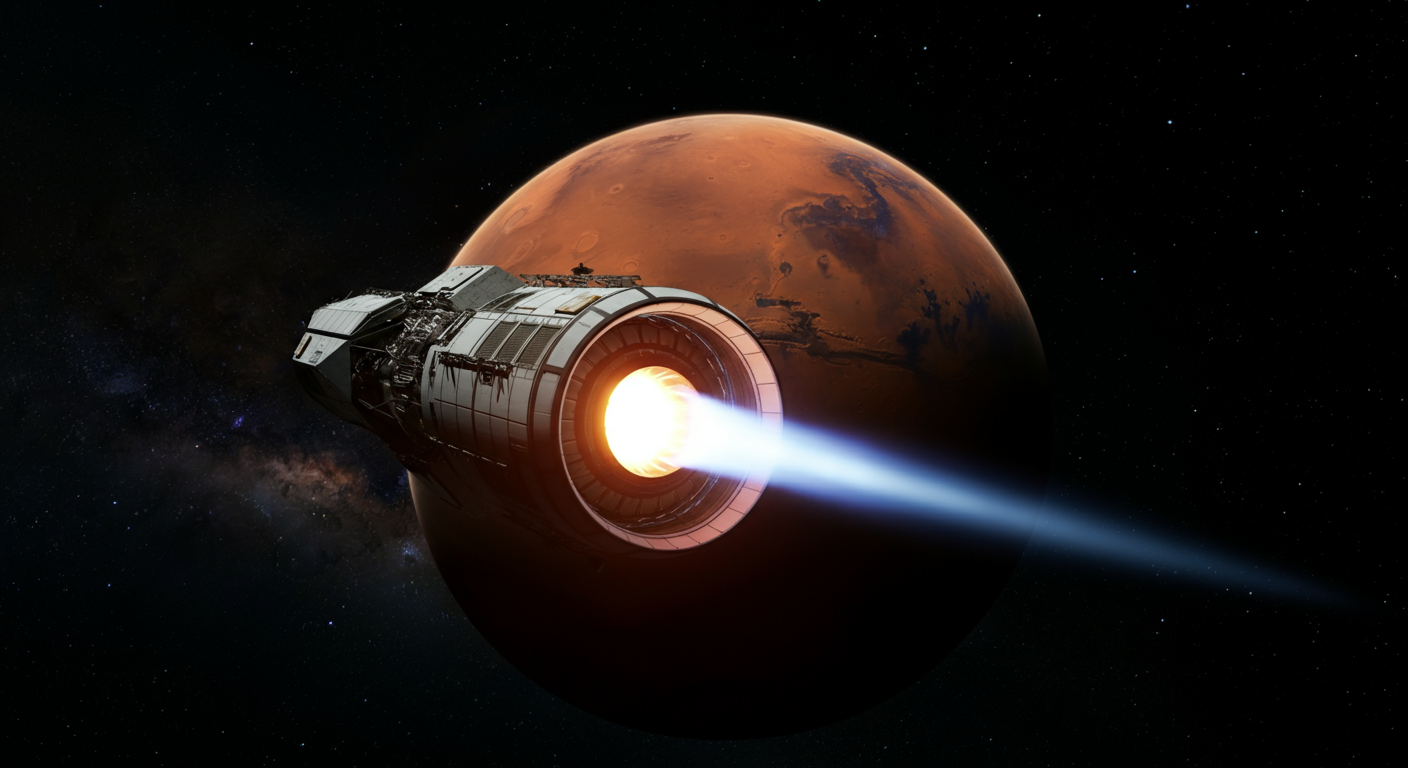
NASA just ran an experimental engine at a record-breaking 120 kilowatts inside a sealed vacuum chamber at the Jet Propulsion Laboratory. The headline circulating through the press is predictable: a new thruster powerful enough to carry human beings to Mars has finally arrived.
It is a comforting narrative, but it ignores the brutal engineering realities of deep space transit. Meanwhile, you can explore similar developments here: Why Drone Show Failures are the Best Thing to Happen to Modern Entertainment.
The device in question is a lithium-fed magnetoplasmadynamic (MPD) thruster. While the recent test at the Jet Propulsion Laboratory successfully demonstrated that the hardware can survive a 120-kilowatt electrical barrage while generating a vivid red stream of plasma, this milestone is merely the first step on an incredibly steep mountain. The hard truth is that a crewed vehicle heading for the Red Planet cannot survive on 120 kilowatts. To move a massive transport ship carrying human life support systems, shielding, food, and water across millions of miles, NASA needs a propulsion system that operates between two and four megawatts.
We are not dealing with a simple scaling issue. We are facing a foundational physics bottleneck. To bridge the gap between this successful laboratory test and an operational interplanetary voyage, engineers must figure out how to make these engines run twenty-five times hotter, package a nuclear reactor into a civilian spacecraft, and prevent the engine from melting its own components during a two-year continuous burn. To see the full picture, check out the excellent report by Ars Technica.
The Chemistry Problem
Every rocket engine ever ridden by an astronaut has relied on chemical propulsion. You mix a fuel with an oxidizer, ignite it, and let the violent chemical reaction push mass out of a nozzle. It provides immense, instantaneous thrust. It is how we break free from Earth's gravity.
But chemical fuel is incredibly heavy, and its efficiency is hard-capped by the laws of molecular chemistry. A chemical voyage to Mars requires carrying so much propellant just to move the propellant itself that the initial launch mass becomes absurdly impractical.
Electric propulsion flips this math. Instead of burning fuel, these systems use electromagnetic fields to accelerate individual atoms out of a nozzle at extreme velocities. By throwing a smaller amount of mass much faster, electric thrusters use roughly 90 percent less propellant than traditional chemical rockets.
The current state of the art is visible on NASA's Psyche spacecraft, which is currently cruising toward the outer asteroid belt using solar-powered Hall-effect thrusters. These thrusters use xenon gas. Xenon is stable, heavy, and easy to ionize, but it is also rare and extraordinarily expensive. More importantly, conventional Hall thrusters hit an operational ceiling when you try to pump hundreds of kilowatts through them. The magnetic fields required to confine the plasma become too unwieldy, and the physical walls of the thruster degrade under the constant bombardment of stray ions.
Enter the lithium-fed MPD thruster.
Instead of relying on a gas like xenon, this engine utilizes lithium metal vaporized into a plasma. Because lithium has a low ionization potential and a lightweight atomic structure compared to xenon, it can be accelerated to much higher exhaust velocities when subjected to massive electrical currents. The engine generates its own internal magnetic field as the current passes from a central tungsten electrode to an outer ring.
During the February test at JPL, this central electrode reached a white-hot temperature exceeding 5,000 degrees Fahrenheit. The physics work. The engine creates an internal electromagnetic field that shoots lithium plasma out the back without needing the complex, heavy external magnetic coils of a massive Hall thruster.
The Two Megawatt Wall
The 120-kilowatt milestone is an achievement for the team at JPL, Princeton University, and Glenn Research Center. It is the highest power level ever recorded for an electric propulsion system in the United States.
Yet, the celebration must be tempered by the cold math of orbital mechanics.
A robotic probe like Psyche weighs a few thousand pounds and can afford to take years to slowly spiral out to its destination using a four-kilowatt thruster. A human crew cannot wait. Every single day spent crossing the void between Earth and Mars exposes astronauts to high doses of galactic cosmic radiation and solar particle events. Prolonged microgravity steadily degrades human bone density and muscle mass, while deep-space isolation presents severe psychological challenges.
To minimize these hazards, the transit time must be compressed. To shorten the journey, the spacecraft must be fast. To make a heavy, human-rated spacecraft fast, you need raw power.
NASA's current baseline architecture for a crewed Mars mission requires a propulsion system capable of handling two to four megawatts of power. The test engine ran at 120 kilowatts. To match the minimum requirements for a Mars voyage, NASA needs to scale this technology by a factor of twenty-five.
This is not a matter of simply building a bigger engine or plugging it into a larger outlet. When you scale an MPD thruster into the megawatt range, the thermal and electromagnetic forces inside the engine do not increase linearly; they spike exponentially.
The primary enemy of the MPD thruster is electrode erosion. The central tungsten electrode must act as a lightning rod for thousands of amperes of current. At 120 kilowatts, the electrode already glows at 5,000 degrees Fahrenheit. At two megawatts, the thermal stress is catastrophic. The plasma itself begins to eat away at the tungsten core.
If the electrode erodes completely after a few hundred hours of use, the engine fails, leaving the crew stranded in deep space. For a Mars mission, these engines must fire reliably for over 23,000 hours across the span of a 2.6-year round-trip mission. Currently, no laboratory on Earth has demonstrated an MPD electrode capable of surviving that kind of prolonged abuse.
The Missing Nuclear Reactor
There is a second, even larger elephant in the room that the optimistic headlines omit: where does the electricity come from?
The thruster tested at JPL was plugged directly into the California power grid. In deep space, you cannot plug into a wall.
For low-power missions near Earth or Mars, solar panels are sufficient. The International Space Station sports massive solar wings that generate roughly 120 kilowatts of power—coincidentally, the exact amount of power needed to run just one of these new prototype thrusters at its initial test level.
To run a four-megawatt array of these thrusters, a solar-powered spacecraft would require solar panels spanning the size of several football fields. As a spacecraft moves away from the Sun toward Mars, solar intensity drops significantly, rendering solar arrays useless for high-power propulsion at those distances.
The only mathematically viable power source for a megawatt-class electric rocket is a space-rated nuclear fission reactor.
To make this Mars engine relevant, NASA must simultaneously develop a flight-ready nuclear reactor capable of converting thermal energy from nuclear fission into megawatts of electrical power, all while remaining light enough to be launched into orbit.
While programs like the Space Nuclear Propulsion project are receiving funding, the development of space-qualified reactors is decades behind schedule, bogged down by strict regulatory hurdles, launch safety concerns, and political hesitation. You cannot test a multi-megawatt lithium thruster in space without a reactor, and you cannot launch the reactor without solving the immense engineering challenge of radiating massive amounts of waste heat into the vacuum of space.
The Path to Operational Reality
If NASA genuinely intends to use lithium-fed MPD thrusters for human Mars missions, the roadmap cannot rely on triumphant press releases celebrating short-duration laboratory tests. The agency must commit to a brutal, iterative verification process that addresses the fundamental physics limits of materials science.
First, engineers must solve the material degradation issue. This means moving away from solid tungsten electrodes toward advanced concepts like hollow cathodes or self-healing liquid-lithium electrodes, where a steady feed of liquid metal protects the underlying structure from plasma erosion.
Second, the testing infrastructure must expand. The current tests were conducted in JPL's Condensable Metal Propellant vacuum facility, an eight-meter-long chamber designed to catch vaporized lithium before it coats the chamber walls and destroys the vacuum pumps. Testing a true one-megawatt engine continuously for thousands of hours will require an industrial-scale vacuum facility that does not currently exist anywhere in the world.
The 120-kilowatt test is an important laboratory validation of an old concept. It proves that lithium plasma can be controlled at higher currents than previously achieved in domestic research. But framing this as a solved problem for human Mars exploration is a disservice to the immense engineering hurdles that remain. NASA has found a promising path forward, but the engine that will actually carry humans to Mars remains unbuilt, unpowered, and unready for the harsh realities of the deep-space void.