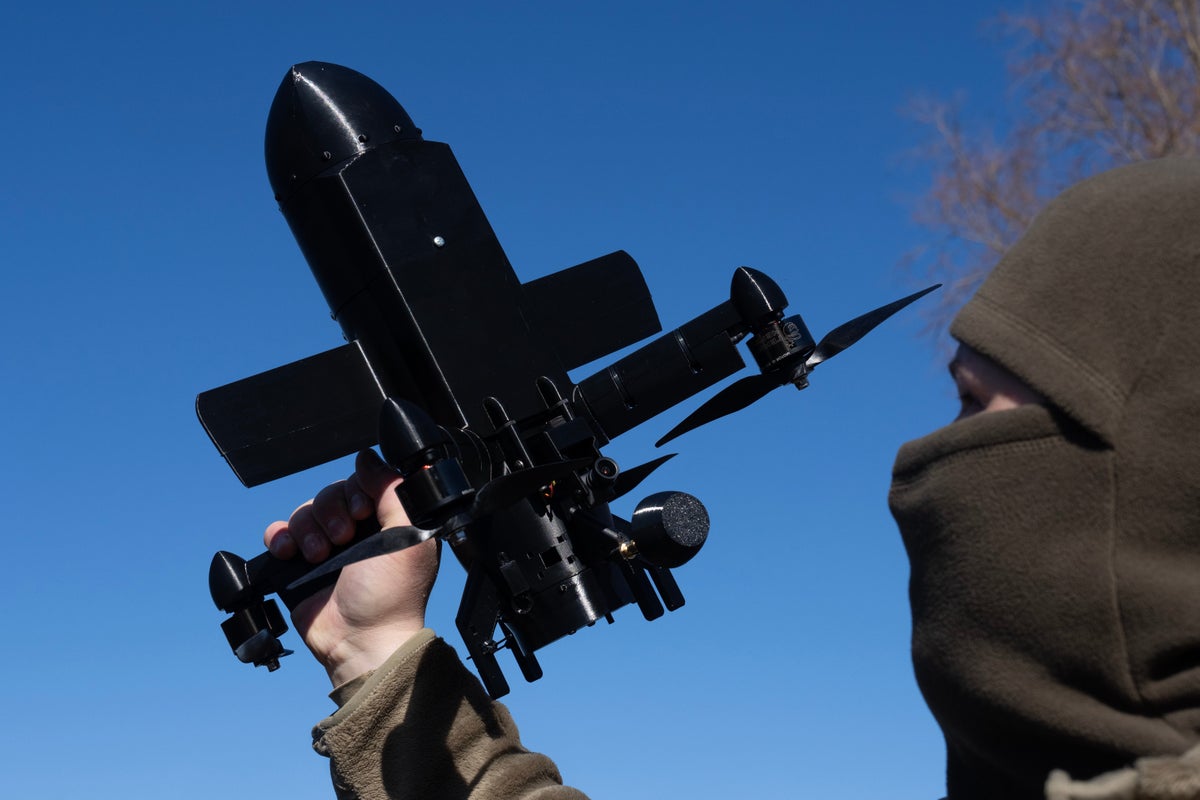
Ukraine recently reported a staggering milestone in the evolution of modern conflict, claiming the destruction of 33,000 Russian drones in a single month. This figure represents an industrial scale of attrition never before seen in the history of aerial warfare. It is not just a statistic. It is a loud signal that the era of traditional air defense is being crushed by the sheer weight of cheap, expendable machines. The sky over the Donbas has become a graveyard for silicon and plastic, but the victory comes with a price tag that few are willing to calculate openly.
The sheer volume of these intercepts suggests that Russia has transitioned its economy into a high-output factory for loitering munitions and tactical reconnaissance units. When we talk about 33,000 drones, we are talking about more than 1,000 intercepts per day. To understand how Ukraine is managing this feat, we have to look past the flashy headlines and into the gritty reality of electronic warfare and localized mobile defense teams. If you found value in this post, you should look at: this related article.
The Industrialization of the Sky
War used to be defined by the scarcity of high-value targets. You had a dozen bombers, a handful of tanks, or a single bridge. Today, the target is everywhere and nowhere. Russia’s reliance on Iranian-designed Shahed platforms and an endless stream of FPV (First Person View) drones has forced Ukraine to rethink the very nature of an "intercept." You cannot fire a million-dollar Patriot missile at a five-hundred-dollar plastic quadcopter. That is a fast track to bankruptcy.
Ukraine has responded by building a decentralized web of sensors and shooters. Much of this record-breaking tally comes from "Low-Tech" solutions. We are seeing heavy machine guns mounted on pickup trucks, guided by acoustic sensors and thermal optics. These teams are the unsung mechanics of the drone war. They sit in the dark, listening for the lawnmower buzz of an incoming engine, then fill the air with lead. It is primitive. It is effective. It is the only way to survive the math of a thousand daily attacks. For another look on this story, see the latest update from The Washington Post.
The 33,000 figure also highlights a massive surge in Electronic Warfare (EW). Not every drone is shot down by a bullet. Thousands are "fried" or sent off course by localized jamming. Ukraine has turned its frontline into a microwave oven of radio frequencies. By flooding the 2.4GHz and 5.8GHz bands—the common frequencies for drone control—Ukrainian EW units create invisible walls. A drone hits this wall, loses its link to the pilot, and falls harmlessly into a field. This is the invisible side of the 33,000-drone count, and it is where the real technological arms race is happening.
The Deception Behind the Numbers
A veteran analyst knows that numbers provided by a Ministry of Defense are both a report and a weapon. We must ask what constitutes a "shot down" drone in these reports. In the chaos of the front, distinguishing between a drone that was jammed, one that crashed due to battery failure, and one that was physically blown apart is nearly impossible.
There is also the matter of decoy warfare. Russia has begun deploying "Geran-3" variants and other plywood mockups that carry no explosives but mimic the radar signature of a lethal drone. If Ukraine shoots down 10,000 pieces of wood, the "record" looks impressive on paper, but the strategic value is shifted. The Russian goal in this scenario isn't to hit a target; it's to force Ukraine to reveal its positions and deplete its ammunition.
Every bullet fired at a decoy is a bullet not available for a real threat. We are witnessing a battle of manufacturing capacity. Russia is betting it can build drones faster than Ukraine can build or buy the means to stop them. When Ukraine reports 33,000 kills, they are effectively telling the world they are keeping pace with an unprecedented industrial onslaught, but they are also signaling a desperate need for more low-cost interceptors.
The Cost of Success
The financial burden of this defense is staggering. Even if Ukraine uses "cheap" methods, the logistical tail of maintaining thousands of mobile groups across a 1,000-kilometer front is a nightmare. Fuel, spare parts, thermal optics, and constant training for operators add up to a bill that the West is currently footed.
Consider the attrition of human capital. It takes months to train a proficient EW specialist or a high-end FPV pilot. It takes seconds for a drone to find them. The "33,000" number masks the reality that for every drone downed, several others likely got through or forced a defensive unit to relocate under fire. This is a war of exhaustion where the machines are the primary combatants, but the humans are the ones who break first.
Software is the New Armor
The pivot from hardware to software is the most significant takeaway from this surge in drone activity. We are moving away from pilots and toward Automated Target Recognition (ATR). Both sides are now testing drones that can fly through jamming by using onboard AI to "see" the target and complete the terminal phase of the flight without a radio link.
Once these drones become the norm, the current Ukrainian defense strategy—which relies heavily on jamming and manual machine-gun fire—will face a crisis. If the drone doesn't need a radio signal, your jammer is just a paperweight. If the drone can swarm in groups of fifty, your machine gunner is overwhelmed.
Ukraine's "record" is a snapshot of a moment in time. It shows a defense that has reached its peak efficiency against the current generation of threats. But in the drone war, a "generation" lasts about three months. The software updates on the Russian side are already working to bypass the very methods Ukraine used to hit that 33,000 mark.
The NATO Obsolescence Problem
This volume of fire should be a wake-up call for Western military planners. Most NATO doctrines are built around air superiority provided by expensive, manned aircraft. In a world where 33,000 drones are launched in a month, a dozen F-35s are statistically insignificant. They cannot be everywhere at once, and they cannot afford to engage a swarm.
Ukraine is currently the world’s largest laboratory for the future of conflict. The lessons learned from this "record month" suggest that future wars will be won by the side with the most resilient supply chain and the fastest software iteration cycles. It is no longer about who has the best tank; it is about who can produce a million flight controllers and 500,000 brushless motors without relying on a hostile neighbor for parts.
Why the Number Matters Now
The timing of this announcement is not accidental. Ukraine is currently navigating a complex period of international support. By highlighting the sheer scale of the Russian drone threat—and their success in meeting it—Kyiv is making a case for continued and specialized aid. They aren't just asking for money; they are asking for the industrial capacity to maintain this level of defense.
If the intercept rate drops even by 10%, the damage to Ukrainian infrastructure would be catastrophic. The 33,000 drones represent 33,000 potential hits on power grids, hospitals, and command centers. The success of the Ukrainian air defense is the only thing keeping the country’s civilian life semi-functional.
But we have to look at the burn rate. How many barrels were worn out? How many EW sensors were burnt out by constant use? This is a high-intensity, high-wear environment. The record reflects a system pushed to its absolute limit.
The Architecture of a Drone Kill
To visualize how these 33,000 kills happen, you have to imagine a layered net.
- The Outer Ring: Long-range radar and acoustic sensors detect the launch.
- The Middle Ring: High-power EW "domes" that disrupt GPS and control frequencies.
- The Inner Ring: Mobile fire groups using "Zushka" (ZU-23-2) cannons and heavy machine guns.
- The Last Resort: Handheld "drone guns" used by individual soldiers in the trenches.
Each layer has a failure rate. When Russia sends a mass wave, they are looking for a hole in that net. The fact that Ukraine is catching so many suggests their net is denser than ever, but a net that is constantly hit by stones will eventually tear.
The international community sees the 33,000 figure and applauds. The Ukrainian soldier on the ground sees it and wonders if the next month will bring 40,000. Or 50,000. The industrialization of drone warfare means the ceiling is constantly rising. Russia has reportedly established multiple factories within its borders to manufacture "Shahed" clones, moving away from reliance on Iranian shipments. This means the 33,000-drone month might soon be considered a "quiet" month.
Logistics as the Ultimate Weapon
The real story isn't the drones; it's the batteries, the chips, and the propellers. The global supply chain for hobbyist-grade electronics has been weaponized. Most of the components in these 33,000 drones come from the same factories that build toys for children in the West.
Sanctions have failed to stop the flow of these dual-use components. As long as a flight controller can be bought on an open market and shipped through a third country, the drones will keep flying. Ukraine’s record-breaking month proves that "clamping down" on high-end tech is useless if you can't control the flow of five-dollar microchips.
The defense must also be commoditized. Ukraine is already working on its own swarming technology to strike back at the launch sites. The only way to stop 33,000 drones is to destroy them before they leave the ground. This requires long-range precision strikes and a political green light from Western allies that has, until recently, been hesitant.
The math is simple and cold. If you spend more to stop a drone than it costs to build one, you lose. Ukraine is currently winning the tactical battle by shooting down record numbers, but the strategic outcome depends on whether they can flip the economic equation. They need to make it more expensive for Russia to launch a drone than it is for Ukraine to kill it. Until that happens, the record for drones shot down will continue to climb, but the danger to Ukraine will remain unchanged.
The war has moved into the factories. The victory will not be found in a single decisive battle, but in the relentless, grinding output of an industrial machine that can sustain 1,000 losses a day without blinking. Ukraine is holding the line for now, but the sky is getting crowded, and the machines never get tired. Demand for smarter, cheaper, and faster defenses is the only reality that matters in a world where 33,000 drones a month is the new baseline.



