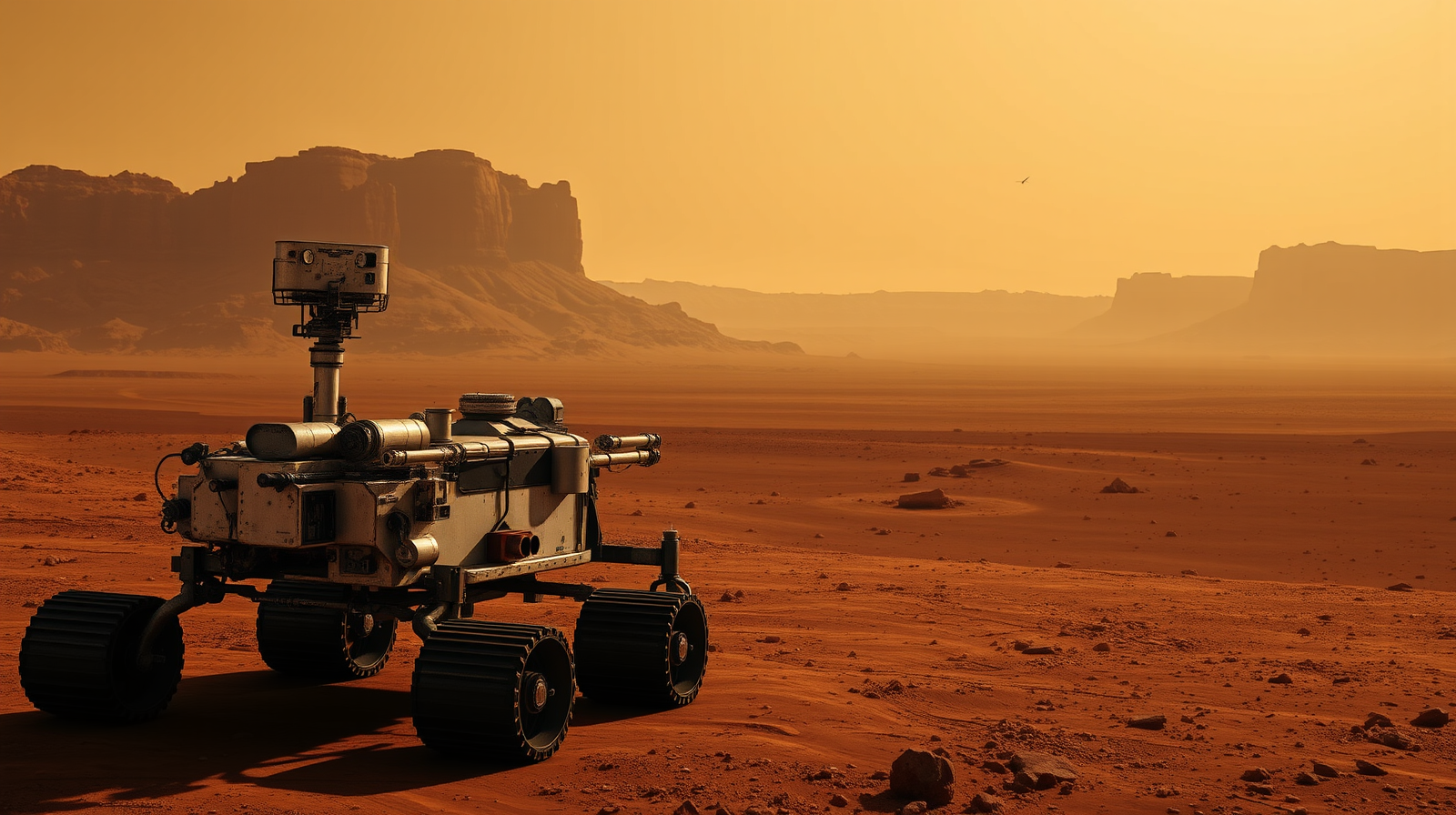
Human colonization of Mars as an open-air world is a multi-century impossibility because modifying its environment requires moving quantities of mass and generating levels of energy that completely exceed our industrial capacity. A study from Slava Turyshev at NASA Jet Propulsion Laboratory confirms that altering Mars demands planetary-scale logistics, including capturing moon-sized celestial bodies for atmospheric bulk and constructing orbital mirrors larger than Asia. The dream of walking the red sands without a spacesuit belongs to science fiction, grounded by the unyielding laws of thermodynamics and orbital mechanics.
For decades, aerospace publicists and tech billionaires have framed the settlement of Mars as a mere matter of political will and capital accumulation. We have been treated to sleek animations of rockets landing on red dunes, followed by quick time-lapses of oceans appearing and skies turning blue. This narrative serves fundraising efforts well. It fails entirely when subjected to fundamental physics.
The true challenge is not getting to Mars. The true challenge is surviving the planet itself. Mars is an irradiated, frozen desert with an atmosphere so thin that human flesh would expand and fluids would vaporize without mechanical pressurization. To change this requires a total restructuring of a planet, a process known as terraforming. The calculations from the Jet Propulsion Laboratory break this process down into five brutal milestones, exposing the vast gap between current engineering capacity and the physical reality of planetary modification.
The Five Milestones of Environmental Alteration
Any attempt to make Mars habitable must follow a strict thermodynamic sequence. You cannot build a breathable atmosphere without first establishing pressure and heat.
The starting baseline is the current Martian environment. The atmospheric pressure sits at a meager 6.1 millibars, less than one percent of Earth's sea-level pressure. The temperature averages a bone-chilling minus 60 degrees Celsius. Solar radiation and cosmic rays pelt the surface completely unhindered by a protective magnetic shield.
Breaking the Triple Point
The first milestone involves raising the atmospheric pressure above the triple point of water. This requires reaching a baseline where liquid water can exist on the surface without instantly boiling away or freezing solid.
To achieve this minor stabilization, billions of metric tons of gas must be injected into the thin air. This would not create a breathable environment. It would merely allow liquid water to pool in deep craters under specific temperature conditions.
The Regional Greenhouse Strategy
The second milestone moves from global adjustments to localized containment. Engineers refer to this as paraterraforming. Instead of altering the entire globe, human settlers would construct massive, pressurized agricultural domes spanning entire valleys.
This approach is highly practical. The structural advantage of Mars is that its low external pressure actually helps support the internal inflation of giant greenhouses. These regional bubbles could support local crop cultivation and closed-loop water cycles. It represents the only viable method for mid-term human survival, yet it keeps humanity trapped inside glass cages.
Preventing the Blood From Boiling
The third milestone targets a critical biological threshold. At a global surface pressure of 62.7 millibars, the boiling point of water drops to 37 degrees Celsius. This is the exact temperature of the human body.
Below this pressure, a human exposed to the atmosphere would experience ebullition. The moisture on the tongue, in the lungs, and within the eyes would spontaneously boil at normal body temperature. Reaching this milestone means an astronaut could technically walk outside without a pressurized suit, though they would still require a full oxygen mask and thermal protection to prevent immediate suffocation and freezing.
The Breathable Horizon
The final milestone is a fully breathable atmosphere. This requires a total atmospheric pressure of roughly 500 millibars, consisting of a substantial nitrogen buffer and at least 210 millibars of oxygen. Temperatures would need to be permanently elevated by 60 degrees Celsius to allow global water cycles to function smoothly.
The Moon Sized Mass Transport Problem
The sheer scale of material required to move through these milestones is staggering. To raise the atmospheric pressure of Mars by just a single millibar, you must add approximately $3.89 \times 10^{15}$ kilograms of gas to the planet.
That single millibar of increase requires a mass equivalent to Deimos, the smaller moon of Mars.
To scale the atmosphere up to a level where human blood no longer boils requires importing or releasing hundreds of times that amount. For a fully breathable atmosphere, the mass required climbs toward $10^{18}$ kilograms. This is roughly equal to the mass of Janus, an irregular, ice-heavy moon orbiting Saturn.
Optimists point out that the outer solar system contains hundreds of these ice moons and comets. They suggest we can simply harvest them. The logistics of this suggestion are absurd.
Moving an object of that size out of its native orbit requires energy outputs that humanity cannot generate. A hypothetical scenario involving thermonuclear propulsion systems mounted to a comet would still take decades of continuous burns just to alter its trajectory toward Mars. If the alignment is off by a fraction of a degree, the project results in a catastrophic planetary impact that would obliterate any existing research bases on the surface.
Furthermore, Mars cannot easily hold onto a heavy atmosphere. The planet lacks a global intrinsic magnetic field. Without this shield, the solar wind continually strips away gases from the upper atmosphere. Any gas imported at great energetic cost would slowly leak into the void of space over geological timescales. While this stripping process takes millions of years, it means any atmosphere we build is inherently unstable and requires constant, massive replenishment.
The Asia Sized Mirror in the Sky
Atmospheric bulk is only half the problem. The other half is solar irradiance. Mars sits on the cold outer edge of the habitable zone, receiving less than half the sunlight that reaches Earth.
To warm the planet by the required 60 degrees Celsius, scientists have proposed injecting artificial greenhouse gases or distributing dark nanoparticles across the polar ice caps to absorb more heat. The most mathematically sound method to achieve sustained warming, however, involves redirecting sunlight using orbital mirrors.
The Jet Propulsion Laboratory calculations reveal the true scale of this engineering nightmare. To reflect enough sunlight to melt the Martian carbon dioxide ice caps and drive global warming, humanity would need to construct an orbital mirror array covering approximately 70 million square kilometers.
To visualize this space structure, consider that the entire continent of Asia covers just 44 million square kilometers.
We do not possess the industrial base to manufacture a sheet of reflective material that size. We do not have the launch capacity to lift it, nor do we have the autonomous robotics required to assemble and maintain a fragile mirror structure the size of a continent in deep space. A single micro-meteorite impact could tear through the ultra-thin reflective material, creating a cascading failure across the array.
The Fallacy of Natural Carbon Reserves
For years, a popular counter-argument suggested that we do not need to import mass or build giant mirrors. The theory held that Mars already possessed enough frozen carbon dioxide in its polar caps and soil to trigger a self-sustaining greenhouse effect if properly heated.
A previous comprehensive survey of spacecraft data shattered this hope. The total accessible carbon dioxide locked in the Martian ice caps and surface soil can only provide a maximum of 10 to 12 millibars of pressure.
Even if we baked the entire surface of the planet using nuclear explosions, the released gas would not even get us close to the pressure needed to keep human blood from boiling. The planet is fundamentally volatile-poor. The raw materials needed to build an Earth-like sky are simply not present on Mars. They must be dragged across millions of kilometers of deep space.
Living in the Underground Reality
The data leaves no room for romantic notions of green fields under a Martian sky. If humanity settles on the red planet within the next two centuries, it will look like a heavy industrial mining operation, not a new frontier of open-air cities.
Settlers will live deep underground in carved lava tubes or inside thick, lead-lined concrete bunkers covered in meters of Martian soil. This shielding is non-negotiable. Without it, the constant barrage of galactic cosmic rays and solar particle events would induce fatal cancer rates within a few years of arrival.
Human interaction with the actual surface of Mars will be highly mediated by machinery. Automated rovers, teleoperated drones, and heavily armored pressure suits will do the physical work of extracting water ice from glaciers and processing perchlorate-rich soil into usable oxygen and fertilizer.
The immediate future of space exploration belongs to paraterraforming. Enclosed, highly managed agricultural ecosystems will provide the food and air for small teams of scientists and specialized technicians. These bases will remain entirely dependent on a delicate logistical supply chain stretching back to Earth for precision electronics, medical supplies, and complex machinery.
The physical reality of Mars forces a harsh choice. We can spend trillions of dollars and centuries of concentrated industrial effort attempting to brute-force the physics of an entire planet, or we can accept that humanity is a species fine-tuned for Earth. The red planet will always be an environment that actively tries to kill us. Our survival there depends not on changing the world, but on our ability to build flawless boxes to hide from it.