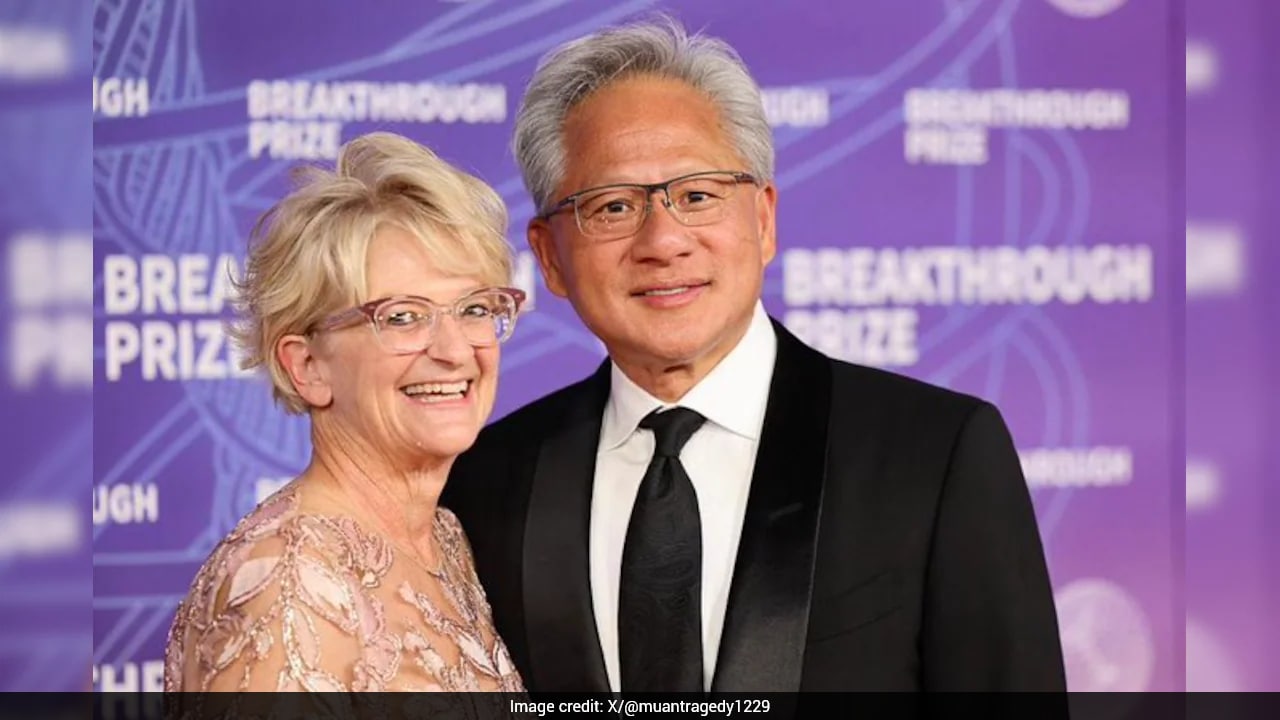
In 1995, sitting inside a cramped office in Sunnyvale, California, Nvidia co-founder and CEO Jensen Huang made a promise to his wife, Lori, and their two young children. He told them that if he could just make the company successful, he would spend the rest of his life making up for the time he was missing while building it. More than three decades later, with Nvidia standing as the undisputed engine of the global artificial intelligence infrastructure and commanding a multi-trillion-dollar valuation, Huang still hasn't collected on that debt. In various candid interviews—most notably during his Stanford Graduate School of Business appearance and reflections on his career—Huang has revisited that unwritten apology note, admitting openly that the "rest of his life" clause remains perpetually deferred because the work never actually stops.
Surface-level business profiles love to frame this story as a heartwarming testament to founder grit or a cautionary tale about work-life balance. That reading misses the point entirely. When a CEO worth tens of billions of dollars confesses that he still owes his family the life he promised them thirty years ago, it isn't just a personal anecdote. It is an unfiltered look at the structural reality of the semiconductor industry, where existential paranoia isn't a personality quirk—it is a survival mechanism. For an alternative view, consider: this related article.
The 1995 Crucible and the Anatomy of a Founder's Debt
To understand why Huang wrote that mental promissory note to his family in the mid-1990s, you have to look at the financial ledger of Nvidia in 1995. The company wasn't a juggernaut. It was a distressed startup bleeding cash on a fatally flawed architecture.
Founded in April 1993 by Huang, Chris Malachowsky, and Curtis Priem over booths at a Denny’s in East San Jose, Nvidia raised $20 million from Sequoia Capital and Sutter Hill Ventures to build its first chip, the NV1. By 1995, the NV1 was a commercial disaster. Nvidia had bet on quadratic texture mapping—a rendering technique that Microsoft promptly rendered obsolete when it released DirectX, which standardized polygon rendering. Sega, Nvidia’s primary customer and lifeline, demanded a completely different approach for its upcoming Dreamcast console. Similar insight on this trend has been shared by The Motley Fool.
Huang faced an impossible bind. If he finished the contract for Sega using the old architecture, Nvidia would deliver a chip nobody wanted. If he abandoned the architecture to build a DirectX-compatible chip, he would breach the contract and run out of money before the new silicon could even tape out.
He chose the nuclear option. He went to Sega’s CEO, Shoichiro Irimajiri, admitted the NV1 was a dead end, and asked Sega to release Nvidia from the contract while still paying the remaining $5 million in development funds so Nvidia could survive. Remarkably, Irimajiri agreed. Even with that lifeline, Huang had to lay off more than half of his 100 employees, shrinking the company down to roughly 40 survivors, and bet everything on a single chip, the RIVA 128.
Nvidia was thirty days from bankruptcy.
During those months, Huang worked seven days a week, often sleeping under his desk or coming home only after his children were asleep. The apology note to Lori and the kids wasn't born out of ambition for wealth or status. It was born out of acute survival panic. He genuinely believed that if he could just get the RIVA 128 out the door, stabilize the balance sheet, and take the company public, the emergency would end. He could finally step off the treadmill and give his family the "rest of his life."
The RIVA 128 shipped in 1997, sold a million units in four months, and saved the company. Nvidia went public in January 1999 at $12 a share. By every conventional metric, Huang had won. The debt to his family was due.
He never paid it.
Why the "Thirty Days from Bankruptcy" Mantra Never Died
Most corporate slogans expire once a company hits a billion dollars in revenue. At Nvidia, the phrase "our company is thirty days from going out of business" became permanent operating doctrine. Huang repeated it in town halls throughout the 2000s, the 2010s, and well into the 2020s, even as Nvidia’s cash reserves swelled into the tens of billions.
Critics outside the chip sector often dismiss this as performative billionaire anxiety. In reality, it reflects the unforgiving physics of fabless semiconductor economics.
Unlike a consumer software company, which can push a buggy update on a Tuesday and patch it by Thursday, a chip designer operates on multi-year capital cycles with zero margin for error. Designing a modern GPU architecture like Hopper, Blackwell, or Rubin requires billions of dollars in upfront research and development, years of software stack engineering, and tens of millions of dollars just to create the photomasks for a single tape-out at Taiwan Semiconductor Manufacturing Company (TSMC). If a hardware flaw slips past verification and makes it into silicon, you cannot patch it over the air. You lose an entire product generation, forfeit shelf space in hyperscale data centers, and watch your market capitalization evaporate in a single earnings cycle.
Consider a hypothetical example of how fast that erosion happens in hardware. Suppose a dominant chipmaker misses a thermal efficiency target by just 15 percent on its flagship server processor. Cloud providers—who measure profitability in performance-per-watt across megawatt-scale facilities—immediately reallocate their capital expenditure budgets to a rival architecture for the next four quarters. By the time the original vendor fixes the silicon eighteen months later, the software ecosystem has already begun migrating to the competitor's tools.
Huang watched this exact destruction happen to dozens of rivals. In the late 1990s, Nvidia fought over 60 graphics chip competitors, including 3dfx, S3, Matrox, and ATI. Almost all of them are gone or absorbed. Later, Huang watched Intel—once the most unassailable monopoly in computing—stumble on its 10-nanometer manufacturing node and lose a decade of technological leadership.
To Huang, taking his foot off the gas to claim the "rest of his life" didn't mean coasting at 80 percent capacity. In his worldview, 80 percent capacity in the semiconductor business is indistinguishable from liquidating the company.
The Cost of the CUDA Bet and the Decade of Wall Street Neglect
The period that truly cemented Huang’s perpetual absence from normal family life wasn't the 1995 near-death experience. It was the decade between 2006 and 2016.
In 2006, Huang introduced CUDA (Compute Unified Device Architecture), a software platform that allowed developers to use Nvidia’s graphics chips for general-purpose parallel computing rather than just rendering video game pixels. Every GPU Nvidia shipped included the extra silicon transistors required to run CUDA, which bloated manufacturing costs and squeezed gross margins.
Wall Street hated it.
For ten years, Nvidia’s stock price stagnated, hovering between $10 and $20 (pre-splits) while mobile chipmakers like Qualcomm and ARM captured the smartphone boom. Activist investors and financial analysts repeatedly pressured Huang to abandon the expensive general-purpose computing experiment, cut R&D spending, and focus strictly on high-margin PC gaming cards.
If Huang had stepped back into a ceremonial chairman role or handed the CEO reins to a traditional operational executive during that decade, CUDA would almost certainly have been killed to appease quarterly earnings targets. Instead, Huang doubled down. He flew constantly between Santa Clara, Taiwan, and research labs worldwide, personally evangelizing GPU computing to physicists, oil-and-gas engineers, and obscure academic researchers working on neural networks.
When Alex Krizhevsky, Ilya Sutskever, and Geoffrey Hinton used two Nvidia GTX 580 gaming cards to win the ImageNet competition with AlexNet in 2012, the decades of deferred personal life suddenly compounded into an insurmountable technological moat. Nvidia wasn't just selling chips anymore; it owned the entire accelerated computing stack.
Yet the reward for winning that decade-long bet wasn't leisure. It was an exponential increase in stakes. Once Microsoft, Google, Meta, and Amazon began spending hundreds of billions of dollars on AI data centers, Nvidia ceased to be a component supplier and became critical geopolitical infrastructure. A single supply bottleneck in CoWoS advanced packaging at TSMC or a delay in NVLink switches now sends shockwaves through global equity markets. You do not walk away from the controls when you are piloting a system that the entire global economy is using as collateral.
The Structural Trap of the Founder-CEO
There is a sharp counter-argument to Huang’s philosophy, and it comes from organizational theorists and succession planners who view extreme founder endurance as a single point of failure.
In modern corporate governance, a CEO who still works 14-hour days after thirty-three years at the helm represents a profound key-person risk. Unlike Apple, where Steve Jobs deliberately built Apple University and groomed Tim Cook for years to execute a seamless operational handoff, or Microsoft, where Bill Gates transitioned out of day-to-day management to let Steve Ballmer and later Satya Nadella reshape the company, Nvidia has never had a second CEO.
Huang famously maintains an unusually flat organizational structure for a company employing tens of thousands of people. Instead of a tight inner circle of four or five senior vice presidents buffering him from daily operations, Huang regularly has 40 to 60 direct reports. He skips traditional formal status meetings in favor of reading raw "Top 5 Things" emails sent directly by employees across all ranks, diving straight into engineering bottlenecks without filtering layers.
This flat architecture explains why Nvidia moves at startup speed despite its massive scale. There are no corporate bureaucracy layers slowing down product pivots. However, it also explains why Huang cannot keep his 1995 promise to his family. He hasn't just built a company that requires a strong leader; he has engineered an organizational nervous system where he is the central cortex.
If he steps away to reclaim his personal life, the entire decision-making cadence of Nvidia has to be re-architected from the ground up.
What Lori Huang and the Next Generation Actually Built
Media narratives surrounding Huang’s apology note often paint his wife, Lori, and their children, Madison and Spencer, as passive bystanders waiting endlessly for a husband and father to come home. The actual record tells a very different story—one of quiet adaptation rather than victimhood.
Lori Huang, who met Jensen when they were engineering lab partners at Oregon State University (he was 17, she was 19), is an electrical engineer herself. She understood the technical obsession from the beginning. Rather than sitting idle while Jensen lived on airplanes and factory floors, she took the helm of the Jen-Hsun & Lori Huang Foundation, directing hundreds of millions of dollars into higher education, STEM infrastructure, and public health initiatives, including major endowments to Oregon State University and Stanford.
Meanwhile, both children charted paths that eventually intersected with the technological reality their father helped create, though neither started inside Nvidia’s corporate ranks. Madison Huang worked in the hospitality and luxury sectors—attending Le Cordon Bleu and working at LVMH—before joining Nvidia’s Omniverse marketing and product strategy team. Spencer Huang spent years in Taiwan running a successful cocktail bar and studying business before joining Nvidia as a product manager focusing on robotics simulation.
Their trajectories highlight an uncomfortable truth about ultra-high-stakes entrepreneurship. The "rest of my life" promise made in a cramped 1995 office was built on a faulty premise: that a family stays frozen in amber while the founder builds an empire, waiting for a ribbon-cutting ceremony where normal life resumes. Children grow up, build their own careers, and develop their own identities while the company is being forged. By the time the founder looks up from the workbench, there is no 1995 family left to go back to.
The Myth of the Finish Line in High-Stakes Tech
When Jensen Huang reflects on that apology note today, his tone isn't one of regretful defeat, nor is it a boast. It is a candid admission that he miscalculated the nature of the beast he was creating.
In 1995, Huang viewed business like an engineering problem with a defined specification: solve the cash crisis, ship the chip, achieve market stability, and exit the emergency phase. What he discovered—and what every founder chasing generational scale eventually confronts—is that success doesn't eliminate existential threats; it merely upgrades them to a higher tax bracket. Surviving Sega and 3dfx only earned Nvidia the right to fight AMD and Intel. Surviving the CUDA winter only earned Nvidia the right to navigate US-China export controls, custom ASIC threats from hyperscalers like Google’s TPUs and Amazon’s Trainium, and the crushing weight of Wall Street’s quarterly expectations.
Huang’s confession resonates across Silicon Valley and global boardrooms because it strips away the polished PR veneer of "work-life integration" and "mindful leadership." Building a monopoly-grade technology company from scratch requires an asymmetric sacrifice that cannot be balanced on a spreadsheet or paid back with a yacht, a foundation, or an apology note thirty years later.
For founders reading Huang’s words today, the lesson isn't to work harder or to feel guilty about missing dinner. The lesson is to stop lying to the people at home about a finish line that does not exist. When you sign up to build something that reshapes an industry, you aren't borrowing time from your family with a plan to pay it back later—you are spending it permanently, and the only honest currency left is admitting that the bill will never be settled.