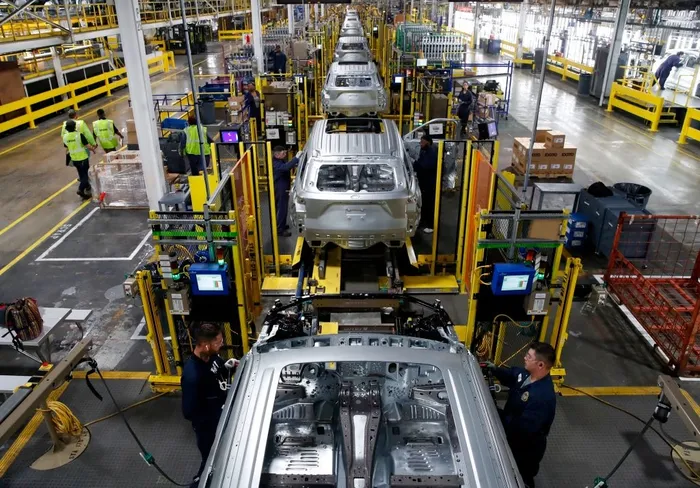
American factory floors are humming, but the balance sheets are bleeding. While the surface-level data suggests a sector holding its breath in a state of "steady" activity, a deeper look reveals a industry caught between a political mandate to build at home and a crushing financial reality. Raw output hasn't collapsed, but the profit margins that make expansion possible are being devoured by a relentless climb in input costs. The industry isn't thriving. It is merely surviving on momentum while the cost of doing business threatens to stall the engine entirely.
The Illusion of Stability
If you look at the top-line numbers, you see a sector that refuses to quit. Industrial production indexes remain stubbornly flat, which many analysts mistake for resilience. It isn't resilience; it’s an obligation. Most mid-to-large-scale manufacturers operate on multi-year contracts that don't allow them to simply flip a switch and stop production because electricity or steel became 15% more expensive overnight.
They are locked in.
This creates a dangerous statistical lag. We see the machines moving, so we assume the health of the organism is fine. In reality, we are watching a marathon runner finish the race on a broken ankle because they aren't allowed to stop before the finish line. The "steady" activity reported in recent months hides the fact that new orders are softening and backlogs are being cleared without being replaced. When those backlogs run dry, the cliff edge will become visible to everyone, not just those of us staring at the ledger books.
The Triple Threat of Input Inflation
The narrative that inflation is cooling hasn't reached the factory floor. Manufacturers are currently battling a three-front war that the consumer price index fails to fully capture.
Energy Costs and the Power Grid Paradox
Electricity is no longer a predictable utility; it has become a volatile commodity. As the United States pushes for an aggressive energy transition, the reliability of the grid has fluctuated while prices have climbed. Heavy industry requires massive, consistent loads of power. When a rolling brownout or a price spike hits, it doesn't just cost money in the form of a higher bill. It ruins batches of product, damages sensitive machinery, and forces expensive downtime.
The Labor Premium
There is a shortage of skilled hands. This isn't news, but the way companies are responding to it is. To keep the lights on, firms are paying record wages not just to attract new talent, but to keep their veterans from being poached by the competitor down the street. However, productivity isn't rising at the same rate as these wages. We are paying more for the same level of output, which is the literal definition of a margin squeeze.
Raw Materials and the Protectionism Tax
Trade policy has consequences. While tariffs are designed to protect domestic industries, they act as an immediate cost increase for any manufacturer that relies on global supply chains for specialized components or raw metals. You cannot mandate a "Made in America" revolution while simultaneously making the ingredients for that revolution 20% more expensive through trade barriers.
The CAPEX Freeze
The most concerning metric isn't what factories are making today, but what they aren't buying for tomorrow. Capital Expenditure (CAPEX) is the lifeblood of industrial evolution. It is how a shop moves from manual welding to robotic automation. It is how a chemical plant upgrades to more efficient reactors.
Currently, that money is staying in the bank or being diverted to service debt. With interest rates remaining at levels not seen in decades, the cost of financing a new production line has doubled or tripled compared to five years ago. When you combine high borrowing costs with shrinking margins, the "why" behind the lack of innovation becomes clear.
We are seeing a generation of equipment being pushed past its prime. Maintenance costs are rising because companies would rather patch an old machine than finance a new one at 8% interest. This "make do and mend" mentality works for a few quarters, but eventually, the lack of investment leads to a loss of global competitiveness.
The Geopolitical Anchor
Washington is obsessed with "friend-shoring" and "near-shoring." The idea is sound in a vacuum: move production closer to home to avoid the supply chain nightmares of the early 2020s. But the execution is hitting a wall of reality.
Building a factory in Mexico or the American South is significantly more expensive than maintaining a legacy relationship in Southeast Asia. The infrastructure isn't always there. The regulatory environment is more complex. The "hidden" costs of domestic production—legal compliance, environmental impact studies, and local taxes—are often the final straw for a company already reeling from high material costs.
We are asking manufacturers to be the frontline soldiers in a cold trade war, but we aren't providing them with the ammunition they need to win. Instead, we are giving them "steady" headlines while their operational cash flow evaporates.
The Automation Myth
There is a popular theory that robots will save American manufacturing from high labor costs. It's a clean, logical argument that falls apart when it hits the shop floor. Automation is not a plug-and-play solution. It requires a massive upfront investment, a specialized workforce to maintain the tech, and a level of volume that justifies the cost.
For the thousands of small-to-mid-sized machine shops that form the backbone of the US supply chain, total automation is a fantasy. They operate on high-mix, low-volume orders. You don't buy a $500,000 robotic arm to make 50 specialized valves for a local utility. You hire a machinist. And right now, that machinist is more expensive than ever, and the $500,000 arm is unaffordable due to interest rates.
The Strategy of Controlled Attrition
Smart operators are no longer chasing growth; they are chasing efficiency. This is a subtle but vital shift. Instead of trying to capture more market share, they are firing their least profitable customers. They are trimming product lines that have high "complexity costs" and focusing on the few things they can produce with the highest predictable margin.
This looks like "steady" activity on a macro level, but on a micro level, it is a retreat. It is a pruning of the American industrial tree. While pruning can lead to a healthier tree in the long run, it results in a smaller tree today. Fewer jobs, fewer choices for consumers, and a more fragile supply chain that lacks the redundancy it once had.
Breaking the Cycle
Survival in this environment requires a cold-blooded assessment of the floor. The companies that will be standing in three years are those currently ignoring the "steady" headlines and preparing for a period of prolonged high costs.
They are renegotiating every single vendor contract. They are investing in "soft" technology—software that optimizes scheduling and reduces waste—rather than "hard" hardware that requires massive debt. Most importantly, they are being honest about the fact that the era of cheap energy, cheap labor, and cheap money is over.
The industry isn't holding steady. It is transforming under extreme pressure. Those who fail to see the pressure because they are blinded by the output numbers will be the first to disappear when the momentum finally breaks. Stop looking at the smoke coming out of the stacks and start looking at the interest payments hitting the accounts.
Identify your highest-cost production bottleneck today and eliminate it, even if it means reducing your total volume. In a high-cost environment, volume is a vanity metric; cash flow is the only reality that matters.