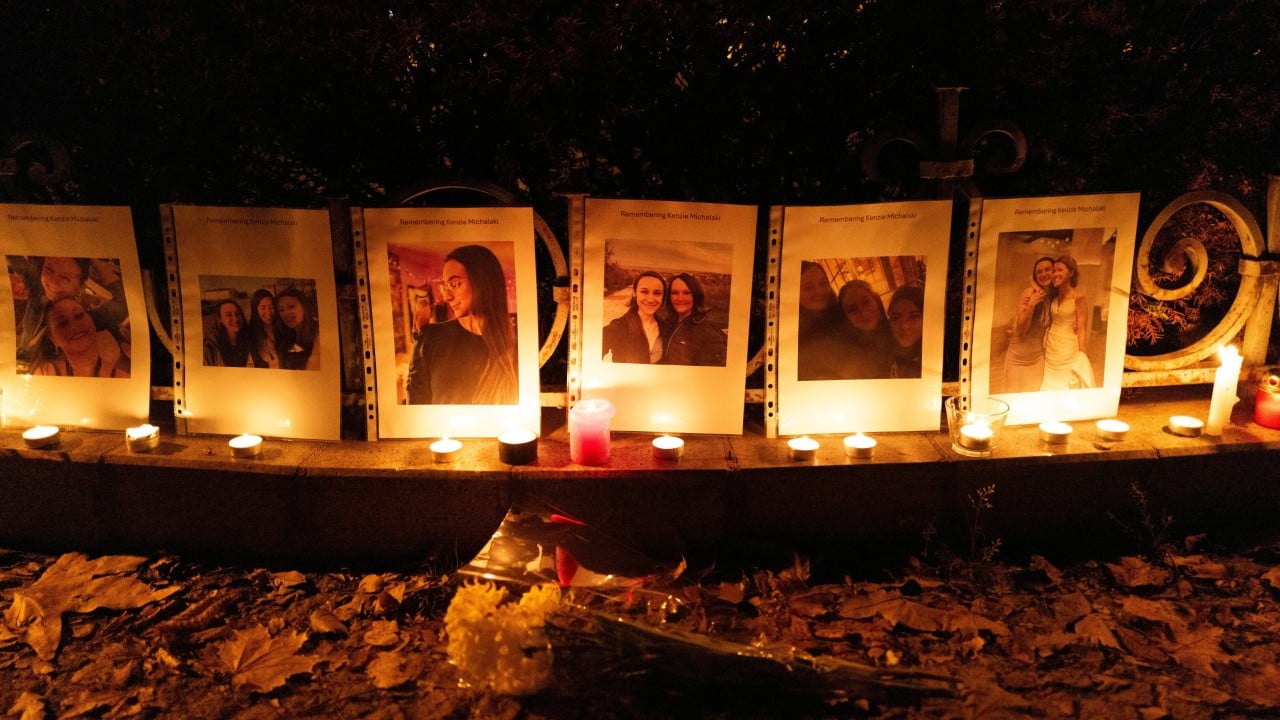
A Budapest metropolitan court has brought a definitive end to one of Hungary’s most chilling recent criminal cases, sentencing 37-year-old Irish citizen L.T.M. to 14 years in prison without parole for the murder of Mackenzie Michalski, a 31-year-old nurse practitioner from Portland, Oregon. The ruling concludes a grim international saga that began in November 2024, when what was described by authorities as an intimate encounter turned into a lethal assault inside a rented apartment.
The defense maintained that the young woman's death was a catastrophic accident, but the trail of digital and physical evidence left behind painted a far more calculating picture. As the judge handed down the sentence, the details of the crime highlighted a growing, disturbing phenomenon in global criminal jurisprudence: the utilization of the "intimate encounter" defense to mask deliberate acts of fatal violence.
The Fatal Night in Budapest
Budapest had long been a sanctuary of joy for Mackenzie Michalski, a dedicated neurosurgery nurse who openly referred to the Hungarian capital as her happy place. She arrived in the historic city for a vacation, capturing the vibrant atmosphere and sending photographs to her friends as she explored the local nightlife.
The music stopped. After midnight on November 5, 2024, all communication from her phone ceased abruptly, leaving her belongings untouched at her rented Airbnb and sparking an immediate, frantic search by her family and friends across social media platforms.
Hungarian investigators immediately turned to the city's extensive network of security cameras, tracing Michalski’s movements through the dense, cobblestone streets of central Budapest. CCTV footage captured her dancing and laughing at a local nightclub with a man later identified as L.T.M., a tourist from Ireland. The video tracked the pair as they left the establishment together and walked back toward his rented apartment. It would be the last time Michalski was seen alive, transforming a standard missing person case into a high-stakes homicide investigation within forty-eight hours.
The Anatomy of a Panic and Cover Up
When Hungarian police detained the suspect on November 7, his initial cooperation was framed around a narrative of sheer panic following an unexpected medical emergency during sex. He claimed that Michalski’s death was an unforeseen accident, a sudden tragedy that left him too terrified to contact local emergency services or alert the embassy.
The court rejected this completely. According to the formal judicial findings, the defendant did not attempt to perform CPR, nor did he make any effort to seek medical assistance from neighbors or professionals. Instead, he embarked on a meticulous, multi-step operation to eradicate any trace of the woman's presence from his living quarters.
He chose the woods. After wrapping Michalski’s body and concealing it temporarily inside a wardrobe, L.T.M. walked out into the city to purchase a large rolling suitcase. He returned, packed her remains into the luggage, cleaned the apartment thoroughly with household detergents, and secured a rental vehicle. Driving over 150 kilometers southwest of the capital, he navigated toward the dense thickets surrounding Lake Balaton. In a isolated, wooded area outside the small town of Szigliget, he dumped the suitcase containing the young nurse's body into the undergrowth, believing the remote location would permanently swallow the evidence of his actions.
The Digital Trail of an Alleged Accident
What ultimately dismantled the defense’s narrative of a panicked, accidental death was not just the physical movement of the body, but the forensic extraction of the suspect's internet search history. Long before police knocked on his door, the defendant's smartphone had been recording a sequence of queries that revealed an unsettling level of premeditation and strategic curiosity.
The algorithms remember everything. Investigators discovered that prior to his apprehension, L.T.M. had used his phone to research the specific mechanics of corpse decomposition and local wildlife behavior. His search terms included direct inquiries into how to dispose of a human body, standard police protocols for managing missing person investigations, and whether pigs genuinely consume human remains.
Furthermore, he searched for information regarding the presence of wild boars in the Lake Balaton region, presumably weighing the likelihood that local wildlife would destroy the physical evidence before authorities could locate it. His digital footprint also included a cynical inquiry into the actual competence of the Budapest police department. This sequence of searches exposed a mind that was not paralyzed by grief or shock, but rather one actively assessing the logistics of evasion and legal survival.
The Myth of the Intimate Accident
The case brings to the forefront a defense mechanism that has increasingly frustrated prosecutors worldwide, often colloquially referred to as the rough sex defense. In these scenarios, perpetrators attempt to mitigate murder charges by claiming the victim died accidentally during a consensual, albeit aggressive, intimate encounter.
Strangulation requires sustained force. Medical experts consistently testify that fatal asphyxiation via strangulation cannot occur in a fleeting, accidental second; it demands continuous, intense pressure applied to the neck for several minutes, long after a victim has lost consciousness.
The Budapest Capital Regional Court emphasized this biological reality in its ruling, stating that the sheer duration and physical nature of the assault proved an intent to kill. By tying up and physically assaulting Michalski before exerting lethal pressure on her airway, the defendant's actions crossed the line from a tragic misadventure into an act of definitive homicide. The court’s refusal to accept the accident narrative sends a clear message regarding the limits of criminal spin when confronted with raw forensic data.
A Sentence in the Shadows of Lake Balaton
The final verdict leaves a complex legal and emotional wake. The court sentenced L.T.M. to 14 years of imprisonment without the possibility of parole, ordering his immediate deportation from Hungary once the physical term is served. He was also ordered to pay 2.5 million forints, roughly 8,000 dollars, in accumulated court costs.
The defense has filed an appeal. This means the legal battle will continue in the higher appellate courts of Hungary, prolonging the agonizing process for Michalski’s family, who traveled across the Atlantic to face their daughter's killer in an unfamiliar courtroom.
For the international community and tourists navigating the modern dating and social scenes abroad, the tragedy serves as a stark reminder of the vulnerabilities inherent in foreign travel. Michalski’s legacy remains tied to her work as a compassionate medical professional in Oregon, a stark contrast to the violent manner in which her life was cut short in a rental apartment thousands of miles from home. True justice in international homicides is rarely clean, and a 14-year sentence can feel remarkably brief to a family left looking at an empty space where a vibrant young woman used to stand.
Inside Edition broadcast on the suspect's arrest
This video provides direct broadcast coverage detailing the initial arrest of the suspect and features statements from the victim's grieving family during the search in Budapest.



