Every few months, a predictable wave of outrage washes over the Brussels press corps. Watchdogs, opposition MEPs, and financial journalists clutch their pearls because the European Commission allegedly "sugarcoated" macroeconomic data to justify wiring another billion-euro tranche to Cairo.
The lazy consensus is easy to digest. Bad autocrats get European taxpayer money. Bureaucrats fudge the spreadsheets to look the other way on human rights and structural reforms. Everybody shakes their heads at the moral decay of European foreign policy. If you enjoyed this post, you might want to check out: this related article.
This narrative is completely backwards.
If you believe the European Commission is manipulating numbers because they are naive, corrupt, or sloppy with accounting, you fundamentally misunderstand how sovereign debt restructuring, geopolitical risk pricing, and the Macro-Financial Assistance (MFA) instrument actually work. Brussels isn't cooking the books to pretend Egypt is healthy. They are using creative accounting to buy time on a geopolitical time bomb they cannot afford to let detonate. For another perspective on this story, see the latest update from Associated Press.
The Myth of the Objective Spreadsheet
Let’s look at the mechanics of the accusation. Critics point out that the European Commission’s assessment of Egypt’s macroeconomic stability relies on wildly optimistic projections—rosy forecasts for Suez Canal revenues, aggressive assumptions about privatization, and suspiciously smooth debt-to-GDP trajectories. They argue that if the Commission applied strict, objective auditing standards, the payout would be blocked.
They are right about the math. They are wrong about the purpose of the math.
In sovereign finance, an International Monetary Fund (IMF) or EU Macro-Financial Assistance assessment is not an audit. An audit looks backward to verify reality. A bailout assessment looks forward to engineer a self-fulfilling prophecy.
When a country of 110 million people sits on the brink of a sovereign default, the numbers never add up on paper. Never. If a distressed nation had clean, undeniable, mathematically sound fundamentals, it wouldn't be begging Brussels or Washington for emergency liquidity. It would be issuing bonds on the open market in London and New York at reasonable yields.
I have sat in rooms where sovereign debt restructuring terms are hammered out, and the dirty secret of international finance is that conditionality is theater designed to satisfy domestic parliaments, not economic reality.
When the European Commission drafts an assessment saying Egypt has met the "preconditions" for a €1 billion or €4 billion disbursement, they are engaging in what economists call constructive ambiguity. To release funds under EU law, the Commission must certify that the recipient country respects democratic mechanisms and has a viable path to debt sustainability. Because the law demands a binary "yes" or "no" on an inherently messy geopolitical crisis, bureaucrats write assessments that bend reality until it fits the legal checkbox.
Calling this "sugarcoating" is like criticizing a paramedic for using a tourniquet instead of performing open-heart surgery on the sidewalk. The paramedic knows the tourniquet isn't a cure. They just need the patient alive long enough to reach the hospital.
What Happens If Brussels Tells the Truth?
Imagine a scenario where the European Commission’s Directorate-General for Economic and Financial Affairs (DG ECFIN) decides to appease its critics. They throw out the optimistic projections. They publish a brutally honest, strictly conservative audit of Egypt’s finances.
They point out that state-owned and military-affiliated enterprises still crowd out the private sector. They highlight that inflation has gutted the Egyptian middle class, that Houthi attacks in the Red Sea have slashed Suez Canal transit fees by more than half, and that debt servicing consumes nearly half of all government revenue. Based on this rigorous, uncompromising truth, Brussels freezes the funds.
What happens next?
- Immediate Currency Collapse: Within 48 hours, the Egyptian pound goes into freefall. The parallel market explodes.
- Import Freeze: Egypt is the world’s largest wheat importer. Without hard currency liquidity, letters of credit for basic foodstuffs and fuel dry up overnight.
- Sovereign Default: Cross-default clauses trigger across Eurobonds. The IMF program collapses because IMF disbursements are legally contingent on bilateral and multilateral financing assurances—specifically the money promised by the EU and Gulf states.
- Regional Contagion: A state collapse in Cairo doesn't stay in Cairo. With Sudan in a brutal civil war to the south, Libya fractured to the west, and Gaza burning to the east, Egypt is the last load-bearing wall in North Africa.
If that wall comes down, Europe doesn't face a debate over accounting standards. It faces a migration crisis that makes 2015 look like a minor border skirmish, alongside the complete destabilization of Eastern Mediterranean energy routes.
When critics accuse the Commission of sugarcoating figures, they are demanding fiscal purity at the exact moment fiscal purity guarantees geopolitical suicide. Brussels knows the numbers are soft. Ursula von der Leyen knows it. The European Parliament’s budgetary control committee knows it. Even the people writing the angry op-eds know it, though they pretend otherwise because outrage generates clicks.
The Real Flaw in the EU’s Egypt Strategy
Does this mean the European Commission is playing four-dimensional chess and deserves a round of applause? Hardly.
The critics are attacking the wrong target. By obsessing over whether Brussels massaged GDP growth forecasts by 1.2 percentage points, watchdogs are letting the Commission off the hook for a far more dangerous strategic blunder: buying a depreciating asset at full price.
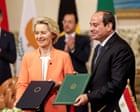
Let's strip away the diplomatic jargon and look at what the EU-Egypt Strategic and Comprehensive Partnership actually is. It is a protection racket in reverse. Europe is paying Cairo €7.4 billion over several years primarily to police its borders, hold back irregular migration from sub-Saharan Africa, and keep a lid on regional chaos.
The flaw isn't that the EU is paying Egypt despite bad economic data. The flaw is that Brussels structured the deal as a traditional macroeconomic bailout rather than a transactional security contract.
By routing the money through Macro-Financial Assistance, the Commission forced itself to pretend this is about economic reform and democratic governance. That creates three massive vulnerabilities:
- Zero Leverage on Actual Reforms: Because Cairo knows Brussels cannot afford an Egyptian collapse, President Abdel Fattah el-Sisi holds all the cards. When a creditor is terrified of the debtor going bankrupt, the debtor owns the bank. Cairo signs whatever reform pledges Brussels wants, pockets the tranche, and continues business as usual—knowing full well the Commission will invent a reason to release the next tranche six months later.
- The Moral Hazard Trap: Every time the EU, the IMF, and Gulf allies step in with another multi-billion-dollar lifeline, they remove the pain required to force genuine structural change. Why dismantle the military's economic monopolies when geopolitical blackmail yields guaranteed hard currency?
- Institutional Credibility Erosion: When the European Ombudsman or the European Court of Auditors inevitably investigates these deals, the Commission looks dishonest. By lying about the economic metrics to justify a security payout, Brussels destroys public trust in its own regulatory rigor. If the Commission will bend the rules on €4 billion for Egypt, why should European taxpayers trust its fiscal assessments of Italy, France, or Hungary?
Dismantling the "People Also Ask" Fallacies
When this story hits the news cycle, casual observers usually ask the same three questions. Every single one of them is built on a faulty premise.
"Why doesn't the EU just tie the money strictly to human rights and economic milestones?"
Because conditionality only works when you are willing to walk away. You cannot credibly threaten to withhold money from a regime when you are simultaneously terrified of what happens the day they run out of cash. The EU tried strict conditionality in the aftermath of the Arab Spring. It failed because authoritarian survival instincts always outweigh the allure of European grants.
"Is the European Commission breaking its own laws?"
Technically, no. Legally, they are exploiting the vast gray zones written into EU financial regulations. MFA regulations require "satisfactory progress" on IMF programs and "respect" for democratic principles. Neither term has a hard quantitative threshold. Lawyers in Brussels spend their entire careers drafting clauses elastic enough to stretch across the Mediterranean without snapping. It isn't illegal; it is weaponized ambiguity.
"Couldn't the IMF step in and enforce the real numbers?"
The IMF is playing the exact same game. In 2024, the IMF expanded Egypt’s loan program from $3 billion to $8 billion, not because Egypt suddenly became a paragon of free-market virtue, but because Washington leaned on the IMF Executive Board after the October 7 attacks turned Egypt into an indispensable geopolitical buffer. The IMF and the EU are co-conspirators in the same necessary fiction.
The Uncomfortable Truth About Geopolitical Accounting
If you want to understand international finance, stop reading press releases from Brussels and start looking at credit default swaps and sovereign bond yields. The market doesn't care about the European Commission's rosy prose. Investors know Egypt is a distressed sovereign kept afloat by geopolitical rent—money paid not for economic productivity, but for geographic location.
There is a massive downside to this contrarian reality. Acknowledging that bailouts are geopolitical bribes rather than economic investments strips away the comforting illusion of a rules-based international order. It forces Western citizens to admit that their governments routinely bankroll authoritarian regimes with cooked books to keep migration and instability away from European shores. It is cynical, transactional, and deeply uncomfortable.
Yet pretending otherwise is worse.
When media outlets and NGOs frame this issue as "EU bureaucrats caught sugarcoating economic data," they reduce a complex, high-stakes geopolitical hostage situation into a clerical scandal. They imply that if the Commission just fixed its spreadsheets and hired stricter auditors, everything would work out cleanly.
It wouldn't. If Brussels stopped sugarcoating the numbers tomorrow, the ink wouldn't even dry on the honest audit before the first migrant boats hit Lampedusa and the Suez Canal descended into chaos.
Stop asking why the European Commission is lying about Egypt’s economy. Start asking what happens to Europe the day the lies stop working.