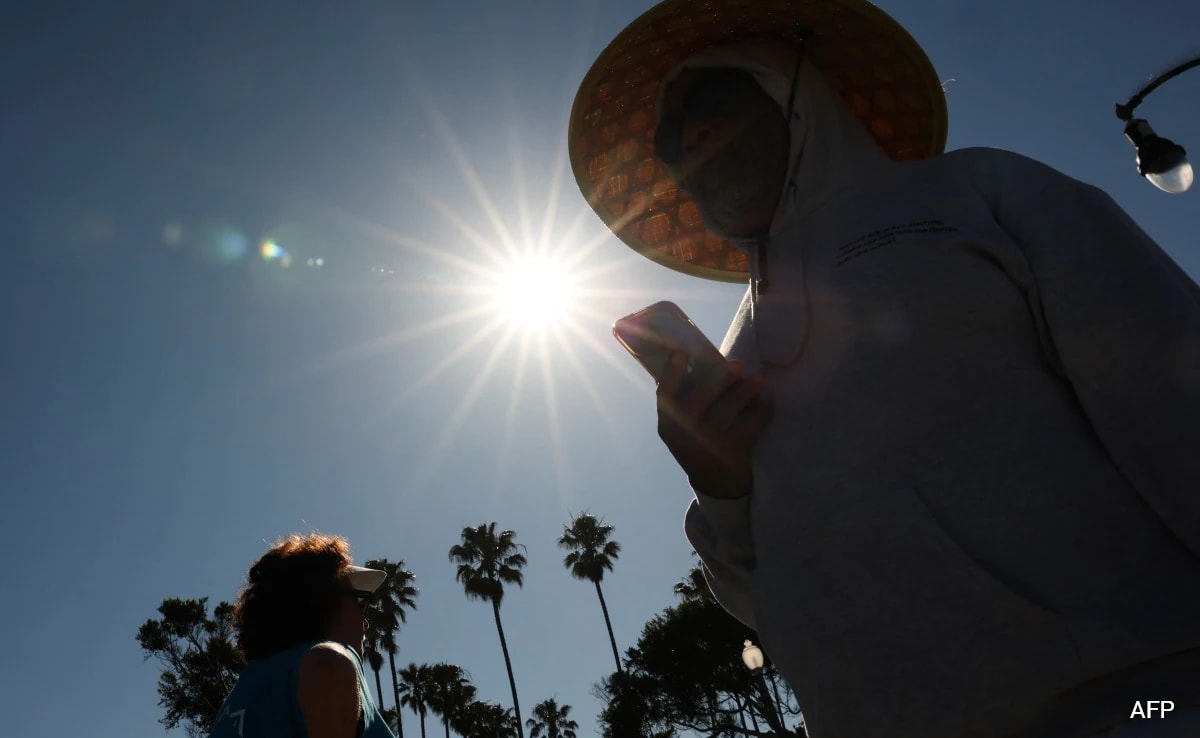
The term "once-in-500-years" has become a linguistic crutch for meteorologists and policymakers who are struggling to describe a reality that no longer follows the rules of the 20th century. When a heat dome settles over the United States, shattering records from the Pacific Northwest to the Gulf Coast, the public is told these are freak occurrences. Statistical outliers. Black swans. But when these outliers happen every three summers, the math is no longer just broken. It is obsolete. The record-breaking heat waves currently paralyzing the country are not temporary weather events but the structural realignment of the American climate, driven by atmospheric stagnation and a power grid built for a world that ceased to exist twenty years ago.
The current heat crisis is defined by a phenomenon known as an omega block. This occurs when high-pressure systems become fixed in place, flanked by low-pressure troughs, creating a shape reminiscent of the Greek letter. This configuration acts as a literal atmospheric wall. It traps hot air, bakes the soil, and prevents the natural west-to-east flow of weather that usually provides relief. As the soil dries out, the sun’s energy stops going into evaporating moisture and starts going entirely into heating the air. This feedback loop creates a self-sustaining furnace.
The Myth of the Return Period
Infrastructure in the United States—bridges, power plants, and drainage systems—is built based on "return periods." This is the statistical probability that an event of a certain magnitude will occur. A 100-year event has a 1% chance of occurring in any given year. A 500-year event has a 0.2% chance.
The problem is that these calculations are stationary. They assume the future will look like the past.
When we see "once-in-500-year" heat levels occurring twice in a decade, it indicates that our baseline has shifted. We are using a 1950s playbook to manage a 2026 atmosphere. Engineers are finding that the thermal expansion limits of rail lines and the cooling requirements of data centers were never designed for sustained temperatures exceeding 110 degrees Fahrenheit. We are watching the physical hardware of civilization reach its melting point because the statistical models used to build it were too conservative.
The Deadly Nighttime Minimum
For decades, the primary metric for a heat wave was the daytime high. This is a mistake. The real killer, and the true indicator of a shifting climate, is the nighttime minimum temperature.
Human biology requires a cooling-off period to recover from heat stress. When the sun goes down and the temperature stays above 80 or 90 degrees, the body remains in a state of high alert. The heart continues to pump rapidly to move blood to the skin for cooling. For the elderly or those with underlying cardiovascular issues, this lack of nocturnal recovery is fatal.
In recent record-breaking events, we have seen nighttime lows that are higher than the record daytime highs from a century ago. This "dark heat" is particularly aggressive in urban centers. Asphalt and concrete act as thermal batteries, absorbing radiation during the day and radiating it back into the streets all night. This Urban Heat Island effect can make a city 10 to 15 degrees hotter than the surrounding countryside, turning metropolitan areas into heat traps that never reset.
Grid Failure by Design
The American electrical grid is currently facing a pincer movement. On one side, demand for air conditioning is surging to unprecedented levels. On the other, the efficiency of power generation drops as temperatures rise.
Thermoelectric power plants—including nuclear, coal, and gas—rely on cooling water. When the source water from rivers or lakes becomes too warm, these plants must throttle back their output or shut down entirely to avoid equipment damage or environmental violations. Simultaneously, high heat causes transmission lines to sag and lose efficiency.
We are asking the grid to do more work exactly when its physical capacity to move electrons is at its lowest.
- The Transformer Bottleneck: Most neighborhood transformers are designed to cool down at night. If the nighttime temperature stays high, the transformer never sheds its internal heat. It eventually reaches a point of "thermal runaway" and explodes.
- The Peaker Plant Problem: To meet extreme demand, utilities fire up "peaker plants." These are often older, less efficient, and more polluting. Their operation during a heat wave worsens the very air quality issues that heat waves exacerbate, creating a localized respiratory crisis.
The Economic Mirage of Air Conditioning
There is a pervasive belief that air conditioning is a total solution to heat. It is not. It is a temporary life-support system that creates a massive economic divide.
In the United States, heat is the leading cause of weather-related deaths, far outpacing hurricanes or tornadoes. However, these deaths are often invisible. They happen behind closed doors in rental units where the AC is broken or the tenant is too afraid of the utility bill to turn it on. We are seeing the emergence of thermal inequity, where the ability to survive a "once-in-500-year" event is directly tied to a household's disposable income.
Furthermore, air conditioning is a localized solution with a global cost. The heat removed from inside a building is dumped directly into the street, raising the ambient temperature for everyone else. It is a zero-sum game played with a thermostat.
Why the Jet Stream is Faltering
The "how" of these record-breaking events often traces back to the Arctic. The jet stream—the high-altitude river of air that steers weather systems—is powered by the temperature difference between the cold north and the warm tropics.
As the Arctic warms faster than the rest of the planet, that temperature gradient weakens. A weaker jet stream becomes "wavy" and sluggish. Instead of moving briskly, it meanders, creating massive loops that can get stuck for weeks. This is why a heat wave that used to last three days now lasts three weeks. The atmospheric engine is stalling.
Agriculture and the Invisible Wilt
While the human toll is documented in emergency rooms, the industrial toll is being felt in the soil. We are seeing a phenomenon known as flash droughts.
Traditional droughts take months to develop. A flash drought, fueled by record-shattering heat, can devastate a landscape in weeks. The high "vapor pressure deficit"—essentially the atmosphere's thirst for moisture—literally sucks the water out of plant tissues and soil.
For the American Midwest, this is a systemic risk. Corn and soy have specific biological windows for pollination. If a record heat wave hits during that window, the yield doesn't just drop; it vanishes. We are looking at a future where the "breadbasket" faces erratic production cycles that the global commodity market is not prepared to price.
The Failure of "Record-Breaking" Rhetoric
Every time a news anchor announces a "new record," it reinforces the idea that we are witnessing a peak. A record implies a limit. But in the current atmospheric regime, today’s record is merely tomorrow’s baseline.
The focus on the "500-year" label gives a false sense of security, suggesting we have now "paid our dues" to the weather gods and can expect a long period of calm. The reality is that the statistical probability of these events is being rewritten in real-time. We are not experiencing a series of accidents; we are experiencing the inauguration of a new climate.
Municipalities must stop planning for the "worst-case scenario" of the past and start building for a median-case scenario of the future. This means mandatory cool-roof mandates, the aggressive expansion of urban tree canopies to break up heat islands, and a total overhaul of building codes to prioritize passive cooling over mechanical reliance.
If the power goes out during a 115-degree heat wave in a city like Phoenix or Chicago, the resulting mortality rate would rival a major natural disaster. We are currently leaning on a fragile, overstressed electrical umbilical cord to prevent that from happening.
The heat is no longer a guest. It has moved in. We either rebuild our cities and our expectations to accommodate this reality, or we continue to treat every summer as a series of "unprecedented" surprises until the system finally snaps. Stop looking at the records. Start looking at the structural vulnerabilities the heat is exposing. Use the current crisis to justify the immediate, aggressive decentralization of the power grid. Move toward microgrids and localized solar storage that can keep cooling centers running when the main lines sag and fail.
The math has changed. The response must follow.