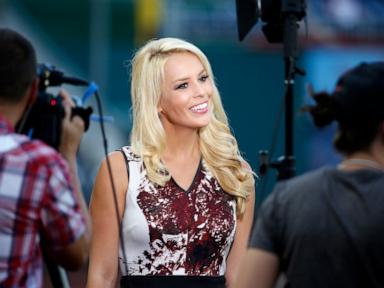
Britt McHenry resigned from her post as a State Department press adviser in late October 2026 after footage of her throwing a drink at a spectator during a Washington Wizards game went viral. The exit came barely a month after she joined the agency and less than a day after she had reportedly been slated to lead external affairs and press for Under Secretary Jacob Helberg's team.
Surface-level coverage treated the episode as a straightforward cautionary tale about a public figure losing her cool in front of smartphone cameras. That framing misses the deeper institutional mechanics at play. When political operatives, cable news personalities, and sports media figures move back and forth between high-conflict entertainment ecosystems and federal agencies, behavior rewarded on television or social media quickly collides with bureaucratic expectations of restraint.
What Happened Inside Capital One Arena
The incident unfolded on October 21, 2026, during a basketball game in Washington, D.C., where spectators seated near McHenry were heckling Milwaukee Bucks forward Kyle Kuzma over comments aimed at his fiancée, Winnie Harlow. According to accounts of the altercation, McHenry pushed back against the insults, drew criticism from surrounding fans, and became involved in a drink-throwing exchange as she moved toward the aisle and exit. Video circulated widely online showing her leaving the section while blowing kisses toward onlookers before arguing with arena security near an entrance.
Two days later, on October 23, McHenry was out at the State Department. Public reporting diverged slightly on whether she was pushed out or stepped down under pressure, while State Department officials declined to comment on internal personnel matters. Either way, the outcome was swift and decisive. A single viral clip erased a newly minted promotion before it even took root.
Why Vetters Keep Betting on Combative Profiles
Anyone who has watched Washington communications shops over the past two decades knows the temptation. Press offices frequently hire former broadcasters and partisan commentators because they arrive camera-ready, fluent in rapid-response spin, and unafraid of confrontation.
Combativeness cuts both ways. A pugilistic style that earns applause on a cable panel or generates engagement on X does not automatically translate into disciplined message management for a cabinet department. Diplomats and senior agency officials spend much of their time trying to lower the temperature of public disputes rather than escalate them in crowded arenas.
Hiring for combative instincts solves for short-term media noise while creating long-term reputational exposure.
Consider a hypothetical communications director debating between two candidates for a senior press slot. Candidate A has years of quiet policy and interagency coordination experience but rarely appears on television. Candidate B commands an instant following and thrives in verbal sparring, yet has a history of public flare-ups. If leadership prioritizes immediate loudness over institutional friction-proofing, it accepts a higher probability of sudden embarrassment whenever the candidate steps outside a controlled studio.
The Pattern Behind the Headlines
For longtime observers of sports and political media, the Wizards game clip did not land in a vacuum. In April 2015, while working as an ESPN reporter, McHenry was suspended for a week after a video surfaced showing her berating a towing company employee in harsh, demeaning terms. She later apologized for letting her emotions get the best of her during a stressful moment, though the episode remained a permanent fixture in her public dossier.
Her subsequent career arc—moving from ESPN to Fox News and conservative commentary outlets before entering a State Department press role in September 2026—illustrates how polarised media ecosystems often treat past controversies differently. Where mainstream corporate networks once treated viral public clashes as brand liabilities, partisan media spaces frequently view sharp-elbowed personalities as fighters willing to dish it out.
That tolerance has limits once a figure enters executive branch service. Even when an administration values punchy communicators, physical altercations caught on video in public venues leave little room for plausible deniability. A drink tossed in an arena aisle is harder to spin away as mere rhetorical rough-and-tumble.
Overlooked Factors in Rapid Political Exits
Fast resignations in Washington usually stem from three overlapping pressures rather than a single moral judgment.
- Reputational contagion: Senior officials overseeing external affairs cannot afford headlines about their immediate team dominating entertainment and news feeds for the wrong reasons.
- Timing and optics: Being tied to a fresh promotion or high-profile portfolio amplifies the contrast between projected authority and chaotic viral footage.
- Low switching costs: Short-tenured political appointees and advisers generally have fewer institutional roots than career civil servants, making a clean break faster and less disruptive for leadership.
There is also a fair counter-argument worth acknowledging. Arena crowds can be hostile, loud, and baiting, and spectators who heckle players or bystanders rarely face the same career stakes as a government employee. Being in the right about stopping obnoxious taunts does not guarantee smart execution in the heat of the moment.
Bureaucratic Reality Versus Arena Spectacle
The State Department is built on protocol, measured language, and carefully vetted talking points. A pro basketball game in downtown Washington operates on almost the opposite frequency, fueled by alcohol, tribal loyalty, and instant phone cameras.
Bringing those two worlds together through a high-profile press adviser created predictable friction. When McHenry stepped out of her seat and into a viral confrontation, she was no longer just a former sports anchor or media commentator. She was a federal press official whose off-duty conduct immediately reflected back on her agency.
For hiring managers and political aides watching the fallout, the lesson is straightforward. Performative toughness is easy to spot on a resume reel, but impulse control under real-world provocation is what keeps a career intact when the cameras roll unexpectedly.


