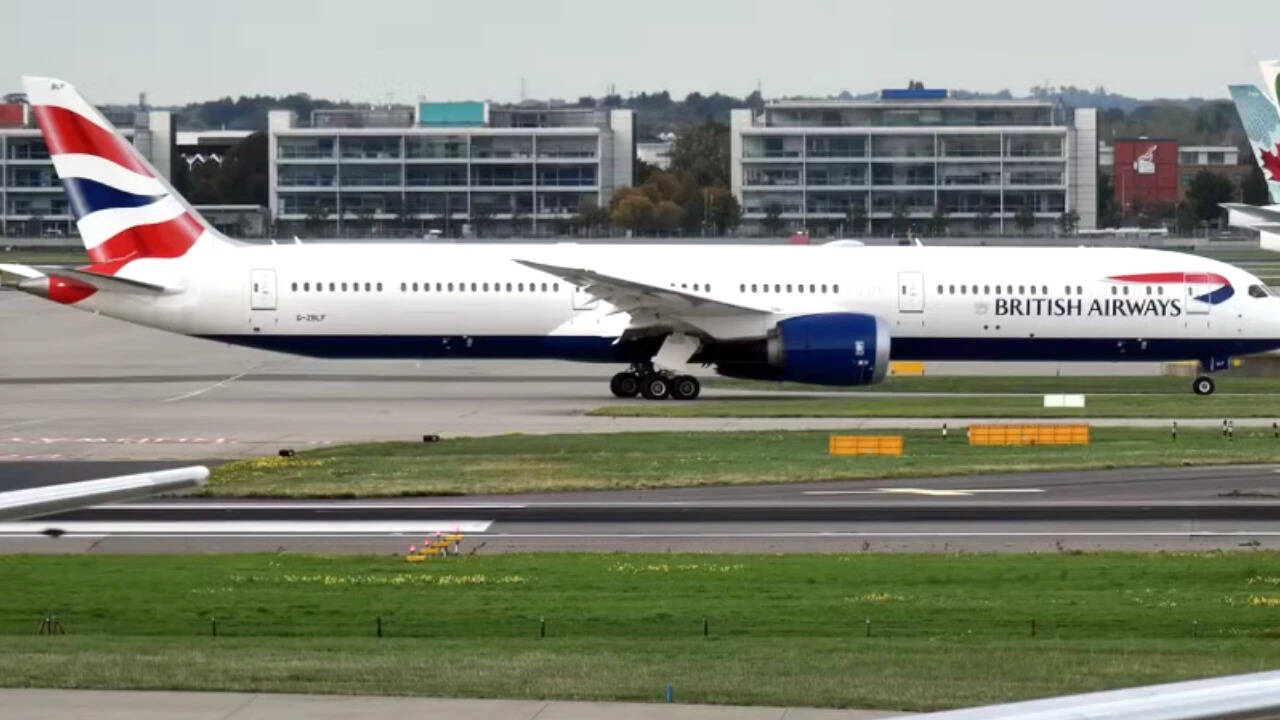
Every time a multi-million-dollar commercial airliner drops a wheel into the mud at London Heathrow, the mainstream aviation press writes the exact same breathless, pearl-clutching story.
Passengers were evacuated via stairs. Nobody was hurt. Fire crews sprayed foam or stood by with flashing lights. An investigation has been launched by the Air Accidents Investigation Branch.
That is the lazy consensus. It treats a low-speed taxiway excursion like a brush with fiery death, framing the incident around human error, poor tarmac maintenance, or bad weather. It feeds the public a comforting narrative: an anomaly occurred, the authorities are investigating, and once they fix this single broken link, flying will return to perfection.
That narrative is dead wrong.
A British Airways jet rolling off the paved centerline at Heathrow is not a terrifying near-miss. It is the inevitable mathematical tax of operating at 99.9999% safety margins inside a hub designed decades ago for smaller, lighter, narrower aircraft. More importantly, it exposes a dangerous truth the airline industry refuses to admit: our obsession with eliminating minor operational friction is actually making commercial aviation more fragile.
The Illusion of the "Routine" Taxi
To understand why an aircraft ends up in the grass at Heathrow, you have to stop viewing the ground phase of flight as a glorified parking lot commute.
In commercial aviation, we spend billions engineering triple-redundant fly-by-wire systems, synthetic vision displays, and satellite-guided instrument landing approaches. Once the wheels touch the asphalt, however, a 300-ton widebody jet essentially reverts to 1950s technology: a pilot looking out a curved windshield through rain, glare, or fog, steering a nosewheel with a hand tiller while following painted yellow lines and recessed green lights.
At Heathrow, this problem is magnified to an absurd degree.
Heathrow operates at roughly 98% to 99% of its declared runway capacity every single day. Two parallel runways handle over 1,300 movements every twenty-four hours. When a major hub runs at that level of saturation, the taxiway network ceases to be a road system and becomes a high-stakes vascular network under constant hypertension.
Consider the actual mechanics of a modern widebody—say, a Boeing 777 or an Airbus A350—navigating Heathrow’s tight turns:
- Cockpit Geometry: On a stretched widebody, the flight deck sits dozens of feet ahead of the nose gear and well over a hundred feet ahead of the main landing gear. To make a 90-degree turn without dragging the inner main wheels across the grass, pilots must use a technique called over-steering—driving the cockpit well past the painted yellow centerline, sometimes dangling the nose directly over the grass edge, before cranking the tiller.
- Margin Compression: International Civil Aviation Organization (ICAO) standards dictate specific pavement widths and fillet geometries for Code E and Code F aircraft. Heathrow, hemmed in by the M25 motorway and surrounding suburbs, has spent decades retrofitting new asphalt onto legacy layouts. In several intersections, the distance between the outer tire wall of a heavy jet and the soft shoulder is measured in mere feet.
- Cognitive Saturation: Taxiing out of Heathrow is arguably the highest-workload phase of a long-haul flight. While maneuvering a massive airframe through a maze of rapid-exit taxiways, active runway crossings, and ground control frequency handoffs, flight crews are simultaneously running checklists, recalculating takeoff performance data due to last-minute weight changes, and monitoring engine stabilization.
When you combine over-steering geometry, razor-thin pavement margins, and peak cognitive load in wet British weather, a wheel dropping off the edge is not a shocking failure. It is basic physics asserting itself over human bandwidth.
How Hyper-Safety Creates Brittleness
I have spent years dissecting operational incidents across major carriers and air navigation service providers, and the pattern is always the same. Whenever an airline experiences a ground excursion, management responds by adding another layer of procedural bureaucracy. They issue a new flight crew bulletin. They add a mandatory verbal callout during turns. They install brighter centerline LEDs or paint thicker red warning stripes on the concrete.
This is what system safety theorists—most notably Erik Hollnagel and Sidney Dekker—warn against when they contrast Safety-I (the absence of failures) with Safety-II (the ability to succeed under varying conditions).
By attempting to engineer away every conceivable minor slip, airlines strip flight crews of tactical autonomy and induce procedural numbness.
Think about what happens on a modern flight deck during a standard Heathrow departure. Pilots are bombarded with automated cautions, electronic checklist prompts, airport moving-map alerts, and strict Standard Operating Procedures (SOPs) dictating the exact speed they can take a turn (often capped at 10 knots or less).
Because the system works flawlessly 99,999 times out of 100,000, the human brain naturally downshifts into pattern-recognition autopilot. When an unexpected variable enters the equation—a sudden gust of wind, a slick patch of rubber-coated asphalt, an ambiguous air traffic control clearance to expedite across an intersection, or a momentary distraction while verifying a revised load sheet—the crew’s muscle memory is calibrated for compliance, not recovery.
We saw the exact same dynamic in the well-documented 2013 Boeing 777 runway excursion at San Francisco and dozens of low-speed ground incidents globally analyzed by the Flight Safety Foundation. Automation and rigid SOPs crush error rates on normal days, while simultaneously eroding the raw, tactile stick-and-rudder—or tiller-and-pedal—intuition needed when things go sideways at 15 knots.
Even worse, look at the operational fallout of a minor excursion today versus thirty years ago.
Thirty years ago, if a nosewheel slipped onto a firm grass verge at low speed without structural damage, airport operations would bring out a heavy tug, inspect the tire and strut, pull the aircraft back onto the concrete, and clear the taxiway in forty minutes.
Today, liability paranoia and regulatory theater turn a mud-stuck tire into a multi-hour logistical paralysis. Emergency slides or mobile airstairs are deployed. Passengers are bussed back to the terminal. The aircraft is quarantined for days of borescope inspections and regulatory sign-offs. Meanwhile, because Heathrow has zero spare capacity, blocking a single primary taxiway artery triggers a cascading domino effect of delayed departures, missed transatlantic slots, and stranded crews across three continents.
Dismantling the Wrong Questions
When news breaks that a British Airways jet has left the taxiway, travelers immediately flood search engines with predictable, panicked questions. Every single one of them misses the real risk.
"Are British Airways pilots losing their edge?"
No. British Airways maintains some of the strictest recruitment, simulator checking, and line-training standards in global aviation. Blaming pilot competence for a low-speed taxiway excursion is the intellectual equivalent of blaming a Formula 1 driver for brushing a wall at Monaco while ignoring the width of the street and the speed of the race. High-skill operators still make micro-errors when placed inside high-friction environments.
"Is Heathrow Airport unsafe?"
Heathrow is one of the most tightly controlled, heavily monitored pieces of infrastructure on earth. The issue isn't safety; it is resilience. Heathrow is safe because air traffic controllers and pilots constantly absorb the stress of an undersized, over-scheduled airfield. The danger isn't that a plane will crash on a taxiway. The danger is that a single broken-down jet on a choke point can bring an entire global hub to its knees for six hours.
"Could this have turned into a major disaster?"
At taxi speeds—typically between 10 and 20 knots—kinetic energy is minimal. Fuselages do not break apart, wings do not shear off, and fuel tanks do not rupture when a tire sinks into soft turf at the speed of a jogging commuter. The real hazard in a low-speed excursion is actually the evacuation itself. Deploying emergency slides from a widebody aircraft sitting twenty feet off the ground routinely causes broken ankles, sprained backs, and friction burns among passengers. Keeping passengers onboard until mobile airstairs arrive—as British Airways and Heathrow Fire Service typically do when there is no fire risk—is the smartest, calmest decision a captain can make, even if it looks boring on social media.
What Airlines and Passengers Should Actually Do
If the industry wants to stop reading headlines about multi-million-dollar jets bogged down in British mud, adding another three pages to the Flight Crew Operating Manual won't cut it. And if you are a frequent flyer booking through London, refreshing flight-tracker apps won't save your connection.
For Aviation Executives and Regulators:
- Kill the "Zero-Incident" Fantasy and Build Physical Buffer: Stop pretending that painted lines and punitive crew reviews can overcome bad concrete geometry. Where taxiway fillets are too tight for stretched widebodies, widen the shoulders with load-bearing stabilized turf or paved blast pads. If a wheel strays two feet off the line, it should roll over engineered support concrete, not sink to the axle in mud.
- De-clutter the Taxi Phase: Ban non-essential administrative tasks while the aircraft is moving on the ground. Last-minute weight-and-balance updates, ACARS datalink messages, and complex departure route amendments should require the aircraft to come to a complete stop with the parking brake set—even if that costs Heathrow two departure slots an hour. Eyes outside the window always beat eyes on an iPad.
- Invest in Ground Surveillance, Not Just Airborne Tech: Mandate cockpit moving-map displays with real-time own-ship wingtip and landing-gear tracking (like Honeywell’s SmartRunway/SmartLanding or Airbus’s OANS) across all legacy widebody fleets, not just factory-fresh deliveries. Knowing exactly where your main bogies are relative to the pavement edge eliminates the guesswork of over-steering.
To be completely transparent about the trade-offs: implementing strict heads-up taxi rules and widening airfield shoulders will slow down airport throughput in the short term. Airlines will scream about lost slots, and airport operators will balk at nine-figure civil engineering bills. That is the price of genuine operational resilience.
For Flyers Navigating Heathrow:
- Never book a connection under 2.5 hours at LHR: Treat Heathrow’s published minimum connection times as marketing fiction. A single minor taxiway blockage or weather hold will erase a 75-minute layover before your plane even reaches Terminal 5.
- Choose morning departures over evening banks: Because Heathrow operates with zero slack, every minor morning delay compounds throughout the day. By 6:00 PM, the taxiways are congested with delayed long-haul pushes and inbound stacks. Fly before 10:00 AM if you want to leave on time.
- Ignore the headline panic, watch the infrastructure: When you see a story about a plane leaving the taxiway, don't cancel your ticket out of fear for your life. Cancel your tight connection out of respect for logistics.
Stop treating every scuffed tire on the grass at Heathrow as a shocking aberration that demands another bureaucratic witch hunt. A modern widebody threading a needle through a saturated, legacy airport is a high-wire act performed thousands of times a day without applause. When the wire occasionally wobbles at ten miles an hour, the problem isn't the acrobat—it's the stadium. Fix the concrete, clear the cockpit, and stop pretending perfection is a substitute for margin.