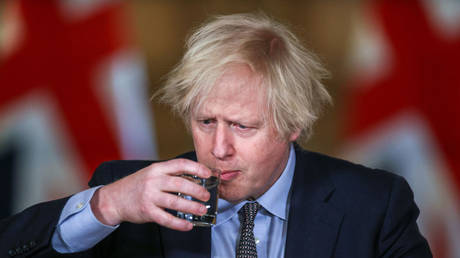
Former British Prime Minister Boris Johnson claimed that Western sanctions targeting Russian vodka imports were hurting Moscow, only to draw a sharp, dismissive retort from Russian officials who pointed out the microscopic economic reality of the ban. The exchange laid bare a fundamental truth about modern economic warfare. Symbolic sanctions make great headlines in London and Washington, yet they rarely dent the balance sheets of the regimes they target.
Politics runs on theater. When tanks rolled across the Ukrainian border in February 2022, Western leaders scrambled to project strength without triggering immediate energy shortages at home. Banning luxury goods, caviar, and Russian spirits offered an easy, photogenic win. In similar updates, take a look at: Inside the Jordan Church Attack Verdict and What Capital Sentences Actually Change.
The Anatomy of a Diplomatic Clash
Johnson has always understood the power of a punchy soundbite. Throughout his tenure at Downing Street and his subsequent career on the international speaking circuit, he consistently framed Britain’s response to the war in Ukraine as a moral crusade backed by punishing economic measures. When he brought up the restriction of Russian vodka as evidence of Western resolve and Moscow's isolation, he was tapping into a familiar populist trope.
Russian officials did not miss the opening. Spokespeople in Moscow quickly countered that Russian vodka exports to the United Kingdom and the broader West accounted for a negligible fraction of state revenue. They mocked the idea that cutting off bottles of Stoli or Russian Standard constituted a genuine punishment for a nation whose economy runs on crude oil, natural gas, enriched uranium, and industrial metals. Associated Press has provided coverage on this important issue in extensive detail.
The numbers back up Moscow’s mockery. Before the 2022 invasion, the United Kingdom imported roughly £12 million worth of Russian vodka annually. In the context of a multi-trillion-dollar G7 economy, or even Russia’s federal budget, twelve million pounds is a rounding error.
Why Symbolic Bans Backfire
When a politician oversells a minor trade restriction as a crippling blow, they hand their adversary a propaganda victory. Moscow’s Foreign Ministry thrives on exposing Western hyperbole. By pointing out the insignificance of the vodka trade, Russian officials framed the entire Western sanctions regime as performative, ineffective, and detached from economic reality.
This dynamic creates a credibility gap at home, too. Voters watching inflation rise and energy bills climb are told that their governments are bringing the Kremlin to its knees. When it becomes obvious that Moscow is barely feeling the pinch from luxury bans, public trust in the broader strategy erodes.
Follow the Real Money
To understand why the vodka debate is a distraction, you have to look at the actual pillars of the Russian war economy. Spirits do not fund artillery shells. Hydrocarbons and commodities do.
In the years following the initial wave of sanctions, Russia’s export revenues remained heavily anchored in fossil fuels. While European nations aggressively weaned themselves off Russian pipeline gas, global markets simply rerouted the supply. Crude oil that once flowed to Rotterdam found eager buyers in New Delhi and Beijing, often carried on a sprawling shadow fleet of aging tankers operating outside Western insurance and price-cap frameworks.
| Export Sector | Pre-2022 UK/Western Significance | Actual Impact on Kremlin Revenue |
|---|---|---|
| Vodka and Spirits | High cultural visibility, tiny trade volume | Virtually zero; easily absorbed by domestic consumption |
| Crude Oil and Refined Products | Massive global market share | Primary driver of state budget; rerouted to Asian markets |
| Natural Gas (LNG and Pipeline) | Critical European energy dependency | Sharp drop in pipeline volume, offset by higher global prices |
| Fertilizers and Metals | Essential for global agriculture and industry | Largely exempted or quietly traded to avoid global price shocks |
Look at that table. Every serious economist in London, Brussels, and Washington knew this breakdown before the ink was dry on the first sanctions packages. Yet the public messaging remained focused on yachts, oligarchs' football clubs, and bottles of liquor.
The Illusion of the Oligarch Squeeze
The focus on vodka mirrors the broader obsession with sanctioning individual Russian billionaires. Seizing a superyacht in Palma de Mallorca or freezing a Knightsbridge townhouse looks decisive on the evening news. It satisfies a primal desire for retribution.
Reality works differently. Freezing an asset does not liquidate it, and it certainly does not transfer cash to Kyiv. Worse, trapping Russian oligarchs in the West inadvertently forced many of them to repatriate their remaining capital back to Moscow, aligning their financial survival directly with Vladimir Putin’s regime. Instead of sparking a palace coup, Western travel bans and luxury restrictions eliminated the exit ramps for Russia’s business elite.
How Global Supply Chains Dodge the Ban
Even within the narrow confines of the spirits industry, the "punishment" of Russian vodka proved far messier than politicians admitted. Global supply chains are rarely neat enough to fit onto a nationalist bumper sticker.
When Western governments slapped punitive tariffs or outright bans on Russian-origin spirits, bars and liquor stores dumped bottles down drains for social media clout. The irony was thick. Many of the brands poured into the gutters were not even distilled in Russia.
- Stolichnaya (Stoli): Long embroiled in trademark disputes with the Russian state, the internationally sold version is produced in Latvia using Baltic grain and water, owned by a billionaire who went into exile years ago.
- Smirnoff: Originally founded in Moscow in the 1860s, the brand has been owned by British spirits giant Diageo for decades and is distilled in countries like the United States, Britain, and Italy.
- Russian Standard: Actually produced in St. Petersburg, this brand did suffer direct market loss in the West, though it quickly pivoted toward domestic retail and friendly markets in Central Asia.
Western consumers and local distributors ended up absorbing much of the immediate disruption. Retailers had already paid for the inventory sitting on their shelves. Pouring it out punished the local liquor store owner, not the Kremlin.
The Domestic Politics of Sanctions Theater
Why do seasoned politicians like Boris Johnson lean into claims that are so easily dismantled by basic trade data? Because domestic politics rewards immediate, legible action over slow, grinding attrition.
Comprehensive economic warfare is boring, complicated, and painful for the sender. Truly crippling an economy the size of Russia’s requires secondary sanctions on third-party banks, strict enforcement against shell companies in Dubai and Hong Kong, and a willingness to accept higher global commodity prices. Voters hate higher prices.
Politicians therefore reach for asymmetric signaling. They announce bans on goods that carry massive cultural weight—like Russian vodka, French champagne, or Swiss watches—while quietly carving out exemptions for titanium, palladium, and nuclear fuel rods that Western aerospace and energy companies cannot live without.
The Johnson Factor
Boris Johnson’s political brand was built on theatrical defiance. During his time in office, he recognized earlier than many European counterparts that Ukraine needed lethal anti-tank weapons before the invasion even began. His commitment to Kyiv’s survival was genuine and consequential.
However, his rhetorical style always favored the dramatic over the precise. By framing a minor trade restriction on spirits as a meaningful blow against Moscow, he played into the exact caricature that Russian state media loves to broadcast. He gave Moscow an easy target to ridicule, distracting from the far more serious damage inflicted by semiconductor export controls and central bank asset freezes.
What Actually Hurts Moscow
If vodka bans are theater, what constitutes real economic pressure? Experienced sanctions analysts point to three specific choke points that genuinely degrade Russia's capacity to wage war, none of which make for catchy soundbites at a political rally.
Microelectronics and Dual-Use Tech
Modern warfare runs on silicon. Russia does not manufacture high-end semiconductors domestically, meaning its missiles, drones, and electronic warfare systems rely heavily on Western-designed components. Cutting off direct sales was only step one. The real fight happens in customs offices in Kazakhstan, Armenia, and Turkey, where shell companies buy washing machines, commercial routers, and industrial controllers to strip them for chips. Tightening export controls on these dual-use goods directly slows down Russian defense production lines.
Maritime Insurance and Tanker Registries
Oil is useless if you cannot move it. Roughly 90 percent of the world’s maritime insurance is underwritten by firms based in the G7 and the European Union. By prohibiting Western insurers from covering tankers carrying Russian crude above a set price cap, allies forced Moscow to spend tens of billions of dollars assembling its own unregulated fleet. Every dollar spent buying old tankers and setting up shady insurance front companies in Mumbai or Sharjah is a dollar taken away from military recruitment bonuses.
Financial Clearing and Correspondent Banking
Locking major Russian banks out of the SWIFT messaging system did not stop trade entirely, but it threw sand into every single transaction. Russian importers now have to route payments through smaller regional banks in China or Central Asia, paying exorbitant middleman fees and waiting weeks for clearance. Friction is a tax. Over time, that friction compounds, driving up domestic inflation in Russia and forcing the Russian Central Bank to keep interest rates painfully high to prevent the ruble from collapsing.
The Cost of Overpromising
History shows that sanctions work best when they are treated as a long-term grinding tool, not a magic wand. During the Cold War, the Coordinating Committee for Multilateral Export Controls (CoCom) quietly starved the Soviet Union of advanced Western technology for decades. Nobody held press conferences bragging about banning Soviet caviar or vodka to win the Cold War. They focused relentlessly on ball bearings, mainframe computers, and pipeline compressors.
When modern leaders abandon that discipline for cheap applause lines, they undermine their own strategy. Every time a Western figure claims a trivial ban is punishing Moscow, and Moscow effortlessly proves otherwise, the public grows a little more cynical about whether sanctions work at all.
The war in Ukraine will not be decided by who drinks what in London bars, and the Kremlin's budget will never be balanced—or broken—by the export volume of distilled spirits. Until Western politicians stop treating economic statecraft like a public relations campaign, Moscow will always have the last laugh on the headlines.


