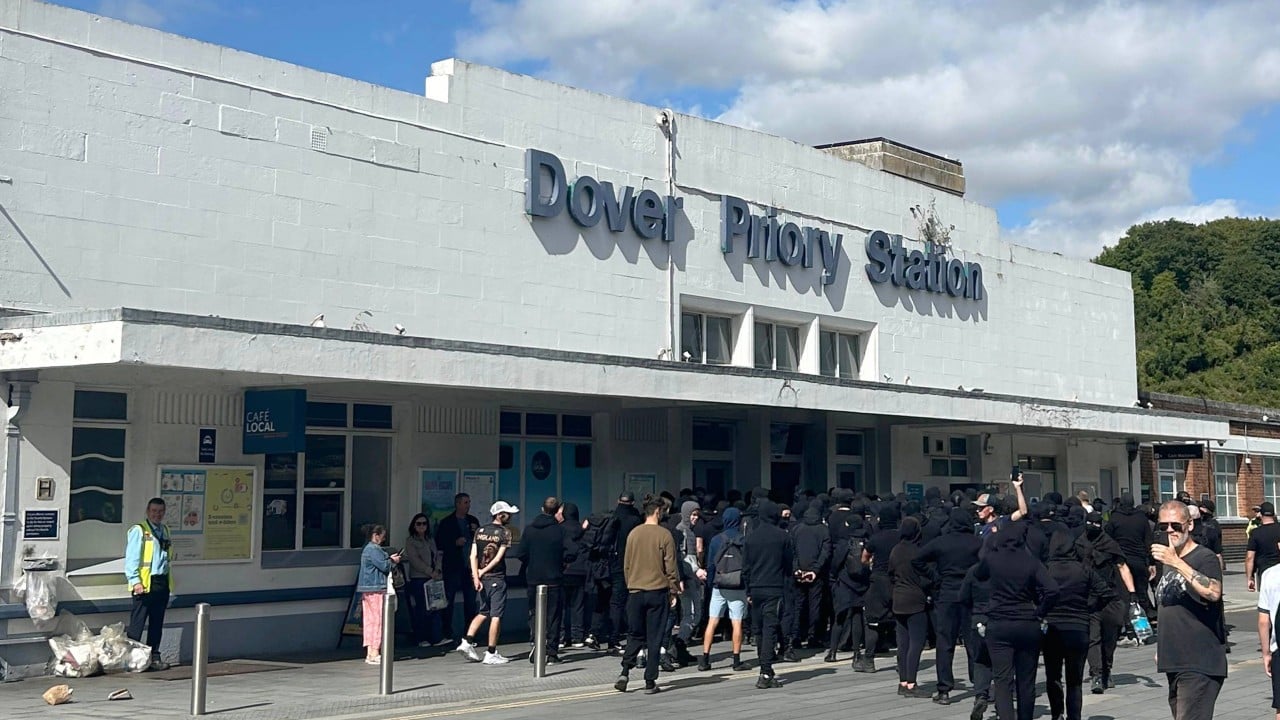
Port blockades function as structural bottlenecks that immediately test supply chain resilience, public order maintenance, and national security protocols. When masked protesters mobilize to restrict transit corridors at the Port of Dover, the event is frequently reduced in mainstream media coverage to a simple clash of opposing ideological factions. That framing ignores the underlying mechanics of critical infrastructure vulnerability. Dover processes a substantial percentage of trade between the United Kingdom and continental Europe, making any disruption to its throughput a systemic shock rather than a localized public disturbance. Evaluating these events requires stripping away political rhetoric and examining the operational vulnerabilities, economic friction, and jurisdictional enforcement challenges that define border chokepoints.
The Structural Vulnerability of Linear Trade Corridors Meanwhile, you can explore related developments here: What the Search for Missing Bodies in Nepal Reveals About Disaster Recovery.
Modern logistics relies on predictable velocity. Just-in-time supply chains operate on narrow time buffers where inventory turnover is synchronized with transport schedules. A port like Dover is not merely a parking lot or a stretch of highway; it is a high-frequency node where maritime and terrestrial transport modes intersect.
When protesters execute a blockade, they exploit the asymmetry between open civil transit and secure trade infrastructure. The port's architecture is optimized for high-volume clearance rather than defensive containment. Access roads, ferry terminals, and vehicle queueing areas are distributed across municipal and port authority jurisdictions, creating friction in emergency response times. To explore the bigger picture, check out the recent analysis by The Washington Post.
- Throughput Velocity Dependency: The system requires continuous vehicle clearing to prevent backups. A stationary obstruction anywhere along the primary arterial routes halts the compounding flow of freight.
- Jurisdictional Fragmentation: Authority is split between local police forces, port operators, border control agencies, and national highways management. This dispersion of command slows tactical decision-making during sudden civil disobedience events.
- Buffer Capacity Limits: Holding areas near the port possess finite spatial capacity. When outbound traffic stalls, congestion immediately spills back onto regional motorways like the A20, paralyzing non-port commuter traffic and secondary logistics networks.
The Economic Cost Function of Forced Delays
The financial impact of a Dover blockade scales non-linearly. Initial hours of disruption generate minor rescheduling costs and driver hour adjustments. Extended blockades cross critical operational thresholds where perishables spoil, manufacturing plants face imminent component starvation, and transport firms incur severe demurrage penalties.
Transport economics relies heavily on asset utilization. Commercial trucks generate revenue exclusively when moving freight. When a tractor-trailer sits idle due to a port blockade, the fixed costs of depreciation, driver wages, and leasing fees continue to accrue while productivity drops to zero.
Transport firms absorb these initial losses, but they rapidly pass them up the supply chain through emergency surcharges and spot-market rate spikes. Retailers and manufacturers dependent on perishable goods or rapid-turnaround components absorb secondary costs through stockouts, lost sales revenue, and expensive modal shifts, such as emergency air freight or alternative routing via less efficient ports.
The Enforcement Dilemma and Public Order Mechanics
Managing civil disobedience around critical national infrastructure presents a tactical dilemma for law enforcement. Security forces must balance three competing imperatives: restoring operational continuity to critical trade lanes, maintaining public safety during confrontations with masked groups, and upholding the legal right to peaceful assembly where applicable.
Masked protesters complicate identification and accountability, shifting the tactical burden onto crowd control units. When demonstrators use anonymous attire to obscure their identities while obstructing public highways, law enforcement agencies face heightened risks of escalation.
- Response Latency: Police deployment depends on intelligence gathering and tactical readiness. Spontaneous blockades catch local forces without pre-positioned containment assets, forcing a reactive posture.
- Escalation Management: Clearing a determined blockade requires physical force or rapid vehicle removal capabilities. Heavy towing equipment is often difficult to position when access roads are deliberately clogged by stationary transport vehicles or human chains.
- Deterrence Deficit: Without rapid prosecution and strict sentencing guidelines for individuals who target critical supply chains, the cost-benefit ratio for protesters favors disruption. The immediate political visibility achieved by the protest often outweighs the delayed legal consequences.
Strategic Mitigation and Systemic Adaptation
Mitigating the threat of future blockades requires moving away from purely reactive policing toward hardening infrastructure and optimizing traffic management systems. Port operators and national transport authorities must treat civil disruption as a predictable operational risk, akin to severe weather events or technical system failures.
Deploying dedicated rapid-response transport clearance teams can drastically reduce the duration of blockades. If heavy towing assets and specialized removal units are permanently stationed near high-risk nodes, the window of vulnerability shrinks from hours to minutes. Furthermore, integrating real-time traffic monitoring with predictive route diversion algorithms allows logistics operators to reroute freight before trucks enter the immediate congestion zone.
Securing vital trade corridors demands an integrated command structure that unifies border control, national policing, and port operations under a single emergency authority during critical incidents. Eliminating jurisdictional friction ensures that tactical decisions regarding crowd dispersal and traffic redirection are executed without bureaucratic delay.
Future resilience will be measured by how quickly transport networks can absorb localized shocks without allowing disruption at a single port to cascade into a nationwide logistical failure. Policy makers must prioritize the legal classification of critical infrastructure blockades as high-severity economic offenses, ensuring that the legal framework matches the systemic danger posed by deliberate supply chain sabotage.