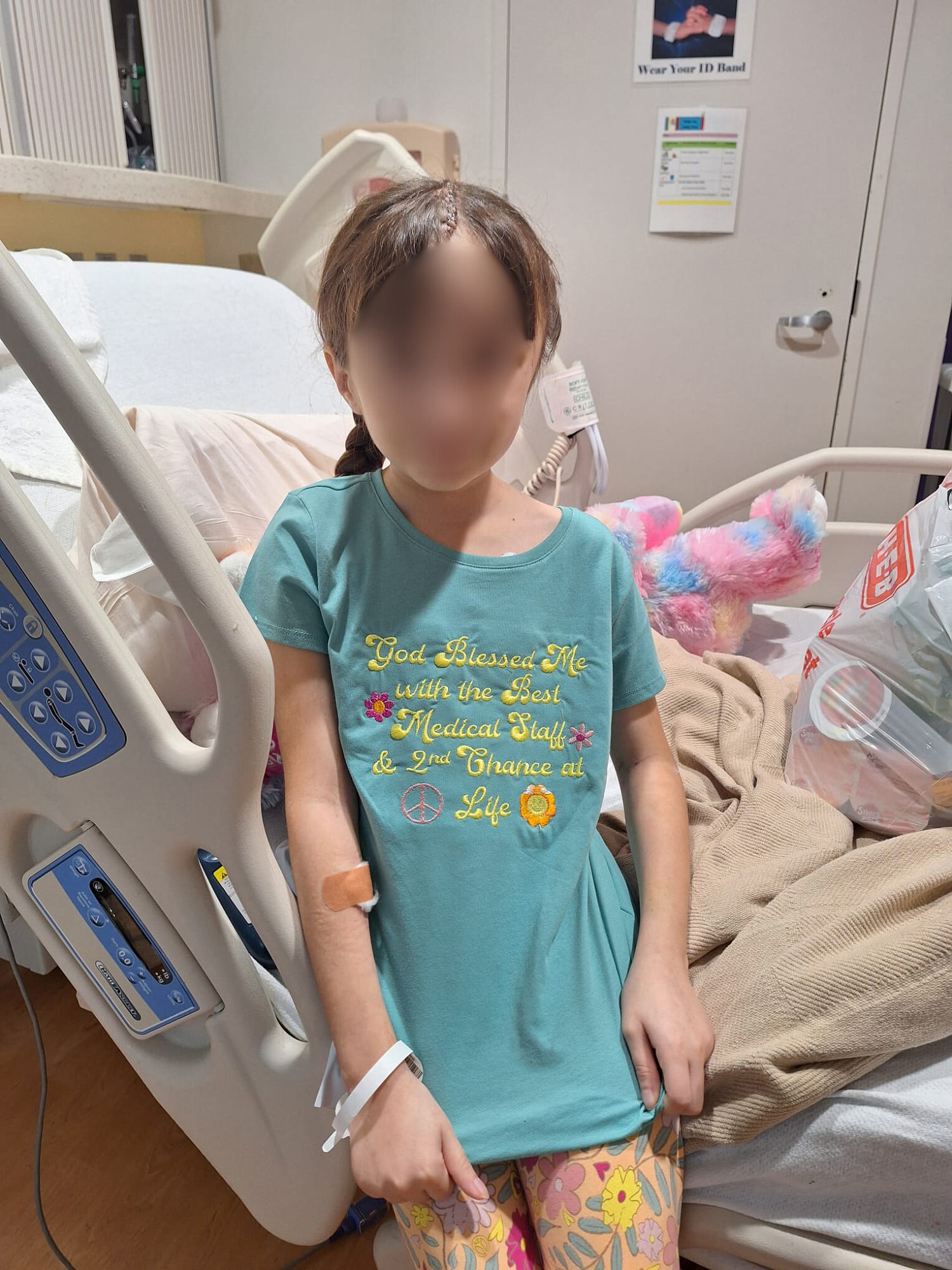
The hospital room smells of industrial lavender and rubbing alcohol. It is a sterile, heavy scent that anyone who has spent a night in a pediatric oncology ward will never forget. Beneath the fluorescent lights, a six-year-old girl named Maya lies in a bed that is far too large for her. A roadmap of blue veins traces beneath her translucent skin, and a scar runs along the side of her shaved head—the physical receipt of a surgery that tried, and failed, to remove all of a rare, aggressive brain tumor.
Maya is a United Kingdom citizen. She has a right to the best medical care this country can offer. She has a right to the experimental trials, the targeted radiation, and the team of specialists who speak in hushed, urgent tones outside her door.
But she does not have her parents.
Two miles away, a stack of legal documents sits on a desk in a government office. The top sheet bears a single, stamped word in red ink: Denied. It is the rejection of a humanitarian parole application. With that one word, the machinery of state immigration policy effectively decides that a dying child must face the hardest fight of her life without the two people she needs most.
This is not a story about statistics, or border security, or the legal definitions of citizenship. It is a story about the devastating friction between rigid bureaucratic policy and the fragile, messy reality of human survival.
The Architecture of Absence
To understand what humanitarian parole actually means, you have to look past the legal jargon. It is, at its core, a safety valve. The law recognizes that immigration rules are written in stone, but human lives are lived in quicksand. It is a mechanism designed for urgent, compelling humanitarian reasons—a way to temporarily pause a deportation order or allow a deported individual back across the border because a crisis demands it.
If a six-year-old girl fighting a terminal brain tumor does not qualify as an urgent humanitarian reason, it begs a chilling question: What does?
Maya’s parents were deported two years ago due to a visa overstay. It was a standard, by-the-numbers enforcement action. The system worked exactly the way it was designed to work. The paperwork was filed, the orders were signed, and a family was severed. At the time, Maya was a healthy toddler, living under the care of an aunt who is a legal resident.
Then came the headaches. Then came the loss of balance. Then came the diagnosis: a diffuse intrinsic pontine glioma, a tumor so deeply embedded in the brainstem that complete surgical removal is impossible.
When a child faces a diagnosis like this, the medical protocol is only half the battle. The other half is psychological comfort. Any pediatric nurse will tell you that a child’s cortisol levels, their willingness to eat, and their resilience during grueling chemotherapy cycles are tethered directly to their emotional security. They need their mother to hold their hand when the IV line goes in. They need their father’s voice to soothe them through the claustrophobia of an MRI machine.
Instead, Maya gets a tablet screen.
Every evening, her father’s face appears in a pixelated window from a choppy internet connection hundreds of miles away. He tries to sing her to sleep through a lagging audio feed. He watches his daughter fade in real-time, unable to touch her forehead to see if she has a fever, unable to speak to her doctors face-to-face, unable to do anything but watch a tragedy unfold through a piece of glass.
The Cost of Rigid Consistency
The justification for denying the family’s return is rooted in a familiar logic. Government agencies argue that rules must be applied uniformly to maintain the integrity of the border system. If exceptions are made too easily, the system risks collapse under the weight of precedent. Policy, by design, cannot have a heart; it must have structure.
But when structure becomes entirely blind to human suffering, it ceases to protect the society that created it.
Consider the sheer asymmetry of power in this scenario. On one side is a sovereign nation with vast resources, legal frameworks, and enforcement agencies. On the other side is a sick child whose time is measured in months. The denial of humanitarian parole doesn't make the country safer. It doesn't fix the immigration system. It simply ensures that a child’s final memories will be defined by an artificial separation.
The legal argument often shifts to the caretakers who remain. Maya has her aunt. She has doctors. She is not abandoned in a physical sense. But substituting an aunt for a mother during an oncology crisis is like substituting a textbook for a teacher. It covers the basic requirements, but it misses the soul of what is actually needed.
The system treats the family as separate, atomized individuals: the child is a citizen, the parents are undocumented, the aunt is a resident. The law draws sharp, unforgiving lines between them. But a family is not a collection of individual legal statuses. It is an ecosystem. When you damage one part, the whole structure begins to wither.
The Invisible Stacks
We often talk about the cost of immigration policy in terms of finances—the price of detentions, the cost of deportations, the strain on public health systems. We rarely calculate the moral deficit.
Every time a decision like this is handed down, a quiet tremor goes through communities. It sends a message that citizenship is a tiered shield. Maya's passport says she belongs, but the state's actions tell her that her family does not. It creates a profound sense of alienation for the thousands of children who occupy this strange, liminal space—born citizens to parents who exist in the shadows of the law.
Medical professionals involved in Maya's care have filed affidavits detailing the regression they see in her mental and physical state when the reality of her parents' absence sets in. They describe the acute anxiety attacks before major procedures, the depression that mimics the physical lethargy of the tumor itself. These are not hypothetical outcomes. They are clinical observations recorded in black ink on white paper, filed into the same system that rejected the appeal.
The legal avenues are narrowing. Lawyers can file for a motion to reconsider, they can seek emergency judicial intervention, but the clock is a luxury Maya does not possess. The slow, grinding gears of the judiciary move at a pace that ignores the aggressive growth of abnormal cells.
The Light in the Ward
Visiting hours are ending. The hospital corridors are growing quiet, save for the rhythmic, mechanical beep of heart monitors and the soft squeak of nurses' shoes on the linoleum.
Maya’s aunt sits in a vinyl chair beside the bed, her face lined with the exhaustion of a woman trying to hold two worlds together with sheer willpower. She holds the tablet up one last time. The screen lights up, illuminating Maya’s pale face.
On the screen, her father is sitting in a poorly lit room. He is smiling, but it is a fragile, exhausting smile that doesn't reach his eyes. He tells her a story about the street where he grew up, about the trees that bloom in the spring, about how much he wishes he could show her the world outside this room.
Maya closes her eyes, her breathing slowing as the medication takes hold. She reaches her small hand out toward the nightstand, her fingers brushing against the edge of the tablet, seeking a warmth that a screen can never replicate.
The call disconnects. The screen goes black. In the silence of the room, the only sound left is the steady, indifferent ticking of the wall clock, counting down the hours in a world where the law has won, and a little girl is left to fight alone.


