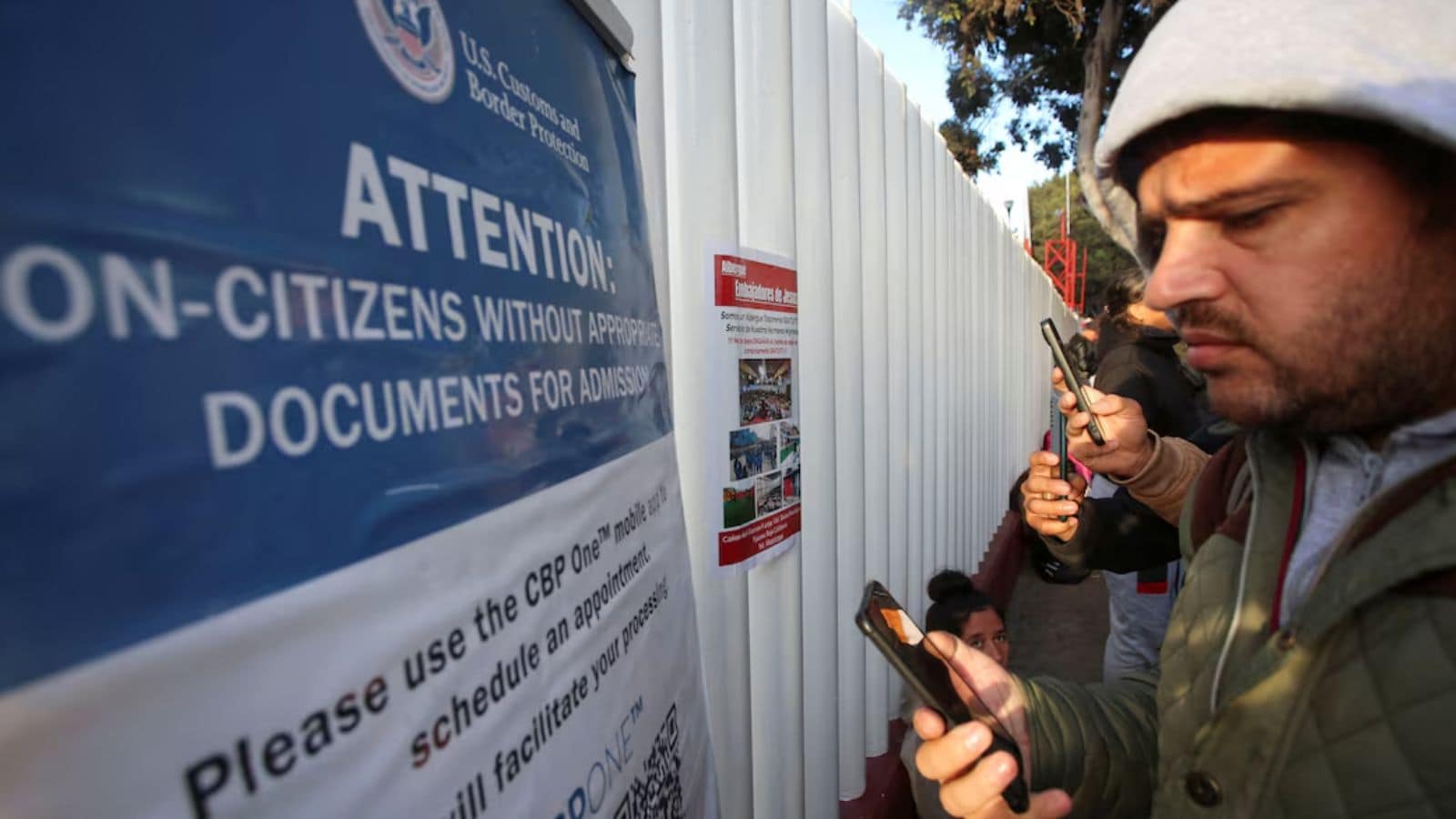
The fluorescent lights of a federal processing center do not care about the heat of the Chihuahuan Desert. They hum a flat, continuous note. Underneath that hum, a man sits on a metal bench, holding a damp folder of papers. His hands are shaking. Not from fear, exactly, but from the sudden, jarring transition from the chaotic rush of the Rio Grande to the absolute, sterile stillness of American bureaucracy.
For a person fleeing violence, that folder is not just paper. It is a shield.
But a single pen stroke in Washington can make that shield vanish before a judge ever looks at it.
The United States Supreme Court recently handed down a decision that alters the machinery of American asylum. It sounds like a bureaucratic footnote: the Court sided with the executive branch regarding fast-track deportation procedures, specifically concerning how quickly the government can reject asylum claims at the threshold. To the legal scholars reading the briefs, it was a technical victory regarding statutory interpretation and executive authority. But to anyone who has ever stood in a crowded processing room, it represents a profound shift in who gets a voice and who is silenced at the gate.
The legal mechanism at play is called "expedited removal." It is a system designed for speed. When a migrant crosses the border without authorization, the government wants to know, almost immediately, if there is a valid claim to stay. To do this, asylum officers conduct a "credible fear" interview. It is a screening test. A baseline.
If you pass, you get to see a judge. If you fail, you are sent back.
The case before the Supreme Court centered on whether the federal courts have the power to review those rapid-fire rejections. When the high court ruled that the judiciary's hands are largely tied, they did not just rule on a case. They validated a conveyor belt.
Imagine trying to explain the worst trauma of your life through a cracked plastic window, via a translator on a scratchy phone line, while an exhausted officer clocks their twelfth hour of overtime. You have forty-eight hours to gather your thoughts. You have no lawyer. You have no understanding of the intricate nuances of U.S. immigration law. You must simply perform your terror convincingly enough to meet a legal standard.
Consider what happens next if that officer misinterprets your dialect, or misses the subtext of your story because they are rushing to meet a quota. Under the new legal reality, that mistake becomes permanent. The safety valve of judicial review—the right to ask a neutral judge to look at the paperwork and say, "Wait, this person was misunderstood"—has been cut away.
This is where the abstract concept of national sovereignty collides brutally with human frailty.
Supporters of the ruling argue that the system is drowning. They are not wrong about the numbers. The sheer volume of arrivals at the southern border has strained every municipal, state, and federal agency involved. In their view, allowing every single expedited removal to be appealed to a federal court would paralyze the entire American legal system. The backlog is already measured in years. To them, speed is a logistical necessity. Efficiency is the ultimate virtue when the alternative is chaos.
But efficiency has a shadow side.
When we prioritize the speed of the line over the accuracy of the outcome, the cost is paid in human lives. The law assumes that a credible fear interview is a robust enough filter to catch the truly desperate while filtering out economic migrants. Yet, anyone who has worked near the border knows that trauma does not speak in a linear narrative. A woman who has watched her family targeted by a cartel does not always articulate her fear with chronological precision on day one. She might shut down. She might lie about small details out of a learned distrust of uniforms.
Under the court’s decision, the system treats that human response as a failure to meet the threshold.
The debate often gets lost in political theater, polarized between slogans of open borders and total enforcement. The reality is far quieter and much more devastating. It is found in the stack of folders that will now be stamped "deported" without ever reaching a courtroom. It is found in the realization that the law can become so streamlined that it loses its capacity for mercy.
The machine works faster now. The queues might move with greater velocity, and the data sheets in Washington will reflect higher numbers of closed cases. But as the bus idles outside the detention center, waiting to carry people back to the very dangers they risked everything to escape, the question remains.
We have perfected the speed of the process. We have yet to reckon with its cost.