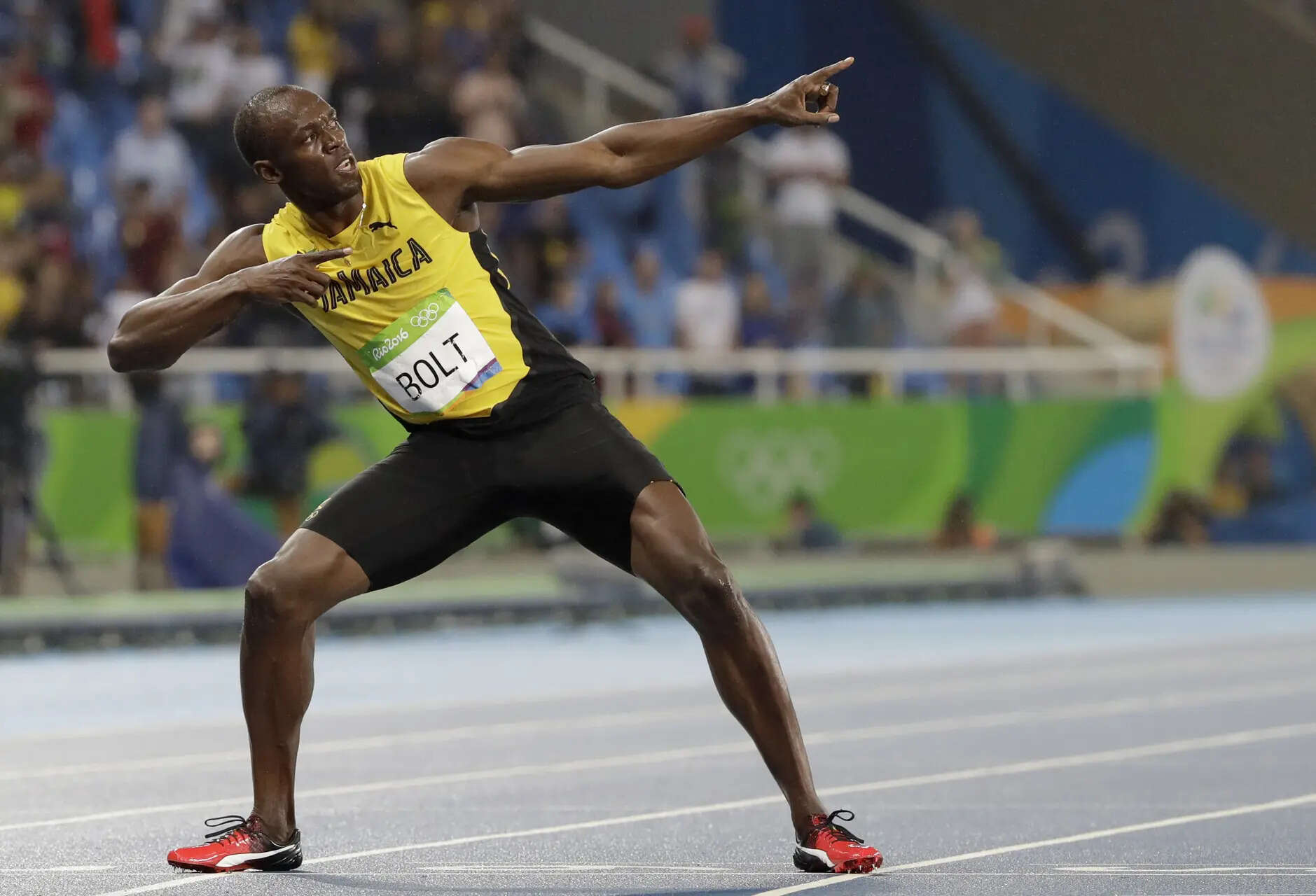
Usain Bolt famously claimed he did not think about limits. On the surface, it sounds like the standard motivational fare fed to corporate seminars and high school track teams. But for those who have spent decades tracking the intersection of biomechanics and elite performance, that statement is less about inspiration and more about a brutal, physiological reality. The fastest man on Earth wasn't just ignoring mental barriers; he was operating on a physical plane that restructured our entire understanding of human locomotion.
When Bolt ran his 9.58-second 100-meter dash in Berlin, he didn't just break a record. He broke the model. Conventional wisdom at the time suggested that the ideal sprinter should be compact, explosive, and built like a middleweight boxer. Bolt was a 6-foot-5 anomaly who defied the laws of leverage. To understand why he could dismiss "limits," we have to look at the cold, hard mechanics of his stride and the unique neurological wiring required to move a frame that large at twenty-seven miles per hour.
The Mechanical Defiance of 9.58
Speed is a simple equation. It is the product of stride length multiplied by stride frequency. Most elite sprinters maintain their speed by taking more steps than their competitors. Bolt flipped this. While his rivals were taking 44 to 46 steps to cover 100 meters, Bolt was finishing the race in 41.
This creates a massive physical problem. A longer limb acts as a longer lever. In basic physics, moving a long lever quickly requires significantly more force than moving a short one. The "limit" for a man of Bolt’s height should have been his inability to cycle his legs fast enough to compete with shorter, more "efficient" athletes. He bypassed this through a sheer output of ground reaction force that seems almost impossible for human tendons to withstand.
Data from the Berlin race shows that Bolt wasn't just moving his legs fast; he was hitting the track with a peak force of nearly 1,000 pounds. He wasn't running so much as he was bouncing, using his body like a carbon-fiber spring. When he says he doesn't think about limits, he is describing a state where the brain stops protecting the body from its own power. Most humans have a "governor" in their brain—a safety mechanism that prevents us from exerting enough force to snap our own bones or tear our muscles. Bolt’s gift was the ability to turn that governor off.
The Cost of the Limitless Mindset
We love the idea of "no limits" because it suggests infinite potential. The reality is far more expensive. The human body is a closed system with a finite energy budget. To achieve the speeds Bolt reached, the central nervous system has to fire with such intensity that it bordering on a seizure-like state of total muscle recruitment.
This is why Bolt’s career was a constant battle against his own anatomy. His scoliosis—a curvature of the spine—meant his body was naturally unbalanced. His right leg hit the ground with 13% more force than his left. In any other athlete, this imbalance would have been a career-ending flaw. Bolt turned it into a lopsided, rhythmic advantage.
The industry often ignores the dark side of this "limitless" approach. We see the gold medals, but we miss the years of chronic inflammation, the shredded hamstrings, and the neurological exhaustion that follows a nine-second burst of peak output. For every Bolt who succeeds in ignoring his limits, there are thousands of athletes whose bodies shattered trying to emulate the same philosophy. The limit isn't a mental wall; it is a biological boundary designed to keep us alive.
Why the Records Have Stagnated
Since Bolt stepped away from the track, the 100-meter world record has remained untouched. We are currently witnessing a plateau in human speed that suggests we may have finally hit the ceiling of what organic muscle and bone can achieve.
Current sports science suggests that the "limit" for the 100-meter dash sits somewhere around 9.48 seconds. To go faster, a human would need to exert a force-to-weight ratio that exceeds the structural integrity of the human patellar tendon. We are reaching a point where the only way to go faster is to change the material we are made of.
The Factors Holding Back the Next Bolt
- Neural Drive: The ability of the brain to send signals to the muscles fast enough.
- Tendon Stiffness: The capacity to store and release elastic energy without losing power.
- Morphological Constraints: The biological "weight" of moving larger limbs at high frequencies.
Bolt was the perfect storm. He had the height of a basketball player and the fast-twitch fiber density of a powerlifter. He arrived at a moment when track technology—specifically the density of the track surface and the stiffness of spike plates—caught up to his physical potential.
The Fallacy of Modern Motivation
The danger in Bolt’s "I don't think limits" quote is how it has been sanitized for general consumption. In the hands of a life coach, it’s a platitude. In the hands of an elite sports scientist, it’s a warning.
Limits exist for a reason. They are the baseline of our species. When we talk about "breaking" them, we are talking about an act of extreme violence against the self. Bolt’s greatness didn't come from a positive attitude; it came from a rare biological makeup that allowed him to survive the stress of his own ambition.
We see this same pattern in other industries. The founder who sleeps four hours a night or the surgeon who works thirty-hour shifts. They claim they don't believe in limits. But eventually, the biology catches up. The heart fails, the brain fogs, or the spirit breaks. Bolt was smart enough to retire exactly when his body started sending the bill for his decade of defiance.
Redefining the Ceiling
If we want to understand the future of human performance, we have to stop looking for the next person to "ignore" limits and start looking for the next person to redefine them through technical precision. The next era of speed won't come from trying harder. It will come from the optimization of recovery and the precision of biomechanical alignment.
We are entering a period where "grit" is less important than "data." The athletes who will eventually challenge 9.58 are currently in labs, measuring their ground contact time in milliseconds and their blood lactate levels in real-time. They aren't thinking about limits because they are too busy calculating them.
The aura around Bolt remains because he was the last of the "naturals"—an athlete who seemed to achieve the impossible through sheer charisma and raw power. But even he was a product of intense, specialized training that focused on managing his spinal issues and maximizing his unique stride. He didn't just ignore the wall; he studied every crack in it until he found a way through.
The Mechanical Truth
The 100-meter sprint is the purest expression of human physics. There is no equipment to hide behind, no teammates to pick up the slack. It is just gravity, friction, and force.
When you look at the slow-motion footage of Bolt at his peak, you don't see a man who is "limitless." You see a man who is under immense physical duress. His face is distorted by G-forces, his muscles are vibrating under the strain, and his joints are absorbing impacts that would hobble an average person. That is the reality of elite performance. It isn't a graceful ascent; it is a controlled explosion.
The Breakdown of a Stride
- Reaction: The milliseconds between the gun and the first muscular contraction.
- Drive Phase: The first 30 meters where the body stays low to overcome inertia.
- Max Velocity: The "Bolt Zone" between 60 and 80 meters where height becomes the ultimate weapon.
- Deceleration: The final 20 meters where the goal is simply to lose speed slower than the person next to you.
Bolt’s secret wasn't that he didn't slow down. Everyone slows down. His secret was that his deceleration curve was flatter than anyone else's in history. He maintained his top-end speed for longer because his massive stride allowed him to cover more ground with less effort once he reached his peak.
Beyond the Quote
We need to retire the idea that success is merely a matter of mental state. If you "don't think limits" but lack the lateral hip stability to hold your pelvis level during a high-speed sprint, you won't win a gold medal; you’ll end up in a physical therapy clinic.
Bolt’s legacy shouldn't be a poster on a wall with an inspirational caption. It should be a case study in the extreme margins of human capability. He showed us where the line is. He didn't prove that limits don't exist; he proved exactly where they are by standing right on the edge of them until the clock stopped.
The next time someone tells you that your only limits are in your mind, remember the 1,000 pounds of force hitting Bolt’s ankle every time his foot touched the track. The mind can set the direction, but the body has to sign the checks.
Understand your mechanics, respect your biology, and recognize that "limitless" is a marketing term, not a training manual. Success at the highest level requires an intimate, almost obsessive understanding of exactly what your limits are so that you can lean against them without falling over.