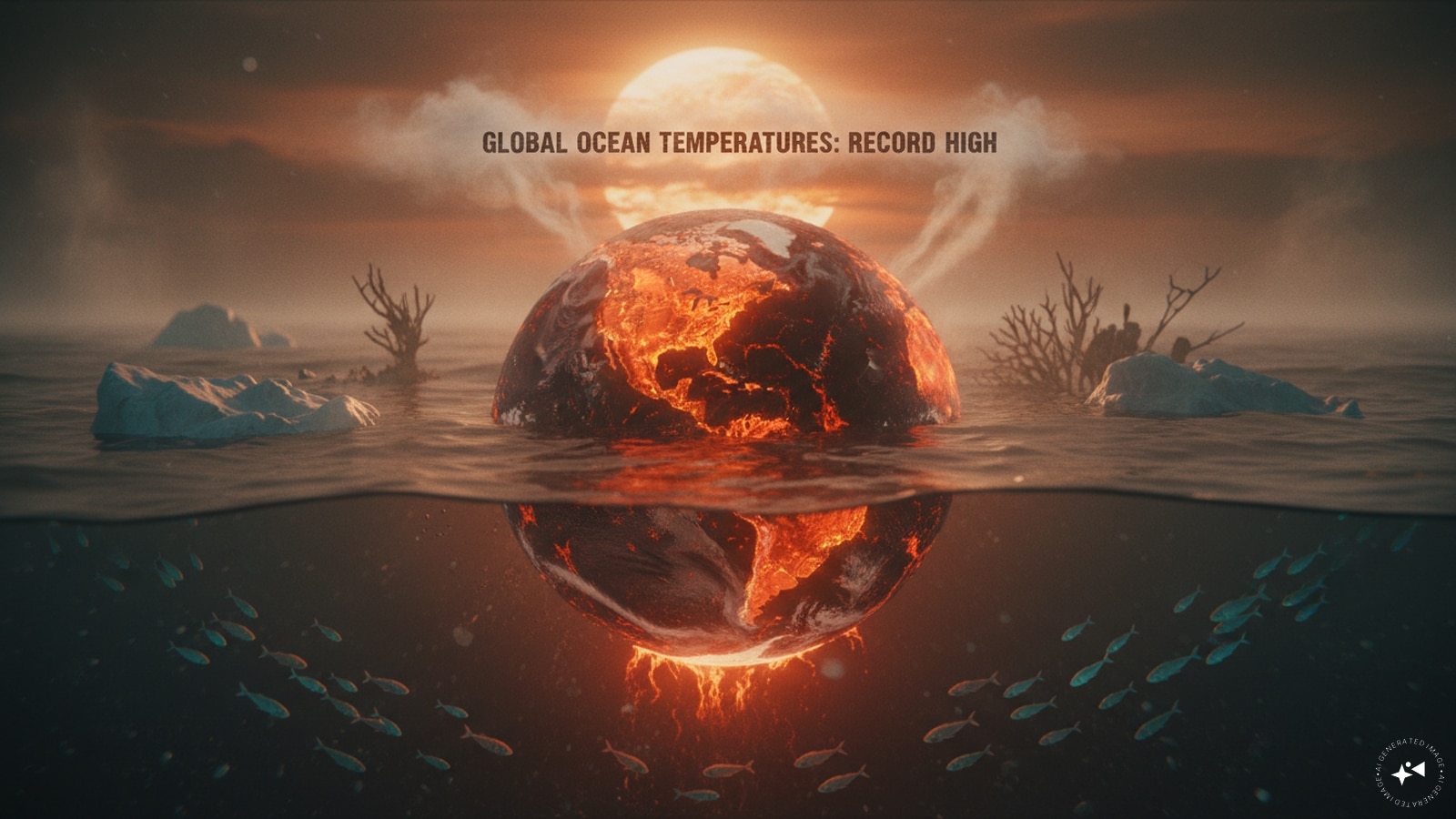
Global ocean temperatures hit an unprecedented 21.1 degrees Celsius, shattering historical baselines at a time of year when marine systems should be cooling down rather than heating up. According to data released by the Copernicus Climate Change Service, this new benchmark bypasses the previous peak set in March 2024.
For nations like India and coastal economies worldwide, this thermal spike represents an immediate structural threat to monsoon stability, fisheries, and shoreline infrastructure. Water retains heat far more efficiently than air. When the extra-polar global ocean builds up this level of excess energy, atmospheric systems respond with volatile intensity. The mechanics driving this anomaly are clear, yet the institutional urgency required to mitigate the fallout remains entirely absent. Recently making waves in this space: The Concrete Shadows of Karachi.
The Seasonal Paradox That Has Scientists Alarmed
The timing of this temperature surge breaks every established meteorological rule. Historically, global sea surface temperatures peak in March and April, coinciding with the end of the Southern Hemisphere summer where the vast majority of the planet's ocean surface area resides. August falls well outside this natural heating window.
When a thermal record falls in late August, standard seasonal logic breaks down. This anomaly signals that the background heating rate of the marine environment has completely decoupled from normal solar cycles. Decades of unmitigated greenhouse gas emissions have loaded the thermodynamic dice, allowing a strengthening El Niño phase in the tropical Pacific to act as an accelerant on an already overheating system. Further details regarding the matter are covered by Al Jazeera.
More than ninety percent of the excess heat trapped by industrial carbon emissions goes directly into the oceans. The water is simply doing its job as Earth's primary thermal sponge, but that sponge is now nearing saturation. As thermal expansion continues unchecked, sea levels rise not only from melting glaciers but from the physical expansion of warmer water volume.
Direct Shockwaves Across the Indian Subcontinent
The Indian monsoon engine depends on precise thermal gradients between the landmass and the surrounding Indian Ocean. When the Arabian Sea and the Bay of Bengal undergo abnormal warming, the fundamental dynamics of moisture transport change.
Consider a hypothetical farming community in Maharashtra relying on predictable rainfall patterns for the Kharif crop sowing season. Extreme marine temperatures alter low-pressure systems, turning steady seasonal monsoons into erratic bursts of catastrophic precipitation interspersed with prolonged dry spells. Flash floods wash away topsoil while dry windows stunt grain development.
Furthermore, marine heatwaves across the western Indian Ocean decimate coastal fisheries. Local artisanal fishers find their nets empty as commercial fish stocks migrate to cooler, deeper waters or perish in oxygen-depleted zones. Coral reefs around the Andaman and Lakshadweep archipelagos face severe bleaching events, removing the natural breakwaters that protect densely populated shorelines from storm surges.
The Feedback Loop Failure of Carbon Sinks
Oceans have historically absorbed roughly a quarter of all human-induced carbon dioxide emissions, acting as the planet's premier biological and chemical buffer. Warmer water loses its solubility. As sea temperatures climb toward record territory, the efficiency of this carbon sink drops precipitously.
When the ocean cannot dissolve carbon dioxide effectively, more of that gas remains in the atmosphere, accelerating atmospheric warming, which in turn heats the surface water further. This feedback loop operates independently of human policy decisions, maintaining momentum even if global emissions flatline tomorrow. Marine phytoplankton—the microscopic base of the entire aquatic food web—struggles to adapt to these rapid thermal shifts, threatening the primary productivity of global fisheries from the tropics to the poles.
The Policy Vacuum and Industrial Inertia
International climate negotiations treat marine heat anomalies as distant ecological footnotes rather than immediate macroeconomic emergencies. Commercial shipping industries, offshore oil extraction conglomerates, and municipal coastal planners continue operating under outdated environmental baselines that assume historical weather patterns will eventually return. They will not.
Adapting to a 21.1-degree ocean average requires an immediate restructuring of coastal defense engineering, disaster early-warning architectures, and fisheries management policies. Nations must abandon reactive disaster management budgets in favor of aggressive structural hardening. Ignoring the raw data ticking upward on ocean monitoring dashboards guarantees that the next major climatic shock will catch global supply chains and vulnerable coastal populations entirely defenseless