The door to the community center in a small, leafy town in the South of England doesn’t quite shut right. It hasn't for three years. If you pull it hard enough, the latch clicks, but the draft still snakes across the linoleum floor, chilling the ankles of the pensioners who gather there for tea and the young parents who come for playgroups. It is a small thing. A trivial thing. But in the eyes of Ed Davey, it is the only thing that actually matters.
Politics is often portrayed as a clash of tectonic plates—great, grinding movements of ideology and national identity that happen somewhere high above our heads. We talk about GDP, net migration, and geopolitical pivoting. We use words that are too big to fit into a shopping basket. While the pundits in Westminster argue about the optics of a manifesto launch, a woman named Sarah is sitting in a cold kitchen three miles away, wondering if the damp patch on her ceiling is going to turn into a hole before the next election.
She isn't thinking about "synergy" or "robust frameworks." She is thinking about the fact that her GP hasn't had an available appointment in three weeks.
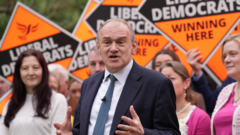
When Ed Davey stood at the podium to launch the Liberal Democrat election campaign, he wasn’t just asking for votes. He was attempting to perform a kind of political exorcism. He wanted to cast out the idea that the British public is obsessed with the grand dramas of the state. Instead, he bet the house on a much quieter, more domestic reality: the feeling that things, quite simply, have stopped working.
The Geography of Neglect
To understand the Liberal Democrat strategy, you have to look at the "Blue Wall." These are the affluent, traditionally Conservative seats where the lawns are manicured but the sewage is currently being pumped into the local chalk streams. There is a specific kind of quiet fury that brews in these places. It is not the loud, shouting anger of a protest march. It is the weary, cynical exhaustion of a taxpayer who pays more every year and receives less in return.
Consider a hypothetical voter—let’s call him Arthur. Arthur has voted Conservative since the eighties. He believes in hard work and fiscal responsibility. But lately, Arthur has been looking at the river where he used to take his grandson to see the kingfishers. The water is grey. It smells of chemicals. When he tries to call his local councillor, he gets an automated loop.
The Liberal Democrats have realized that for people like Arthur, the national government feels like a distant, bickering relative. They are leaning into the role of the local handyman. They are promising to be the ones who finally fix the door at the community center.
It is a gamble. In a world of social media outrage and high-stakes culture wars, focusing on local infrastructure and social care can seem quaint. Almost small-time. Yet, Davey is betting that the "small-time" is exactly where the heart of the country is beating. He isn't talking about rebuilding the empire; he’s talking about rebuilding the local dental surgery.
The Invisible Stakes of Social Care
The most human element of this campaign—and the one Davey speaks about with a vulnerability rarely seen in leaders—is social care. This isn't just a line item in a budget. It is the difference between a dignified old age and a lonely, terrifying decline.
Davey is a carer himself. He has lived the reality of the 2:00 AM wake-up call and the endless, labyrinthine paperwork required to get a fraction of the support a family needs. When he speaks about fixing the care system, he isn't citing a white paper. He is describing the exhaustion of millions of people who are currently propping up a collapsing state with nothing but their own grit and love.
We often treat social care as a "health" issue, but it is actually a "freedom" issue. If you are a daughter who has had to quit her job to look after a mother with dementia because the local council has run out of funds, your world has shrunk. Your choices have vanished. The Liberal Democrats are positioning themselves as the party that understands this claustrophobia.
They are proposing a "Carer’s Minimum Wage." It’s a simple idea: pay the people who do the most difficult, most essential work a wage that reflects their value. It isn't just about economics. It’s about respect. It’s about acknowledging that a society is only as strong as the safety net it weaves for its most fragile members.
The Pothole as a Political Symbol
There is a tendency among the political elite to roll their eyes at "pothole politics." They think it’s beneath the dignity of a national campaign. But they are wrong.
A pothole is a physical manifestation of a broken contract. We pay our taxes; the government maintains the roads. When the roads crumble, the contract is void. For a commuter whose tire is blown out on a Monday morning, that hole in the tarmac is a more powerful indictment of the government than any statistic about inflation.
The Liberal Democrats have mastered the art of the local grievance. They are the party of the orange diamond-shaped leaflet that tells you exactly how many times your local MP voted to allow sewage dumping. They are weaponizing the local. They are taking the mundane frustrations of daily life—the wait for an ambulance, the lack of police on the street, the rising cost of the weekly shop—and tying them directly to the people in power.
But this isn't just about complaining. It's about a fundamental shift in how we view the role of a politician. Is a representative a grand architect of national destiny, or are they a servant of the community?
Davey's launch was less of a coronation and more of a job interview for a caretaker position. He spoke about "fixing" things. It’s a humble word. It doesn't have the glamour of "revolution" or the weight of "reform." But for a person whose boiler has been broken for a week and who can’t get a plumber to answer the phone, "fix" is the most beautiful word in the English language.
The Emotional Cost of Uncertainty
We live in an era of profound instability. The climate is shifting, the global economy is volatile, and the digital world is changing faster than we can adapt. In this context, people crave a sense of agency. They want to feel that their immediate surroundings—their streets, their parks, their clinics—are stable.
When the local library closes, it’s not just about the books. It’s about the loss of a shared space. It’s about the erosion of the "we."
The Liberal Democrat narrative seeks to rebuild that "we." By focusing on community-led solutions, they are trying to counteract the loneliness that has become an epidemic in modern Britain. They are talking about the "green heart" of our communities. They are promising to protect the things that make a place feel like home.
Consider the impact of the cost-of-living crisis on a local high street. The independent butcher closes down. The hardware store is replaced by a boarded-up window. The sense of pride in a town begins to bleed away. The Liberal Democrats are framing this as a choice: do we allow our communities to become "ghost towns" of neglect, or do we invest in the foundations that allow local businesses and families to thrive?
The Long Road to the Ballot Box
The path to power for the Liberal Democrats is narrow. They are squeezed between two giants, often fighting for scraps of airtime. But in the quiet corners of the country, away from the glare of the television cameras, they are making a different kind of noise.
It is the sound of a doorbell ringing. It is the sound of a conversation on a doorstep about a local planning application. It is the sound of someone actually listening to a story about a cancelled hip operation or a child who can’t get the mental health support they need.
There is a risk, of course. By focusing so heavily on the local, they can appear fragmented. They can seem like a collection of 650 different campaigns rather than a single, national movement. But perhaps that is their greatest strength. In a country that feels increasingly disconnected from the center, a party that meets people exactly where they live—in their cold kitchens and their crumbling community centers—might be the only one that truly hears what is being said.
The election will be won or lost in these small moments. It will be decided by the people who feel forgotten by the grand narratives of Westminster. It will be decided by the people who just want the door to the community center to finally, after all these years, click shut.
As the campaign buses roll out and the posters go up, the real story isn't in the slogans. It’s in the quiet, persistent hope that things can be better. Not perfect. Not utopian. Just better. Fixed. Functional.
The man at the podium knows this. He knows that the most radical thing you can do in a broken world is to promise to pick up a wrench and get to work.