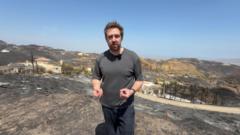
The air in Pahalgam usually carries the scent of pine needles and the cold, crisp promise of the Lidder River. It is a place where pilgrims and trekkers seek a specific kind of peace, a momentary escape from the friction of the modern world. But that peace was shattered by the rhythmic, mechanical thud of gunfire. When the smoke cleared from the recent encounter in Jammu and Kashmir, the silence that followed wasn't peaceful. It was heavy. It was the kind of silence that precedes a storm of accusations.
Within hours, the machinery of international diplomacy began to grind. Indian officials pointed across the Line of Control. They claimed the strings of this violence were being pulled from Islamabad. It is a familiar rhythm in the subcontinent—a tragedy occurs, blood is spilled, and then the finger-pointing begins. But this time, the response from Pakistan wasn't just a standard denial. It was a sharp, biting critique of India’s tendency to "shortcut" the investigative process.
Consider a hypothetical shopkeeper in Pahalgam, let's call him Bashir. Bashir doesn't care about the high-level dossiers exchanged in air-conditioned rooms in New Delhi or Islamabad. He cares about the bullet holes in the wood of his stall. He cares about the fact that every time a diplomat makes a claim without presenting a mountain of forensic evidence, the ground beneath his feet becomes a little more unstable. For people like Bashir, these accusations are not just headlines. They are the atmospheric pressure that dictates whether he can open his doors tomorrow.
Pakistan’s Foreign Office didn't just say "we didn't do it." They went further. They accused India of using the Pahalgam attack as a political tool to drum up domestic sentiment and malign Pakistan on the global stage. This is the core of the friction: the gap between a security reality and a political narrative. To India, the patterns of the attack—the weaponry, the tactics, the intelligence—all scream of cross-border support. To Pakistan, these are "baseless allegations" designed to distract from internal Kashmiri dissent.
The problem with this cycle is that the truth becomes a secondary casualty.
When an attack happens, there is a desperate, human need for accountability. The families of the fallen soldiers and the terrified locals deserve to know exactly who provided the rifles and who mapped out the escape routes. However, when the blame is cast before the brass casings are even cool, it creates a "boy who cried wolf" effect in the international community. Pakistan is betting on this skepticism. By criticizing the speed and "reflexive nature" of India's accusations, Islamabad is attempting to position itself as the rational actor demanding due process.
But look closer at the stakes. This isn't just a spat between neighbors. This is a nuclear-armed standoff where words act as the primary currency of aggression.
Every time New Delhi links a specific act of terror to Pakistan, it builds a case for "pre-emptive" or "retaliatory" action. We saw this in Balakot. We see it in the shifting troop movements along the border. Conversely, every time Islamabad dismisses these links as mere propaganda, they risk shielding actual networks that operate in the shadows of the mountains. It is a dangerous game of poker played with human lives as the chips.
The intelligence gathered in the aftermath of the Pahalgam incident suggests a sophisticated level of planning. This wasn't a random outburst of violence. It was a calculated strike. Indian security agencies point to the encrypted communication channels used by the attackers, claiming they trace back to servers and handlers across the border. These are the "cold facts" the competitor articles list in bullet points.
But the narrative reality is much messier.
If you are a diplomat in a neutral country, say Norway or Brazil, you are looking at two diametrically opposed stories. India presents a story of a nation under siege by a state-sponsored shadow army. Pakistan presents a story of a neighbor that uses "terrorism" as a catch-all excuse for its own administrative failures in a disputed territory.
Who do you believe?
The answer usually depends on whose narrative is more consistent. By criticizing India’s "linkage" strategy, Pakistan is trying to chip away at India's consistency. They are suggesting that India is more interested in the headline than the evidence. It’s a move straight out of a legal thriller: if you can’t disprove the crime, discredit the witness.
The invisible stakes here are found in the youth of the valley. Every accusation that isn't backed by transparent, irrefutable proof fuels a sense of victimization. When a young man in South Kashmir hears New Delhi blame Pakistan for every local grievance, he doesn't always see a perpetrator. Sometimes, he sees a government that refuses to look in the mirror. Similarly, when Islamabad ignores the very real evidence of militant infrastructure on its soil, it betrays the very peace it claims to want for the region.
This isn't a game. It's a tragedy on loop.
The Pahalgam attack is a symptom of a much deeper rot—a refusal to communicate outside of the language of blame. India feels it has provided enough evidence over the decades to earn the world's trust without having to "prove it" every single time. Pakistan feels it has been unfairly maligned for so long that any accusation is automatically suspicious.
Between these two rigid towers of pride sits the actual event. The cold metal of the guns. The red stain on the mountain soil. The grieving mother who doesn't care about the Foreign Office’s press release.
As the sun sets over the peaks of Pahalgam, the soldiers stay on high alert. The diplomats go back to their drafting tables. The shopkeepers lock their doors. The cycle remains unbroken because the narrative has become more important than the solution. We are watching a movie where the actors have forgotten there is an audience, and the audience has forgotten that the blood on the stage is real.
Until the day comes when an investigation is more important than an accusation, the pine-scented air of the valley will continue to smell like cordite. The words will keep flying across the border, sharp and jagged, long after the echoes of the gunfire have faded into the rocks.