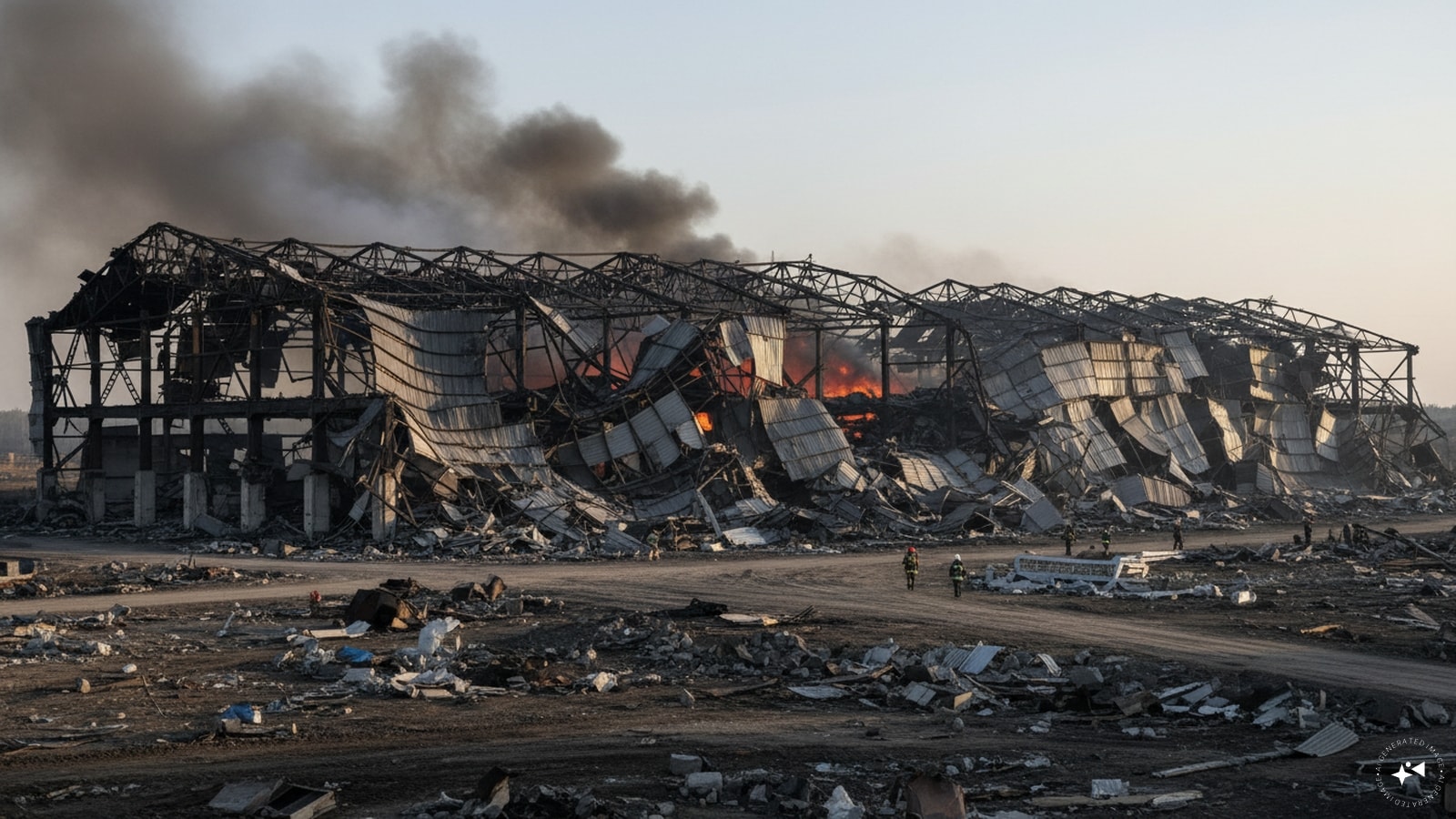
The headlines following every major strike on rear-area storage facilities read like a broken record of superficial outrage. A warehouse blows up, dozens die, and the mainstream media scrambles to write the exact same tear-jerking, analytically bankrupt post-mortem. They talk about tragedies in a vacuum. They scream about escalation. They treat modern supply chain nodes like quaint mom-and-pop grocery stores that just happened to catch a stray spark.
Stop looking at the smoke and start looking at the inventory sheets.
I have spent two decades analyzing the brutal, unglamorous mechanics of wartime logistics and large-scale industrial distribution networks. I have watched billions of dollars in inventory evaporate because operational planners treat storage facilities like static parking lots rather than hyper-dense powder kegs. When a secondary detonation turns a regional distribution center into a massive crater, the shockwave is not just a tactical failure of air defense. It is a catastrophic failure of asset dispersion, inventory classification, and basic operational hygiene.
The conventional narrative wants you to believe that storing massive quantities of explosive-adjacent commercial or dual-use goods near major urban hubs is just an unfortunate byproduct of a wartime economy. That is a lie designed to shield incompetent planners from accountability.
The Myth of the Safe Rear Area
The lazy consensus in modern geopolitical reporting assumes that distance equals safety. If a warehouse sits fifty miles away from the active front line, civilian analysts pencil it in as a secure zone.
That mindset belongs in the twentieth century.
Modern reconnaissance infrastructure—combining persistent commercial satellite imaging, intercepted electronic signals, and low-cost aerial drone surveillance—makes the concept of a hidden rear-area logistics hub entirely obsolete. If you stack thousands of pallets of high-energy components, volatile chemicals, or heavy-duty industrial batteries under a single corrugated tin roof, you have built a beacon.
When a strike hits a facility like the one outside Kyiv, the staggering loss of life is treated exclusively as a human tragedy, which it undeniably is. But let us dissect the mechanical reality: warehouses do not generate massive, leveled-block secondary detonations unless they are packed tight with incompatible, highly combustible materials violating basic hazard segregation rules.
Here is the truth nobody in the mainstream press has the stomach to print: secondary detonations are a choice. They happen because logistics officers prioritize storage density and administrative convenience over risk mitigation. They cram high-value, volatile stock into centralized mega-warehouses because managing twenty small, dispersed depots is harder work on spreadsheets.
The Economics of Clustered Vulnerability
To understand why these facilities keep lighting up the night sky, you have to look at the perverse incentives driving modern procurement and supply chain management.
In a prolonged conflict, supply chains suffer from chronic friction. Procurement is slow, transport is scarce, and fuel costs are prohibitive. The natural organizational response is centralization. Planners want everything in one place so they can count it easily, guard it with a single security detachment, and load it onto trucks with minimal friction.
This creates what risk analysts call a catastrophic concentration point.
[ Centralized Mega-Warehouse ]
       │
       ├── High Inventory Density ──> Maximum Target Value
       ├── Poor Hazard Separation ──> Massive Secondary Detonation
       └── Single Logistics Node  ──> Total Regional Collapse
When you centralize assets, you are offering an adversary an asymmetric return on investment. A single precision-guided munition or loitering munition costing a fraction of what is inside the building can wipe out a month's worth of regional distribution capacity.
The standard counter-argument from military bureaucrats is that decentralization slows down distribution. They claim that breaking inventory down into dozens of smaller, camouflaged, highly distributed micro-depots creates an administrative nightmare and slows down the delivery velocity to the field.
My answer to that is simple: a slow delivery beats a non-existent delivery every single time. If your inventory vaporizes in a giant fireball because you wanted to save three hours of trucking time, your velocity metric drops to absolute zero.
Dismantling the Human Cost Narrative
We need to talk about the workforce placement inside these facilities, and we need to do it without wrapping ourselves in sanitized euphemisms.
Putting civilian warehousing personnel, administrative staff, and contract drivers inside mega-distribution centers that handle dual-use or heavy industrial goods during an active conflict is an operational dereliction of duty. When facilities are co-located or utilized in ways that attract high-priority targeting, treating the resulting casualties solely as random acts of violence ignores the structural decisions that put those bodies in the danger zone in the first place.
I have walked through distribution centers across active conflict zones where managers kept civilian packing staff working around the clock right next to high-risk inventory bays, simply because corporate or military targets demanded throughput. They called it dedication. I call it negligent homicide by spreadsheet.
If a facility handles materials that make it a legitimate military target under international law—regardless of how the civilian administration labels the warehouse's primary function—keeping unshielded, non-essential personnel on-site is an unforgivable gamble.
The Playbook for Survival
If you are running logistics, supply chains, or industrial operations in a high-risk environment, you need to throw out the standard textbooks. Here is how you stop feeding the craters.
First, enforce absolute inventory fragmentation. No single warehouse should ever hold more than five percent of a critical region's stock. If you lose a depot, it should feel like a minor bruise, not a severed limb.
Second, re-introduce strict chemical and explosive segregation. The secondary detonations that level surrounding neighborhoods do not come from the incoming warhead; they come from the sympathetic detonation of poorly stored commercial or industrial materials already inside the building. Separate your oxidizers, your fuels, your batteries, and your finished goods by blast-wall-protected partitions.
Third, embrace radical dispersion and camouflage. Stop building monolithic steel-frame mega-sheds. Utilize existing underground infrastructure, multi-story concrete parking structures, and subterranean industrial spaces where structural overhead can absorb or deflect blast energy.
The missiles are going to keep flying. The intelligence will keep leaking. The only variable you control is how much damage you hand your adversary on a silver platter. Stop building targets.