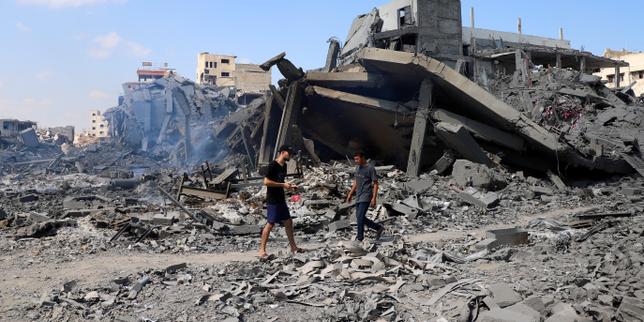
The standard narrative writes itself with lazy predictability. A headline drops claiming that safety is an illusion, that moving from the north to the south was a cruel joke, and that agreements on paper mean nothing when the sky stays lit with iron and fire. The lazy consensus points the finger at a broken truce and calls it a day.
It is clean. It is emotional. And it completely misses the mechanics of modern asymmetric conflict.
I have spent years analyzing urban combat architectures, listening to ceasefire monitoring briefings, and mapping how command-and-control structures actually disintegrate under urban stress. Let us dispense with the comforting fiction that truces are broken simply because bad actors wake up craving violence. Truces fail because they are built on a category error. They treat a totalizing existential struggle like a corporate contract dispute where both sides agreed to arbitration. They do not.
Stop asking why the ceasefire did not protect civilians. That is the wrong question entirely. The right question is why anyone expected a piece of parchment to override the ground-level physics of decentralized guerrilla warfare.
The Myth of the Clean Line
The mainstream media loves a clean map. They draw boundaries across a devastated strip of land and expect human behavior to respect the cartography. When stray ordnance drops or localized skirmishes erupt across those invisible borders, the pundits clutch their pearls and declare the peace dead.
This is amateur hour.
In dense urban environments where combatants operate out of subterranean networks beneath civilian apartments, the boundary between active combat zone and safe haven is a legal fiction. When an insurgent cell emerges from a tunnel shaft fifty meters inside a designated humanitarian zone to launch an anti-tank missile, the military response does not wait for a committee meeting. It strikes back at the point of origin.
To cry foul because the retaliation hits the surrounding block is to misunderstand the geometry of counter-insurgency. The combatants are not wearing uniforms standing in open fields. They are embedded within the civilian architecture. When you mix the actor and the environment inextricably, any kinetic action against the actor guarantees collateral friction.
Blaming the ceasefire ignores the fundamental operational reality: a truce only holds when both sides calculate that peace yields a higher return than continued friction. When one side’s entire strategic objective relies on perpetual mobilization and international sympathy derived from civilian hardship, peace is an existential threat to their survival. They have no incentive to let a ceasefire succeed.
The Economics of Perpetual Grievance
Let us look at the brutal incentives driving this machinery. Humanitarian aid flows, diplomatic pressure, and international resolutions act as a form of economic stimulus for crisis management. When a ceasefire holds too long, the spotlight fades. The international community gets distracted by the next geopolitical flashpoint.
For the leadership managing the asymmetric side of the ledger, a quiet period is a death sentence for their relevance. They need the cameras rolling. They need the tragic human interest stories of families fleeing south only to find more smoke. Every displaced mother featured in a western broadsheet is a strategic asset.
I have seen political actors panic when a ceasefire actually starts working because peace starves their movement of oxygen. The narrative of inevitable suffering must be maintained at all costs.
So when an incident occurs that shatters the fragile quiet, do not automatically assume it was an unprovoked escalation by the state actor. Often, it is a deliberate provocation designed to force a heavy-handed response, resetting the cycle and securing another six months of diplomatic airtime.
The Flawed Architecture of Modern Truces
Diplomats love grand gestures. They fly into regional capitals, pose for handshakes under chandeliers, and announce historic breakthroughs that will allegedly bring quiet to the Mediterranean coast.
It is theater.
Real de-escalation is boring, technical, and incremental. It involves tedious perimeter checks, biometric tracking of combatants, joint patrols, and unglamorous micro-agreements over water rights and cement imports. It does not look good on the evening news.
The current model of diplomacy relies on high-level political pressure applied to leaders who often lack absolute control over the tactical units on the ground. When a local commander decides to break a truce because a rival unit moved into his sector, the prime minister hundreds of miles away takes the blame for violating the accord.
We keep trying to fix the Middle East with the diplomatic equivalent of duct tape. We apply sweeping political accords to hyper-fragmented, localized tribal and ideological factions that answer to no central authority. Then we act surprised when the duct tape snaps under the first real test of kinetic pressure.
What Actually Works (And Why Nobody Wants to Do It)
If you want to protect non-combatants, you have to abandon the fantasy of the comprehensive ceasefire. It is a dead strategy.
Instead, look at localized humanitarian corridors managed by third-party private security contractors with zero skin in the ideological game, backed by hard, automated enforcement mechanisms. No politicians making speeches. No UN committees debating semantics for three weeks while people starve. Just hard borders, enforced by biometric gates and automated surveillance, where anyone carrying a weapon inside the safe zone is neutralized instantly, regardless of their political affiliation.
It is cold. It is clinical. It strips away the moral posturing of both sides.
And that is precisely why the international community hates it. It requires admitting that humanitarian safety cannot be begged for; it must be enforced with absolute, terrifying neutrality.
Until we stop pretending that words on a diplomatic document can override the laws of asymmetric warfare, the families will keep running south, the missiles will keep falling, and the pundits will keep writing the exact same lazy article about how the peace failed again.
Wake up. The system is working exactly as it was designed to work for the people profiting from the chaos.
Stop buying the narrative.


