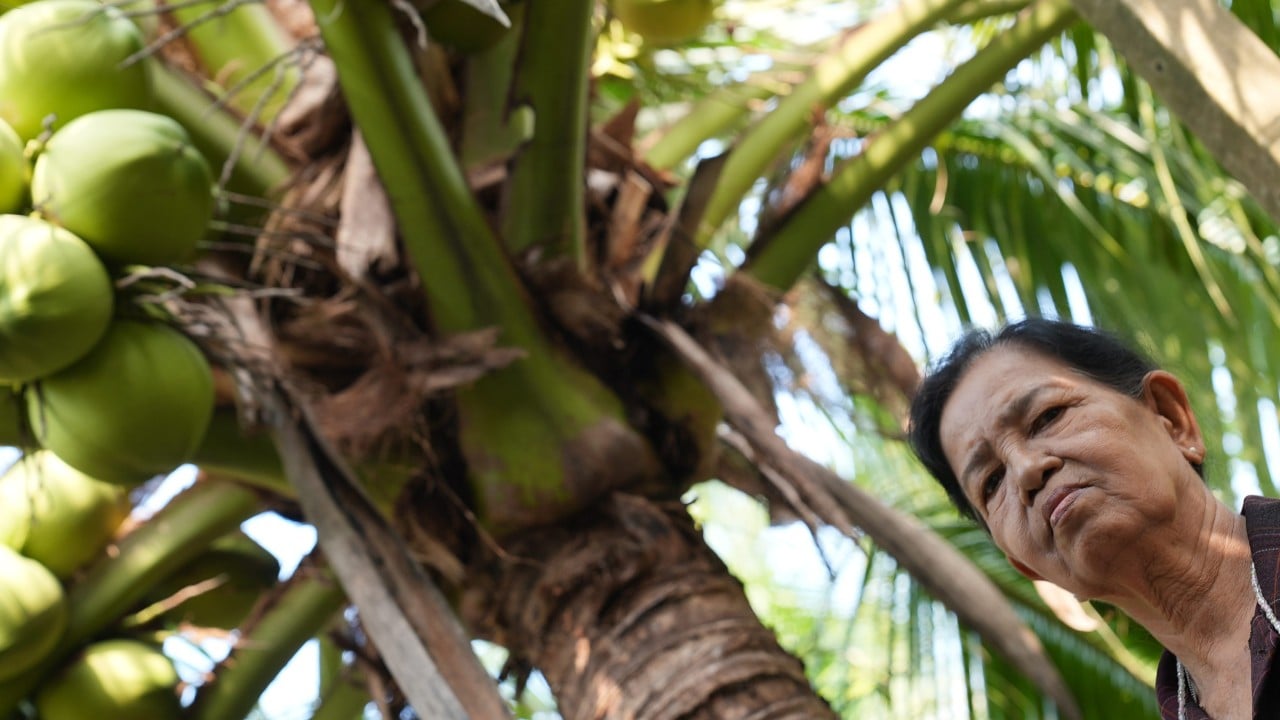
The air in Ratchaburi smells like scorched sugar and damp earth. It is a thick, heavy scent that clings to the back of your throat, a reminder that in this corner of Thailand, the coconut is not just a fruit. It is the pulse of the province. Here, the Nam Hom coconut—prized globally for a fragrance that mimics young perfume and a sweetness that feels like a gift—is the undisputed king.
Piya has climbed these trees since his pulse beat faster than his footsteps. He is fifty-four now. His hands are maps of scars and leathery callouses, the permanent signature of a life spent harvesting the canopy. For decades, the rhythm was simple. He grew the nuts, the local middlemen bought them, and the money paid for rice, school fees, and the occasional repair on his weathered motorbike. For an alternative look, see: this related article.
But the rhythm has changed. The heartbeat of the plantation is now dictated by a language Piya does not speak and a digital ledger he will never see.
The Ghost in the Grove
A few years ago, the buyers changed. The familiar faces of local Thai wholesalers—men Piya had known for a generation—began to vanish. In their place came the "Lhong." In the local parlance, a Lhong is a packing house, the critical bridge between the muddy grove and the refrigerated shipping container. Historically, these were Thai-owned. Today, they are increasingly fueled by a silent, relentless influx of Chinese capital. Related insight on this matter has been shared by Financial Times.
This is not a traditional invasion. There are no flags. Instead, there is the quiet scratch of a pen on a contract. Chinese investors, barred by law from owning the land itself, have found the workaround: they own the destination. By controlling the packing houses and the export licenses, they have effectively built a funnel.
Imagine a massive hourglass. The top bulb is the vast expanse of Thai coconut groves, thousands of small-scale farmers like Piya dropping their fruit into the sand. The bottom bulb is the insatiable Chinese market, where coconut water is no longer a tropical novelty but a multi-billion-dollar health craze.
The Lhong is the narrow neck.
Whoever controls that neck controls the speed, the pressure, and, most importantly, the price. When the neck narrows, the farmer at the top feels the squeeze first.
The Mathematics of Despair
In a fair market, scarcity drives prices up. If the world wants more coconuts and the trees can only grow so fast, Piya should be a wealthy man. The reality is a jarring contradiction. In the aisles of high-end grocery stores in Shanghai or Beijing, a single Thai coconut can command a premium price. Back in Ratchaburi, the "gate price"—what the farmer actually receives—stagnates or even drops.
The squeeze happens through a tactic known as "price-leading." Because Chinese-backed Lhongs now handle the lion's share of exports, they set the daily rate. If the three largest packing houses in a district decide the price of a bunch is twenty baht, the smaller Thai players have no choice but to follow suit or lose their buyers.
Piya explains it through a tired smile. He points to a pile of discarded husks. Last year, he could negotiate. If one buyer offered too little, he’d wait for the next truck. Now, the trucks all seem to be driven by the same invisible hand. The competition has been replaced by a monolith.
The numbers tell a story of lopsided growth. Thailand’s coconut exports to China have surged by double digits year-over-year, yet the debt levels among Thai smallholders are climbing at a similar rate. The farmers are running faster just to stay in the same place. They are the essential gear in a machine that is slowly grinding them down.
The Invisible Border
The shift isn't just about currency; it’s about the erasure of the middle class in the Thai countryside. When a local Thai entrepreneur runs a packing house, the profits tend to circulate within the community. They buy a truck from the local dealer. They hire neighbors. They donate to the village temple.
When the capital is diverted, the circle breaks. The profits from the Ratchaburi soil are digitized and beamed across the Gulf of Thailand before the sun has even set on the grove. The wealth is exported as efficiently as the fruit.
This creates a peculiar kind of ghost town. The plantations are lush and green. The trucks are full. The activity is frantic. But the houses of the farmers remain unpainted. The local markets are quiet. The "coconut cartel," as some disgruntled locals have begun to whisper, has perfected the art of extraction without investment.
Why Your Morning Smoothie Matters
It is easy to view this as a localized trade dispute, a minor friction in the global supply chain. That would be a mistake. This is a preview of the future of food security.
The coconut is the canary in the coal mine. We are seeing a shift from global trade to "vertical integration," where a single foreign entity controls every step from the seedling to the supermarket shelf. When the person buying the crop also owns the warehouse, the shipping line, and the retail brand, the farmer loses the only power they ever had: the power to say no.
If Piya refuses the price offered by the Lhong, his fruit rots. Coconuts wait for no one. They are heavy, they are perishable, and they are his only source of life. The Lhong, backed by deep pockets and a global network, can afford to wait. Piya cannot.
Consider the leverage. By dominating the logistics, these entities can effectively "turn off" a region's economy at will. It is a soft power that tastes like coconut water but carries the weight of an embargo.
The Fragile Strength of the Soil
There is a movement stirring, though it is quiet. Some farmers are attempting to form cooperatives, trying to build their own Lhongs to bypass the squeeze. They are looking for ways to certify their fruit, to prove that the Nam Hom label belongs to the land, not the exporter.
But they are fighting an uphill battle against a mountain of cash. To build a modern packing house that meets international phytosanitary standards requires millions of baht. The farmers have the dirt under their fingernails and the knowledge of the trees, but they do not have the credit lines.
Piya walks through his grove as the golden hour hits, the long shadows of the palms stretching across the grass like bars. He stops at a young tree, barely taller than he is. He planted it for his grandson.
"I don't want him to climb," Piya says, his voice barely a whisper above the rustle of the fronds.
It is a heartbreaking admission. The man who has spent his life providing the world with a taste of paradise no longer wants his own blood to walk the earth he has tended. He sees the writing on the digital wall. He knows that unless the funnel is widened—unless the "neck" of the hourglass is broken—the sweetness of the Ratchaburi coconut will continue to be enjoyed by everyone except the people who grow it.
The next time you crack open a chilled coconut or pour that white water into a glass, look closely at the label. Beyond the marketing imagery of turquoise waves and white sand lies a complex web of debt, shadow investors, and a man named Piya who is wondering if the tree he loves is actually a tether.
The sun sinks lower, disappearing behind the jagged silhouette of the packing houses on the horizon. They stand like fortresses, silent and efficient, waiting for the morning trucks to arrive so they can begin the daily harvest of a farmer's hope.