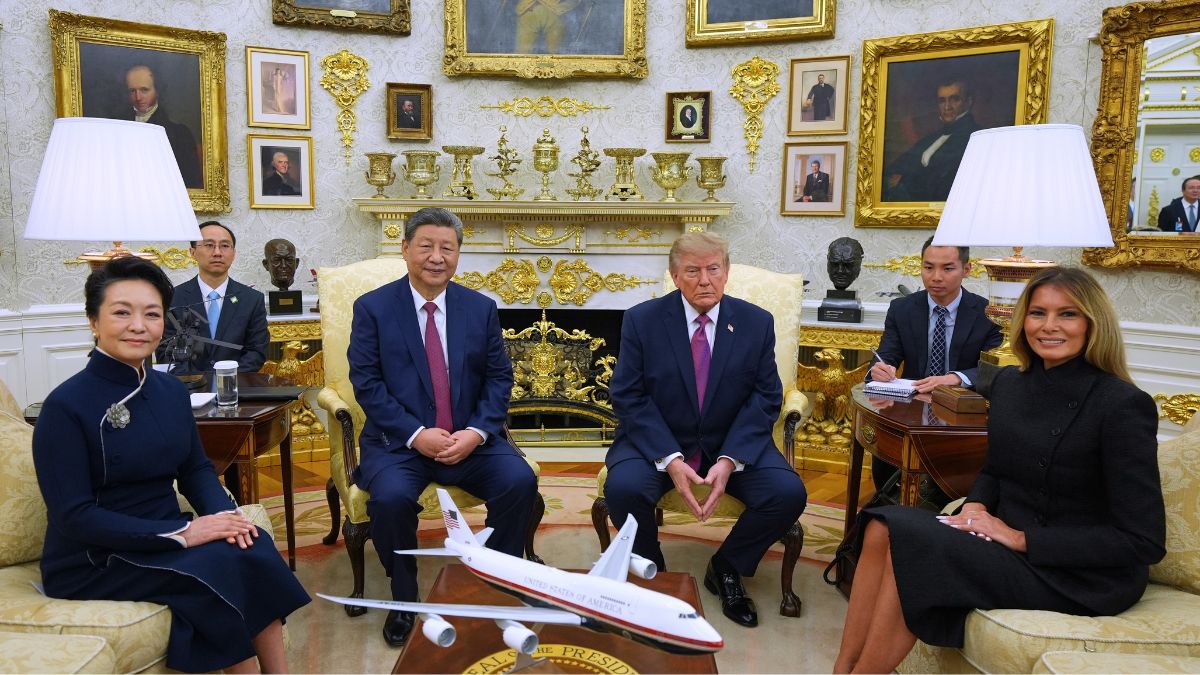
Everybody loves a good sports metaphor. When heads of state start talking about healthy tracks, honorable competitors, and keeping the track clean, the diplomatic corps swoops in to applaud the sportsmanship. The lazy consensus dominating international relations commentary right now treats great power rivalry like an athletic league where two teams can shake hands after the final whistle, grab a smoothie, and agree that the best side won.
It is a comforting delusion. It keeps stock markets from melting down every time a destroyer sails through the Taiwan Strait and gives think-tank pundits something polite to chatter about over canapés in Geneva. In similar updates, read about: The Mechanics of Survival on the Global Stage.
The framing of US-China competition as a non-zero-sum race rather than a zero-sum wrestle is diplomatic theater designed to mask a brutal underlying reality. Geopolitics is not a marathon where runners share the same oval and clap for whoever crosses the line first. It is an evolutionary battle for structural dominance where second place gets to write memoirs about how they used to run the world.
Beijing calling for a healthy race instead of a wrestle is not an olive branch. It is a strategic constraint designed to slow down the opponent while the home team changes the rules of the track. Reuters has provided coverage on this important topic in great detail.
The Architecture of Strategic Ambiguity
Let us dismantle the core premise of the peaceful race narrative. When diplomats push the idea of a healthy competition, they assume both participants agree on the finish line, the boundaries of the course, and the definition of winning. They do not.
Washington operates on a framework of liberal internationalism, believing that trade integration inevitably locks rivals into a stable web of shared rules. Beijing operates on a view of statecraft where economics, technology, and military might are unified levers of national power, deployed to shape a Sinocentric regional hierarchy.
When you run a race against an opponent who is quietly moving the finish line, paving their own shortcuts, and rewriting the rulebook while you stretch, you are not competing. You are being managed.
I have watched corporate executives fall for this exact trap in cross-border joint ventures. They walk into boardrooms in Shenzhen or Beijing hearing soothing rhetoric about win-win cooperation and mutual benefit, assuming it means Western-style partnership. Six months later, their intellectual property has migrated to a domestic competitor, local regulators have reinterpreted compliance codes to favor domestic champions, and the joint venture is suddenly an unequal dependency.
Scale that dynamic up to the global superpower level, and you get the current geopolitical theater. The rhetoric of healthy competition is deployed precisely when one side realizes the other is starting to catch up in critical domains like artificial intelligence, quantum computing, and advanced manufacturing.
The Zero-Sum Trap of Technological Hegemony
To understand why the race metaphor fails, look at the underlying mechanics of modern technological supremacy. In industrial-era competition, you could have multiple successful steelmakers or automakers coexisting in a crowded global market. Market share shifted by percentage points, margins compressed, and life went on.
Information-age dominance follows a winner-take-all logic.
The architecture of the global internet, foundational artificial intelligence models, semiconductor fabrication nodes, and financial messaging rails do not scale horizontally to accommodate five equal champions. Standards are absolute. The entity that writes the technical protocols for 6G, autonomous logistics, and digital currency architecture sets the operating system for the entire planet.
If Beijing sets the technical standards for global smart cities and surveillance infrastructure through the Digital Silk Road, Washington does not get to run a parallel, equally valid system that interoperates seamlessly. The world splits into incompatible stacks.
That is why the attempt to rebrand this friction as a friendly footrace is deeply misleading. You cannot share foundational stack ownership. One standard wins. One ecosystem dominates.
When structural power is at stake, compromise is surrender wrapped in polite syntax.
Dismantling the Myth of Decoupling
Another casualty of this lazy discourse is the fantasy of clean decoupling versus total integration. Pundits love to argue whether the global economy is splitting into two distinct blocs or remaining happily globalized.
The reality is far more cynical and much messier. True economic separation is a myth because the supply chains for green energy transition minerals, pharmaceutical precursors, and consumer electronics are too tangled to untangle without catastrophic short-term pain.
Instead, both superpowers are engaging in aggressive selective decoupling. They are weaponizing interdependence.
Washington subsidizes domestic semiconductor fabrication while choking off access to extreme ultraviolet lithography machines. Beijing secures exclusive offtake agreements for rare earth elements and tightens export controls on critical processing technologies.
This is not a healthy race. It is economic trench warfare fought with tariffs, industrial policy mandates, and national security exceptions. Pretending it is an athletic contest where everyone respects the referee ignores how the game is actually played.
The Cost of Strategic Naivety
Adopting the clean race narrative carries a heavy price. It lulls policymakers and business leaders into a false sense of security, encouraging them to treat strategic vulnerabilities as temporary supply chain glitches rather than permanent structural realignments.
I have seen venture capitalists pour hundreds of millions into cross-border technology plays assuming that geopolitical friction is just political posturing that will blow over after the next election cycle. They lose their shirts because they confuse political rhetoric with economic reality.
The truth is that the structural collision between the United States and China is baked into the architecture of the twenty-first century.
When an established hegemon confronts a rising revisionist power, systemic friction is inevitable. Thucydides mapped this out thousands of years ago, and modern trade data hasn't changed the math. The growth of one power threatens the perceived security of the other.
Navigating the Fault Lines
If the sports metaphors are useless and the clean separation fantasies are dangerous, how should businesses and strategists navigate this landscape?
Stop planning for a stable equilibrium. Stop waiting for the adults in the room to restore normal multilateral trade relations. Normal is not coming back.
Build organizational resilience for a permanently fragmented global economy. That means duplicating supply chains, regionalizing operations, and accepting lower capital efficiency in exchange for strategic survival. It means treating intellectual property protection not as a legal checkbox, but as a military-grade security operation.
The superpower competition is a wrestle. Acknowledge the gravity of the grip, stop pretending there are participation trophies at the end, and start wrestling back.