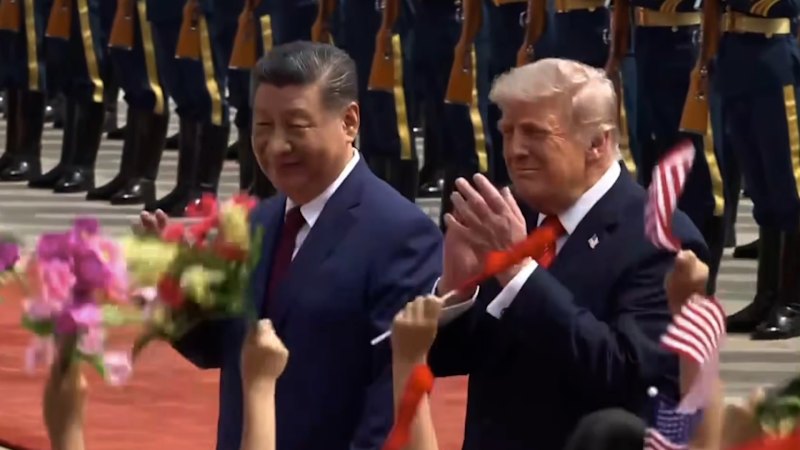
The images look like a victory lap for the West. Xi Jinping stands on the red carpet, a military band plays, and Donald Trump receives the kind of "state visit-plus" treatment usually reserved for emperors. Mainstream media treats this as a sign of respect or a diplomatic breakthrough. They are dead wrong. This isn't a gesture of friendship; it’s a masterclass in tactical theater designed to paralyze American policy.
Most analysts focus on the pageantry. They track the handshake duration. They count the business deals signed in the Great Hall of the People. But if you’ve spent any time navigating high-stakes negotiations in East Asia, you know that the louder the welcome, the harder the pivot.
China isn't rolling out the carpet because they fear American tariffs. They are rolling it out because they know the American ego is the easiest leverage point in the room.
The Illusion of "Special Access"
The "state visit-plus" designation is a brilliant piece of psychological warfare. By making a foreign leader feel uniquely honored, Beijing creates a "debt of hospitality." In the Chinese conceptual framework of guanxi, there is no such thing as a free lunch, and there is certainly no such thing as a free opera performance in the Forbidden City.
While the press corps fawns over the optics of Trump and Xi sipping tea, the actual structural issues—intellectual property theft, market access barriers, and the South China Sea—are being buried under a mountain of protocol. The goal is to move the conversation from "What are you going to change?" to "How can we maintain this wonderful relationship?"
It is a sedative for the White House. When you treat a guest like a king, it becomes socially and politically difficult for that guest to leave the dinner table and immediately slap a 25% tariff on your exports.
Why "The Art of the Deal" Fails in Beijing
The conventional wisdom suggests that these high-level summits are where the real work happens. It’s the opposite. The real work was finished weeks ago by mid-level bureaucrats, or more likely, it’s being intentionally stalled.
American negotiators often walk into these rooms looking for a "win" they can tweet about. They want a big number. $250 billion in signed MoUs (Memorandums of Understanding) sounds like a knockout. But anyone who has actually executed a cross-border contract knows that an MoU in China is worth less than the paper it’s printed on. It’s a "letter of intent" that usually evaporates the moment the Air Force One wheels leave the tarmac.
I have watched American CEOs celebrate "historic" joint ventures in Beijing, only to see their technology cloned by a state-owned subsidiary eighteen months later. The red carpet is the distraction. While the American side is playing for the 24-hour news cycle, the Chinese side is playing for 2049.
The Dependency Trap
The biggest misconception is that China needs the U.S. consumer more than the U.S. needs Chinese supply chains. This was true in 2005. It is no longer true in 2026.
Beijing’s current strategy is "de-risking" from the inside out. They are using these ceremonies to buy time. Every month they keep the U.S. occupied with "constructive dialogue" is another month they spend subsidizing their domestic semiconductor industry and diversifying their energy imports through the Belt and Road.
- Logic Check: If China were actually worried about American pressure, they would be making concessions on structural industrial policy.
- The Reality: They are offering "increased purchases" of soy and gas—commodities that do nothing to shift the long-term balance of power but provide a quick political win for an American president.
Stop Asking About "The Trade War"
The media keeps asking: "Will this visit end the trade war?"
That is the wrong question. The "trade war" isn't a temporary disagreement that can be solved with a nice dinner. It is a fundamental realignment of the two largest economies on earth. Beijing understands this. They are preparing for a "long march" of economic decoupling. The elaborate welcome ceremony for Trump is simply a tactical smoke screen to ensure the decoupling happens on their terms, not ours.
The Danger of Personal Diplomacy
There is a dangerous belief in Washington that personal chemistry between leaders can override national interests. This is a purely Western projection. In the CCP hierarchy, the Party's collective long-term objectives are immune to the "charms" of a foreign head of state.
When Xi smiles, he isn't signaling a change in heart. He is signaling that the current strategy is working. He has successfully funneled the American president into a controlled environment where the narrative is dominated by "friendship" rather than the forced technology transfers happening three blocks away in the Ministry of Commerce.
Actionable Reality for Business Leaders
If you are a C-suite executive watching this summit, do not take your cues from the joint press conference.
- Discount the "Big Numbers": If you see a headline about a multi-billion dollar purchase agreement, ignore it. Look for changes in Chinese domestic law regarding equity caps for foreign firms. If those aren't changing, nothing is changing.
- Watch the Currency, Not the Carpet: The Yuan's valuation tells a truer story than any banquet speech. If Beijing is serious about rebalancing, they’ll stop the artificial suppression.
- Diversify Now: Use the temporary "thaw" provided by this visit to accelerate your supply chain migration to Vietnam, India, or Mexico. The red carpet is a sign that the weather is about to turn.
The American obsession with being "liked" or "respected" by our adversaries is our greatest weakness. Beijing has mapped this flaw with surgical precision. They know that if they give an American president a 21-gun salute and a private tour of the Forbidden City, they can buy themselves another year of aggressive industrial expansion without facing real consequences.
Stop looking at the flowers. Start looking at the fortress.
The red carpet isn't an invitation to lead; it's an invitation to stay quiet while the floor is removed from beneath you.