The Price of Stability
China has officially shifted its strategy in Myanmar, abandoning its cautious neutrality to embrace the military junta led by Senior General Min Aung Hlaing. Driven by mounting losses suffered by ethnic armed groups along its southern border, Beijing determined that a fractured, chaotic Myanmar poses a greater threat to its economic and strategic interests than an autocratic one. By offering diplomatic legitimacy and economic lifelines to a regime isolated by the West, China is betting that authoritarian control can secure its vital trade corridors to the Indian Ocean. This calculated pivot effectively suffocates the democratic aspirations of the Myanmar resistance.
For years, international observers watched Beijing play a double game. It maintained formal ties with the military while simultaneously backchanneling with powerful ethnic armed organizations in Shan State. That ambiguity is dead. The reality on the ground forced China's hand.
The Collapse of Border Buffer Zones
The turning point did not originate in diplomatic chambers, but through the chaos of Operation 1027. Launched late last year by a coalition of ethnic militias, the offensive shattered the Myanmar military’s aura of invincibility. Junta troops surrendered entire brigades, losing vital border crossings that facilitate billions of dollars in bilateral trade.
Initially, Beijing tolerated these disruptions. The targeted militias promised to root out the notorious cyber-scam networks operating with impunity near the Chinese border—syndicates that had entrapped thousands of Chinese citizens. The militias delivered on that promise, handing over ringleaders to Chinese police.
But the resistance did not stop there.
When rebel forces pushed deeper into central Myanmar and captured the military’s Northeastern Command in Lashio, alarm bells rang in Beijing. The collapse of the junta ceased to be a distant possibility; it became an imminent risk. A total military defeat threatened to unleash a power vacuum, potentially plunging a country on China's doorstep into fragmented warlordism.
Faced with the prospect of a chaotic failed state, Beijing chose the partner it deemed predictable.
Securing the Indian Ocean Bypass
China's calculation rests primarily on infrastructure. The China-Myanmar Economic Corridor represents a multi-billion-dollar shortcut that bypasses the geopolitical chokepoint of the Malacca Strait.
Dual oil and gas pipelines cut across Myanmar, starting from the deep-water port of Kyaukphyu on the Bay of Bengal and terminates in China’s Yunnan province. These pipelines supply a significant portion of the energy needs of southwestern China.
[Bay of Bengal / Kyaukphyu Port]
       │
       ▼ (Pipelines & Rail Links)
[Central Myanmar / Mandalay]
       │
       ▼
[Yunnan Province / Kunming, China]
When rebel forces advanced toward Mandalay, they neared the physical intersections of these pipelines. Beijing views these installations not as commercial assets, but as matters of national energy security. The National League for Democracy, the ousted civilian government, had previously cooperated with these projects. However, the current anti-junta resistance is a decentralized coalition. Dealing with a dozen localized civilian defense forces and ethnic armies offers no guarantees for long-term treaties. The junta, desperate for money and recognition, will promise anything to protect Chinese infrastructure.
The Mechanics of Diplomatic Laundering
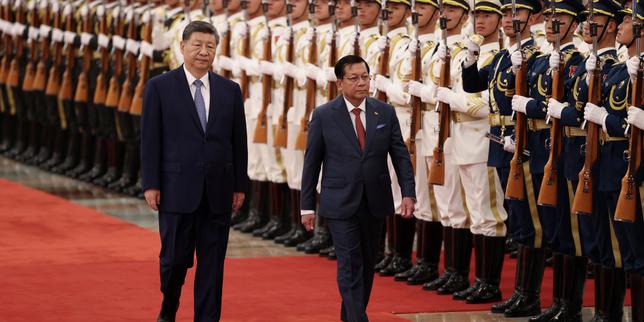
Beijing’s embrace of the junta manifests through structured, high-level diplomatic engagements rather than sudden declarations. High-ranking Chinese officials, including the Foreign Minister, have made consecutive visits to Naypyidaw, culminating in invitations for Min Aung Hlaing to attend regional summits in China.
This recognition serves several distinct purposes:
- Undermining Western Sanctions: While the United States and the European Union impose asset freezes and arms embargoes, China provides access to international financial networks and regional markets.
- Enforcing the Election Lifeline: The junta plans to hold a highly contested election. Beijing has backed this plan, offering technical assistance and census-taking technology to validate a vote that excludes the country's main democratic parties.
- Weaponizing Border Trade: China has periodically closed crucial border checkpoints into rebel-held territories, choking off supply lines for fuel, medicine, and consumer goods to pressure ethnic militias into accepting ceasefires.
This is not a relationship built on mutual admiration. It is a transactional arrangement. The junta despises its dependence on Beijing, historically preferring Russian hardware and weapons to diversify its options. Yet, isolated on the global stage, Naypyidaw has no other choice.
The Resistance Dilemma
This strategic shift places the National Unity Government (NUG)—the underground civilian administration leading the resistance—in an incredibly difficult position. The NUG has gone to great lengths to assure Beijing that a democratic Myanmar would respect Chinese investments and honor existing treaties.
Those assurances fell flat. Beijing prefers centralized control over democratic consensus, which it views as inherently unstable and prone to Western influence.
By backing the military regime, China risks alienating the population of Myanmar. Anti-Chinese sentiment is rising among a youth population that sees Beijing's financial and diplomatic backing as the main obstacle to overthrowing military rule. Boycotts of Chinese goods and protests near joint-venture factories are re-emerging, echoing the anger seen immediately after the 2021 coup.
A Broken Balance
The strategy carries immense risk. The military regime has lost more than half of the country’s territory and suffers from low morale, desertions, and a lack of new recruits. Funding the regime and freezing border trade may slow down the resistance, but it cannot restore the junta's administrative control over the state.
China is attempting to construct an artificial stability using a broken instrument. By locking arms with a deeply unpopular military dictatorship, Beijing might secure its pipelines in the short term, but it anchors its long-term regional interests to a regime completely rejected by its own people.