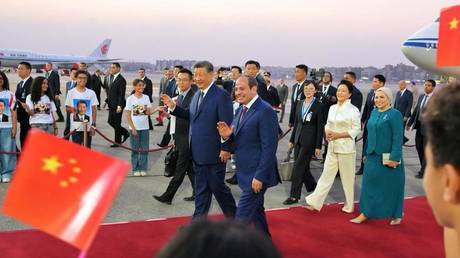
Chinese President Xi Jinping’s recent arrival in Cairo marked a major turning point for Mediterranean and Middle Eastern politics. It was his first state visit to Egypt in a decade, happening right as regional conflicts and shifting global alliances rewrite the rulebook. Most observers watch the Persian Gulf or Tehran when tracking Middle Eastern power struggles. They're missing the real anchor. Cairo is quietly turning into the ultimate diplomatic and economic fulcrum for Beijing's grand strategy.
Bilateral trade numbers tell part of the story, hitting $20.79 billion, while cumulative Chinese investments in Egypt have surpassed the $10 billion mark. But money alone doesn't explain the urgency. Beijing wants a reliable partner sitting right at the intersection of Africa, the Arab world, and critical global shipping corridors.
The Suez Chokepoint and Maritime Security
Geography dictates destiny in international relations. Egypt controls the Suez Canal, an artery carrying a massive chunk of global commerce. When regional conflicts disrupt Red Sea shipping lanes and choke off alternative routes, the entire world feels the economic pain within hours.
Xi’s talks with Egyptian President Abdel Fattah al-Sisi zeroed in directly on securing these maritime routes. During their meetings, Beijing explicitly positioned itself as an alternative security partner, urging regional states to counter outside interference.
By embedding Chinese industrial projects directly into the Suez Canal Economic Zone, Beijing is doing more than just buying real estate. It is tying its own commercial survival to Egypt's stability. Over 200 companies already operate within the China-Egypt Suez Economic and Trade Cooperation Zone, creating thousands of local jobs. The launch of its third phase solidifies an industrial footprint that isn't going away anytime soon.
Moving Beyond Trade Into Military Realignment
Economics rarely stays isolated from defense. Late summer military exercises between Chinese and Egyptian armed forces signaled a deeper operational shift. These aren't just ceremonial photo ops anymore. They represent procedural familiarity between two militaries that used to keep each other at arm's length.
For Cairo, dealing with Beijing is a masterclass in hedging bets. Traditional Western security partnerships are facing strains from ongoing regional instability. Diversifying defense and intelligence relationships gives Egyptian leadership diplomatic breathing room.
Washington isn't thrilled about this drift. Western policymakers are waking up to the reality that Chinese tech, infrastructure financing, and diplomatic alignment are altering traditional loyalties across North Africa. When Cairo imports billions in goods while expanding joint military training, it signals that the old post-World War II security architecture is fracturing.
The Broader Game for a Post-Western Order
Beijing wants a multipolar world where American hegemony is slowly checked by regional anchors. Egypt fits that blueprint perfectly. It is large enough, influential enough, and strategically positioned enough to anchor a broader coalition of states looking for alternatives to Western financial systems.
Look at green energy investments. Chinese firms are pouring money into massive solar installations like the Benban complex and wind developments along the Gulf of Suez. This kills two birds with one stone. It helps Cairo meet its domestic energy goals while finding external markets for China's massive green technology manufacturing surplus.
You can't understand modern geopolitics by looking at superpowers in isolation. You have to watch the middle powers. Egypt is taking the capital, the technology, and the industrial capacity Beijing offers, using them to cement its own status as an indispensable regional power. Watch the Red Sea coast over the next year. That is where the future of Eurasian and African trade will be won or lost.



