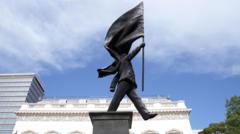
Everyone loves the myth of the night-crawler. They want to believe Banksy is a ghost who haunts the city, outsmarting Scotland Yard with a ladder and a prayer. When a new piece appears in Central London, the media cycle repeats the same tired narrative: "How did he get away with it?"
The truth is much more boring. He got away with it because he followed the rules.
If you think a world-renowned artist with a multi-million dollar secondary market is out there trembling in an alleyway, you’ve bought the marketing hook, line, and sinker. Placing a statue or a large-scale installation in a high-traffic zone like London isn't an act of rebellion. It’s a masterclass in bureaucratic camouflage.
The High-Vis Invisibility Cloak
The biggest misconception about street art is that it requires darkness. Darkness makes you suspicious. Darkness makes the police shine a torch in your face.
The most effective way to install a permanent or semi-permanent structure in London is to do it at 10:00 AM on a Tuesday while wearing a neon yellow vest. I’ve seen production teams move literal tons of equipment through restricted zones simply because they looked like they belonged there. If you have a clipboard, a couple of traffic cones, and a van with "Maintenance" written on the side, the public will walk right around you without looking up.
Banksy’s "guerrilla" tactics aren't about stealth; they are about Standard Operating Procedure.
In Central London, the sheer volume of "temporary works"—fiber optic installs, gas line checks, scaffolding—creates a permanent state of visual noise. The city is a construction site that never ends. To put up a statue, you don't need to pick a lock. You just need to look like a sub-contractor.
The Myth of the "Illegal" Installation
Let’s dismantle the "People Also Ask" obsession with the legality of these stunts. Everyone asks: "Is it illegal if no one stops him?"
Legality in the art world is a sliding scale based on the value of the asset. If a local teenager tags a wall, it’s criminal damage. If Banksy puts a statue on a plinth, it’s an "unauthorized gift" that increases the property value by six figures.
The Metropolitan Police and local councils aren't stupid. They are underfunded and overworked. They aren't going to tackle a man in a hard hat for "repairing" a ledge when there are actual crimes happening three blocks away. More importantly, removing a Banksy is a PR nightmare. No council leader wants to be the person who ordered the destruction of a work worth £500,000.
By the time the "unauthorized" work is discovered, it has already been geotagged by five thousand people. It is protected by the digital mob before the first police report is even filed. This isn't anarchy. It’s leverage.
Logistics Over Luck
You don't "stumble" into placing a statue in a capital city.
Think about the weight. Think about the base. Think about the wind loads. If you put a heavy bronze or fiberglass structure in a public square and it falls over on a toddler, the "Banksy" brand is dead. The liability alone would bankrupt a standard operation.
Every major installation you see involves:
- Pre-scoping: Analyzing CCTV blind spots and patrol patterns.
- Structural Engineering: Ensuring the piece stays upright without being bolted into protected heritage stone (which triggers the "real" crimes).
- Rapid Deployment: Using custom-engineered rigs that can be set in under 120 seconds.
This is the nuance the "competitor" articles miss. They treat it like a magic trick. It’s not magic; it’s engineering. It’s a pit crew for the arts. The "rebel" is actually a project manager with a very specific set of skills.
The Complacent Crowd
The most vital component of a London installation isn't the artist. It's the apathy of the Londoner.
The average person in the West End is either a tourist looking at their phone or a commuter trying to get to a meeting. Neither of them wants to engage with a stranger. If you see a group of men lifting a statue onto a sidewalk, your brain categorizes it as "not my problem."
Banksy exploits the Bystander Effect better than anyone in history. We have been conditioned to believe that authority is loud and visible. We assume that if someone is doing something brazen in public, they must have a permit. We are so afraid of looking stupid by questioning a "worker" that we let the heist happen in broad daylight.
The Commercial Reality
Let’s be brutally honest: Banksy is a corporate entity.
While the "insider" narrative likes to pretend he’s a lone wolf, the scale of these operations suggests a sophisticated logistics network. You need storage units. You need transport. You need legal retainers.
The "scandal" of the installation is the best marketing spend in the world. It’s free. A billboard in Piccadilly Circus costs tens of thousands per week. A "surreptitious" statue costs the price of materials and a rented van, but it generates global headlines.
I’ve seen brands spend millions trying to "go viral" with staged stunts. They fail because they try too hard to look official. Banksy succeeds because he understands that in London, looking "official" is the best way to stay hidden.
The Actionable Truth
If you want to disrupt a space—whether it’s the art world, a market, or a physical city—stop trying to break the door down.
- Adopt the Uniform: Figure out what the "accepted" version of your disruption looks like and wear its skin.
- Move in the Noise: Don't wait for a quiet moment. Wait for the loudest, busiest moment when everyone is too distracted to care.
- Force the Hand of Authority: Create something that is more expensive to remove than it is to ignore.
The statue didn't go up because Banksy is a ninja. It went up because the city of London is a machine that runs on the assumption that everyone is following the rules.
He didn't break the system. He just read the manual more carefully than you did.
Next time you see a new piece of "rebel" art, don't ask how he did it. Ask why you were too scared to try it yourself when all it required was a high-vis vest and the confidence to look like you belonged there.
The city is wide open. You’re just waiting for a permission slip that isn't coming.
Stop looking for the stencil and start looking for the van.