Every time a press release announces a new partnership between a British Columbia First Nation and a legacy timber company, the local media throws a parade. They slap the same tired adjectives on the story. Historic. Groundbreaking. A bold new era of reconciliation.
They are missing the real story by a country mile.
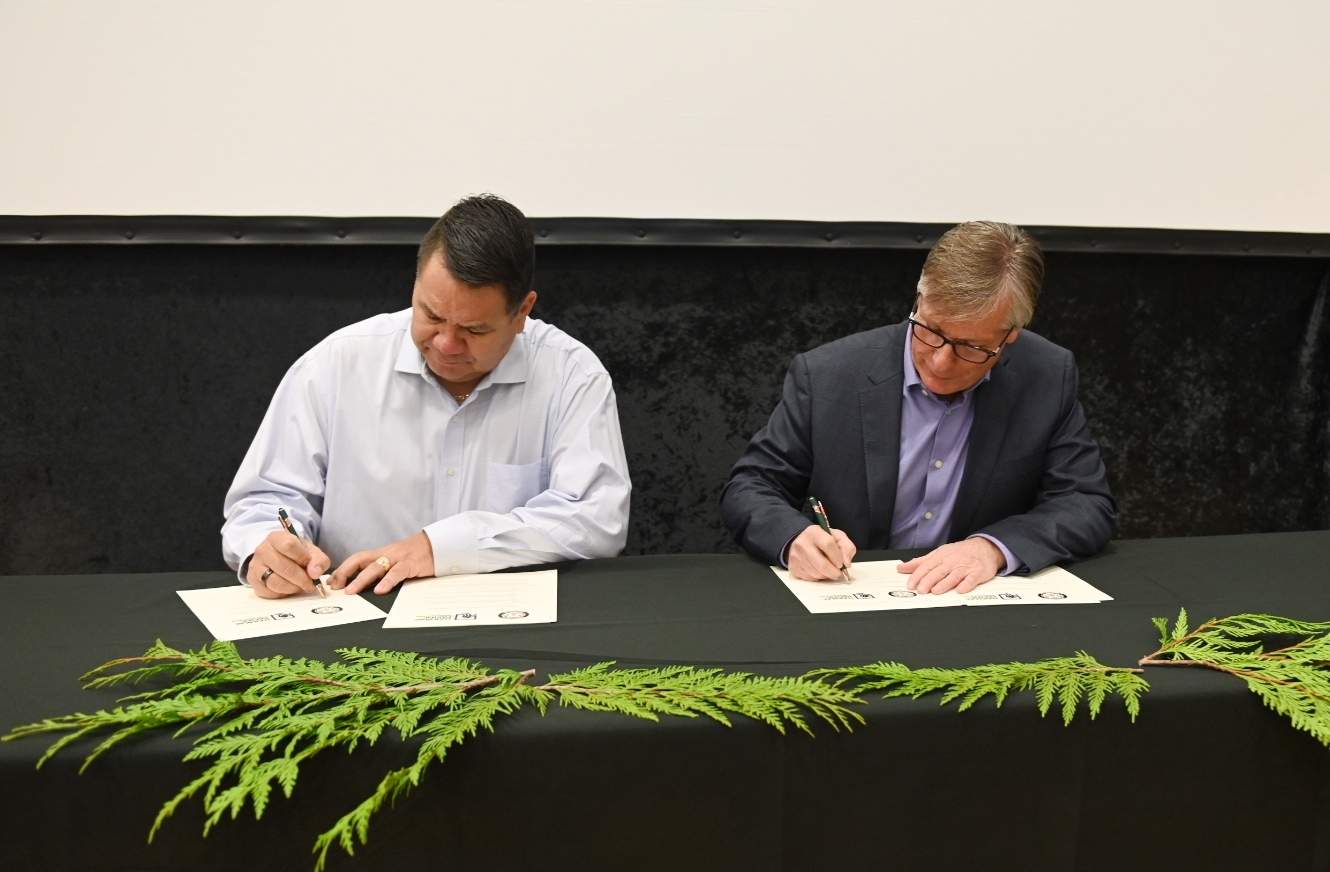
When Snuneymuxw First Nation and Nanaimo Forest Products—the operator behind the Harmac Pacific pulp mill—signed their partnership agreement, the standard industry applause rolled in right on cue. Pundits treated it like a feel-good victory lap for corporate social responsibility. It isn't. If you look at the actual mechanics of the B.C. coastal forest sector, this deal has almost nothing to do with charity and everything to do with raw economic survival.
One side has the capital-intensive processing infrastructure that is starving for fiber. The other side holds the constitutional rights, territorial jurisdiction, and political license required to actually get wood out of the bush. Without each other, both face a slow, painful irrelevance.
The Fiber Supply Crisis Nobody Wants to Admit
Let’s strip away the PR varnish and look at the balance sheet of coastal forestry.
For decades, major forestry corporations operated under a simple assumption: the provincial government controlled the land base, issued the tenures, and guaranteed the Annual Allowable Cut. You paid your stumpage fees, kept your mills running, and treated Indigenous consultation as a regulatory speed bump on the way to the clearcut.
That model is dead. It didn't die from a single court ruling; it bled out from a thousand cuts. Between the old-growth deferral zones, shifting provincial forestry policies, devastating wildfire seasons, and the steady transfer of forest tenures back to Indigenous nations, the available fiber supply on the B.C. coast has collapsed.
Pulp mills like Harmac Pacific do not run on good intentions. They run on wood chips and hog fuel. Specifically, they rely heavily on residual fiber—the sawdust, shavings, and off-cuts generated by sawmills. When sawmills across Vancouver Island and the Lower Mainland curtail shifts or shut down permanently because they cannot secure economically viable logs, the pulp mills starve.
I have sat in boardrooms where executives burned through millions of dollars trying to engineer their way out of a fiber deficit, tweaking chemical recovery boilers and chasing spot-market chips from hundreds of kilometers away. None of it works when the fundamental supply chain is broken. You cannot optimize your way out of an empty log yard.
Nanaimo Forest Products already has a unique ownership structure, having been rescued from bankruptcy in 2008 by a coalition of its own workers, local investors, and corporate partners. They know how to fight to keep the gates open. Partnering with Snuneymuxw First Nation isn't a public relations stunt for them; it is a hard-nosed supply chain strategy. If you want long-term access to fiber in traditional territories, you do not lobby Victoria anymore. You sit across the table from the titleholders and negotiate a real stake in the business.
Why "Reconciliation" Is the Wrong Lens for Business Deals
The lazy consensus in B.C. business journalism frames every Indigenous-corporate joint venture through the lens of social justice. That framing is patronizing, and it insults the sophistication of modern Indigenous economic development corporations.
First Nations are not looking for handouts or symbolic seats on advisory boards that hold zero voting power. They are sovereign governments rebuilding generational wealth after being systematically locked out of their own resource economies for over a century. When a Nation enters a partnership with a major industrial operator, they are deploying capital, land rights, and regulatory authority to secure equity, direct employment, and governance control.
Think about the leverage dynamics at play here.
Under the Declaration on the Rights of Indigenous Peoples Act (DRIPA) in British Columbia, the provincial government has legally committed to aligning its laws with the UN Declaration. Combined with landmark Supreme Court of Canada decisions—from Tsilhqot’in to Yahey (the Blueberry River cumulative impacts ruling)—the legal reality on the ground has fundamentally shifted. No major forestry operation can secure long-term certainty without the explicit, ongoing consent of the Nations whose territories they operate within.
Imagine a scenario where a legacy timber company tries to go it alone today. They spend three years and millions of dollars drafting a Forest Landscape Plan, only to hit a wall of litigation, blockades, and permitting freezes because they treated the local Nation as a stakeholder rather than a partner. Their cost of capital skyrockets. Their investors flee. Their mill sits idle.
Now flip the script. When a Nation becomes an actual partner—sharing in the governance, the stewardship standards, and the upside—the entire risk profile changes. The Nation brings something no Bay Street bank or Victoria bureaucrat can provide: social license and territorial legitimacy.
The Uncomfortable Truth About Industrial Partnerships
Before we start handing out trophies, we need to look at the downside. Because if you think signing a partnership agreement magically solves the headaches of coastal forestry, you have never managed a mill or governed a Nation.
These deals carry massive friction. Pretending otherwise sets both sides up for failure.
First, there is the internal political pressure on Indigenous leadership. Every First Nation government faces a delicate balancing act between economic development and environmental stewardship. When a Nation partners with a pulp mill or a logging operation, leadership immediately opens itself up to criticism from community members who want zero industrial activity in their territories. A pulp mill is not a tech startup. It involves heavy industry, chemical processing, water usage, and timber harvesting. Chief and Council have to defend that trade-off at the ballot box every few years.
Second, corporate operators often suffer from severe cultural whiplash. Traditional forestry executives are trained to optimize for quarterly EBITDA, unit costs, and volume per man-hour. Indigenous governance operates on a seven-generation timeline, prioritizing watershed health, cultural heritage protection, and community employment over short-term margin expansion.
I have seen promising joint ventures implode in year two because the corporate partner couldn't handle the pace of community consensus-building, or because the operational managers kept trying to sneak old-school clearcutting practices past the Nation's forestry technicians. A signed piece of paper does not erase fifty years of institutional muscle memory.
Third, there is the brutal reality of global pulp markets. Northern Bleached Softwood Kraft (NBSK) pulp—Harmac’s bread and butter—is a cyclical, volatile commodity. Prices swing wildly based on Chinese paper demand, European inventory levels, and global shipping bottlenecks. A local partnership protects your fiber supply and your local operating license, but it cannot protect you from a global commodity crash. If pulp prices tank for eighteen months straight, both partners are going to feel the pain.
What People Actually Get Wrong About B.C. Forestry Deals
When news of the Snuneymuxw and Nanaimo Forest Products agreement broke, the usual questions popped up across local forums and industry chats. Most of them are built on outdated premises. Let’s dismantle them.
Does this mean logging is going to stop on Vancouver Island?
No. In fact, it means the exact opposite: it creates a viable pathway for logging to continue, albeit under entirely different rules. Total preservation doesn't pay for community infrastructure, housing, or language revitalization programs. First Nations want active forest management—they just want to be the ones deciding which trees get cut, how the watersheds are protected, and where the profits go. Expect smaller cutblocks, longer rotations, heavier retention of old-growth attributes, and far more rigorous ecological monitoring.
Are First Nations just buying into a dying industry?
People who call B.C. forestry a "dying industry" don't understand global material science. The world is desperately trying to replace single-use plastics, fossil-fuel-based textiles, and carbon-heavy concrete and steel. High-grade softwood pulp, mass timber, and biochemicals derived from wood fiber are central to that transition. The industry isn't dying; the old colonial extraction model is dying. Acquiring infrastructure and market access during a period of industry contraction is actually a classic contrarian value play—provided you control the raw material supply.
Will this drive up the cost of lumber and pulp?
Yes, in the short term. Operating to higher environmental standards, conducting thorough archaeological assessments, and sharing economic rents with titleholders costs more than liquidating old-growth forests at maximum speed. Anyone telling you otherwise is lying. The era of artificially cheap B.C. timber is over. The market has to price in the true ecological and social cost of extraction.
How to Actually Make These Partnerships Work
Most resource partnerships fail not because the deal structure is bad, but because the execution on the ground is lazy. If you are an executive, a policymaker, or an Indigenous economic development officer watching the Nanaimo deal and trying to replicate it, stop copying the press release and start copying the mechanics that actually prevent blowups.
- Put operational veto power in the field, not just the boardroom. Having an Indigenous director on a corporate board is meaningless if the logging contractor in the bush still reports exclusively to a volume-obsessed operations manager. Nation-appointed forestry monitors must have the unilateral authority to halt operations immediately if cultural sites or riparian zones are threatened.
- Tie executive compensation to stewardship metrics. If the mill manager's bonus is 100% tied to production tonnage and cost-per-tonne, they will fight the Nation's environmental standards every single day. Change the incentive structure. Make watershed compliance, local Indigenous hiring targets, and zero-incident cultural heritage records equal to financial metrics.
- Separate politics from business operations. Chief and Council set the high-level mandate, the values, and the red lines. Once those are set, an independent, professional economic development board needs to run the business without daily political interference. When every hiring decision or contractor dispute becomes a council meeting agenda item, the business paralyzes.
- Invest in the middle-management bridge. The CEOs and the Chiefs usually get along great at the signing ceremony. The war happens six months later between the mid-level forester and the Nation's lands manager. Spend real money on cross-cultural operational training and joint technical teams so the people actually executing the work trust each other.
The New Reality on the Coast
The partnership between Snuneymuxw First Nation and Nanaimo Forest Products is a blueprint, not a fairy tale.
It proves that the old power dynamic in British Columbia has permanently inverted. For a hundred years, resource companies held all the cards and decided how much of the pie, if any, to share with Indigenous communities. Today, the Nations hold the land, the legal mandate, and the political legitimacy, while legacy operators hold the aging steel and the global customer contracts.
The companies that recognize this shift early and trade equity and control for long-term survival will still be standing ten years from now. The ones still waiting for Victoria to rescue them with cheap timber tenures are already dead—they just haven't closed the gates yet.