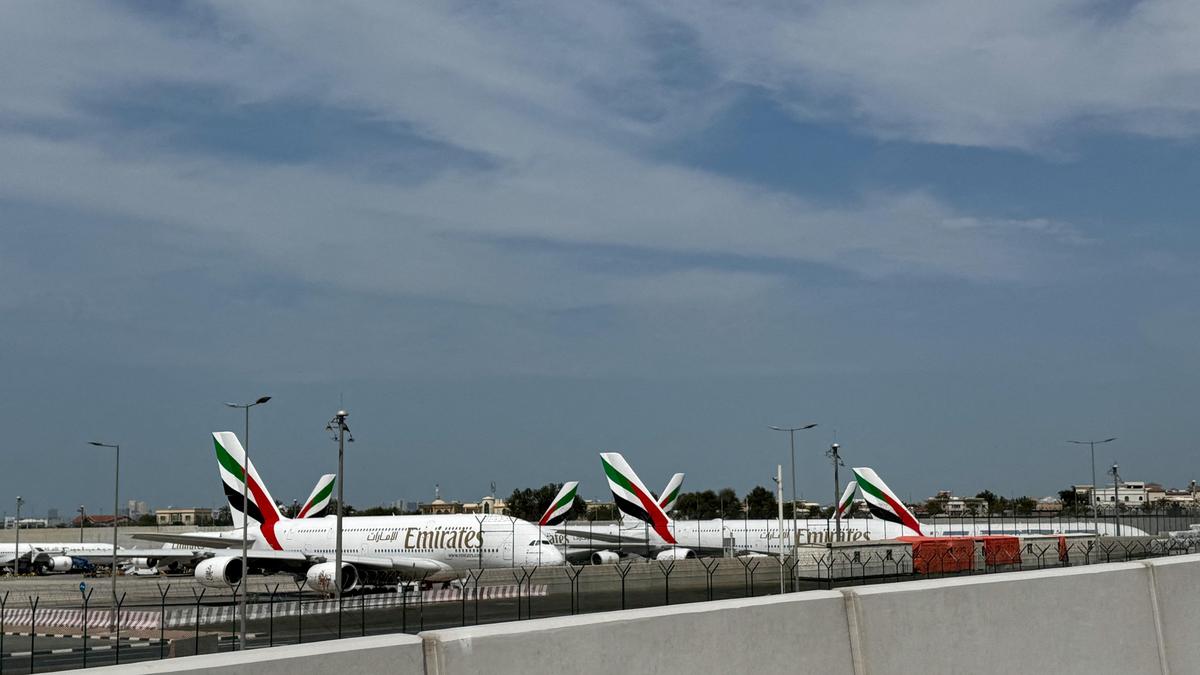
The operational integrity of a primary global aviation hub, such as Dubai International (DXB), rests on a fragile equilibrium between high-frequency throughput and a zero-tolerance security perimeter. When a fire occurs in the vicinity of such an installation—specifically following reports of unmanned aerial system (UAS) activity—the primary disruption is not the physical damage to secondary structures, but the catastrophic breakdown of the temporal "just-in-time" logistics chain. Security at this scale is a function of detection latency and response protocols. Even a low-cost drone represents a high-leverage tool of economic attrition because it forces a multi-million dollar defensive and regulatory apparatus to pivot from efficiency to total cessation.
The Mechanics of Airspace Contestedness
The tactical reality of drone-led incursions near critical infrastructure involves a fundamental mismatch in cost-per-engagement. A consumer-grade or improvised loitering munition costs orders of magnitude less than the radar systems, electronic warfare (EW) suites, and kinetic interceptors required to neutralize it. In the context of Dubai’s aviation sector, the "threat" is categorized by three distinct vectors:
- Kinetic Impact and Fire Ignition: The most visible result, involving the combustion of fuel or storage materials in the "vicinity" of the airport. While the fire itself is often localized to support infrastructure—warehouses or refueling zones—the smoke plume creates a navigational hazard and triggers automated fire suppression protocols that can inadvertently damage sensitive avionics or electrical grids.
- Electronic Signal Saturation: To manage a drone threat, security forces often deploy broad-spectrum jamming. This creates a localized "blackout" for non-military GPS and communication frequencies, which can interfere with ground-handling equipment and secondary airport communications, effectively slowing the "turnaround" time for parked aircraft.
- Regulatory Paralysis: The most significant cost is the mandatory grounding of flights. Under international aviation safety standards, any unverified object in a sensitive flight path necessitates a complete halt of operations. The resulting backlog creates a "ripple effect" across global flight schedules, as DXB serves as the central node connecting European, Asian, and African routes.
The Cost Function of Operational Downtime
To quantify the impact of a security-related fire, one must look at the Disruption Coefficient. This is the ratio of actual throughput to theoretical capacity during the recovery phase. DXB handles approximately 250,000 passengers per day. Even a two-hour closure does not merely delay two hours of traffic; it creates a 24-to-48-hour logistical bottleneck.
- Fuel Burn Penalties: Aircraft forced into holding patterns or diverted to Al Maktoum (DWC) or Sharjah (SHJ) consume fuel at a rate that deviates from their optimized flight plans. For a long-haul wide-body aircraft, this can result in tens of thousands of dollars in unbudgeted fuel expenditure per airframe.
- Crew Duty Limits: Pilots and cabin crew operate under strict legal limits regarding "block hours." A three-hour delay on the tarmac can push a crew over their legal limit, requiring a fresh crew to be swapped in. In a hub-and-spoke model, this creates a shortage of available personnel for subsequent flights.
- Reputational Discounting: Long-term economic stability for a transit-heavy economy depends on "perceived reliability." If a hub is viewed as vulnerable to asymmetric threats, insurance premiums for carriers increase, and high-value cargo may be rerouted through competing hubs like Doha or Istanbul.
The Infrastructure Vulnerability Matrix
Critical infrastructure in the vicinity of an airport—industrial zones, fuel farms, and worker housing—often lacks the hardened defenses of the terminal itself. This creates a "soft perimeter" where an incident can occur that is physically outside the airport fence but operationally inside the flight safety zone.
The fire mentioned in recent reports illustrates the Proximity Paradox: a fire does not need to touch a runway to stop a plane. If the heat signature or smoke density reaches a specific threshold near the approach path, the ILS (Instrument Landing System) sensors can be obscured, or the air traffic control (ATC) visibility can drop below the minimum required for safe landings.
Defensive Architecture and Detection Gaps
Current counter-UAS (C-UAS) technology faces a "false positive" problem. In a dense urban environment like Dubai, distinguishing a malicious drone from authorized commercial drones, birds, or atmospheric clutter is technically demanding.
- Passive RF Detection: Monitoring for the radio signals used to control a drone. This fails if the drone is autonomous or following a pre-programmed GPS path without active telemetry.
- Optical and Thermal Imaging: Using AI-driven cameras to spot the drone. These are limited by line-of-sight and can be defeated by environmental factors like the heavy dust or humidity common in the UAE.
- Active Radar: Specifically designed "low-slow-small" (LSS) radar. These are effective but expensive and require careful calibration to avoid interference with the airport's primary navigation radars.
The failure to prevent a drone-initiated fire suggests a gap in the integrated sensor fusion layer—where data from multiple sources is synthesized to provide a single actionable threat picture. When a drone manages to ignite a fire in the vicinity, it indicates the perpetrator leveraged the "low-altitude clutter" of the city to mask their approach until it was too late for a non-kinetic intervention.
Geopolitical Risk and Insurance Adjustments
From a consultancy perspective, these incidents are analyzed through the lens of War Risk Insurance (WRI). When an attack is attributed to drone activity, it shifts the incident from "accidental fire" to "hostile act." This triggers specific clauses in maritime and aviation insurance policies.
The UAE has invested heavily in "The Layered Defense" model, utilizing systems like the THAAD and Patriot batteries for high-altitude threats. However, these systems are ill-suited for the "micro-threat" of a small drone. The pivot toward directed-energy weapons (lasers) and high-power microwave (HPM) systems is the logical progression to counter this, as these provide a "deep magazine" with a low cost-per-shot.
Logical Chain of Escalation
The transition from a drone sighting to a localized fire follows a predictable causal chain:
- Infiltration: The UAS enters the "Red Zone" (inner 5km radius) using terrain masking.
- Payload Release/Impact: The device targets flammable secondary infrastructure (e.g., plastic storage or fuel runoff).
- Thermal Propagation: The initial fire spreads due to high ambient temperatures and wind, creating the visible plume that necessitates the ATC shutdown.
- Logistical Cascading: The grounding of the "First Wave" of flights leads to gate congestion, preventing arriving flights from deplaning, which in turn leads to diversions.
Strategic Optimization of Perimeter Security
To mitigate future occurrences, the focus must shift from terminal-centric security to Deep Perimeter Monitoring. This involves placing C-UAS sensors on skyscrapers and industrial landmarks several kilometers away from the airport. By expanding the detection radius, the "reaction window" increases from seconds to minutes, allowing for electronic mitigation before the drone reaches a target.
Furthermore, the implementation of a "Digital Dome"—a persistent electronic fence—is necessary. This requires a regulatory framework where every authorized drone carries a mandatory remote identification (Remote ID) chip that broadcasts an "I am friendly" signal. Any signal not on the "White List" is automatically engaged by automated jamming systems.
The underlying vulnerability exposed by these events is not the lack of military power, but the inherent friction between security and speed. As long as global hubs prioritize the rapid movement of people and goods, they will remain susceptible to the "asymmetric tax" imposed by small-scale, high-impact disruptions. The only path forward is the total automation of the detection-to-neutralization cycle, removing human latency from the security equation.
Security directors must prioritize the hardening of "Type 2" assets—warehouses, power substations, and water desalination plants within a 10km radius of the runway. If these secondary targets remain soft, they will continue to be used as proxies to shut down the primary aviation asset without ever needing to penetrate the terminal's main defenses.