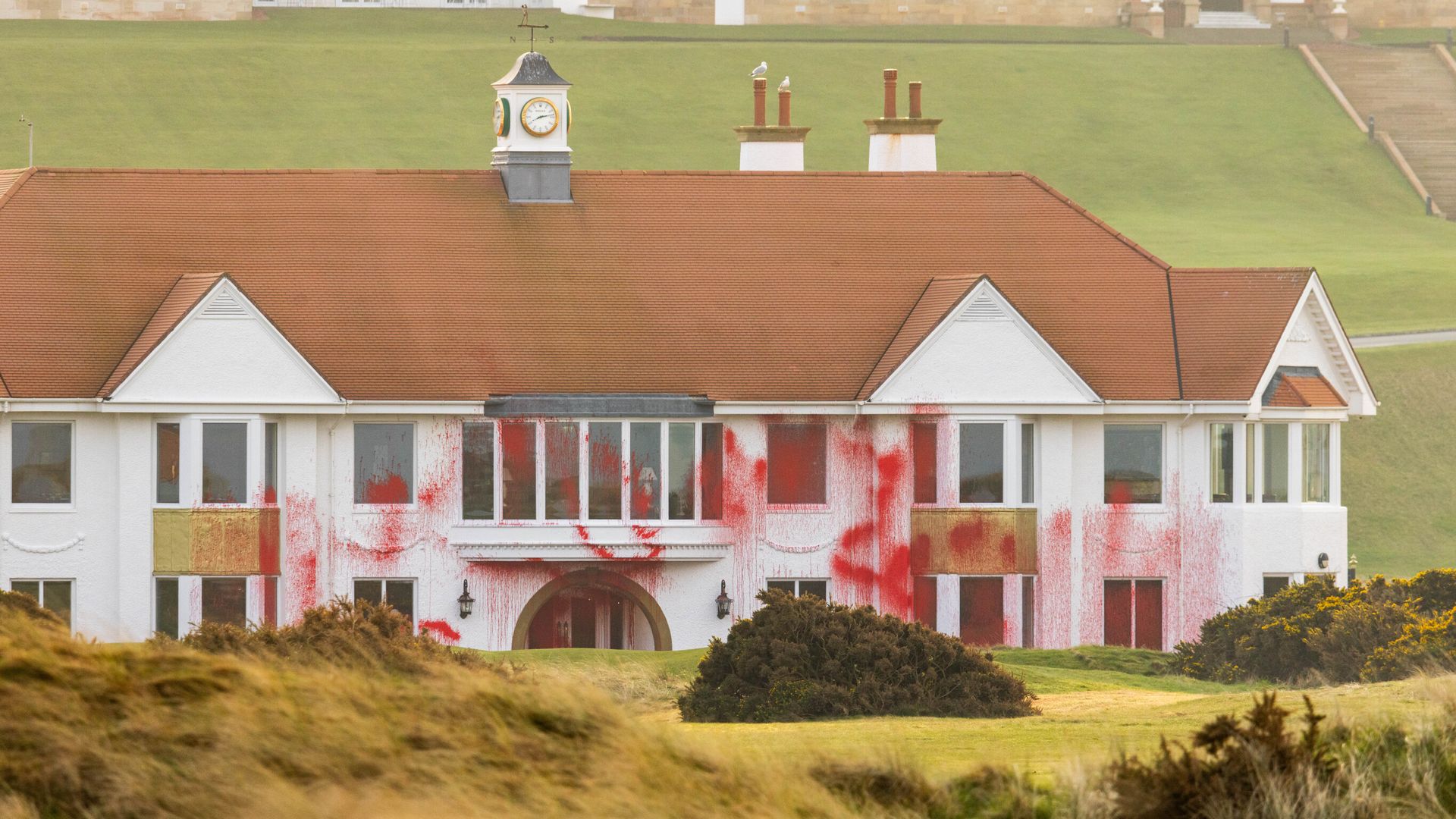
High-profile commercial properties operate under an asymmetric risk profile where physical security failures translate directly into geopolitical messaging, reputational degradation, and complex criminal litigation. When individuals accused of vandalizing the Trump Turnberry golf resort in South Ayrshire, Scotland, are ordered to stand trial, the event ceases to be a routine localized property crime. Instead, it becomes a case study in perimeter vulnerability, the operational friction of the Scottish criminal justice system, and the economic calculus of securing sprawling, politically exposed hospitality assets.
Standard media coverage treats these incidents as isolated flashpoints—focusing on the spectacle of the damage or the political identity of the property owner. That framing misses the structural reality. A luxury golf resort spanning hundreds of acres of coastal terrain cannot be hardened like an urban financial institution without destroying its core commercial value proposition. Operators and legal analysts must evaluate these trials through three distinct mechanisms: the physical mechanics of perimeter exposure, the procedural architecture of Scottish criminal prosecution, and the deterrence economics governing ideologically motivated vandalism.
The Structural Vulnerability of Sprawling Hospitality Assets
Securing a championship golf course presents an inherent operational contradiction. The asset's revenue model relies on openness, unobstructed coastal sightlines, and public accessibility to clubhouses, hotels, and grounds. Unlike an industrial facility or a private residence, a commercial resort must actively invite transient foot and vehicular traffic onto the premises.
This creates three distinct vulnerability vectors that standard security protocols struggle to neutralize without degrading the customer experience:
- Perimeter-to-Staff Ratio Imbalances: Coastal links courses like Turnberry occupy vast footprints with multiple natural ingress points—beaches, public footpaths, and adjacent agricultural land. Maintaining continuous physical surveillance across miles of open turf requires either prohibitive human capital or intrusive technological arrays.
- The Access-Control Dilemma: During operating hours, distinguishing between a legitimate patron, a curious tourist, and a bad-faith actor conducting reconnaissance is operationally difficult. Hardening entry points with aggressive screening introduces friction that alienates high-net-worth clientele.
- Target Surface Area: In standard commercial burglary, perpetrators target concentrated high-value nodes (safes, inventory, server rooms). In ideologically motivated vandalism, the entire physical canvas—greens, fairways, signage, and exterior masonry—serves as a viable target. Damaging a single putting green with chemical agents or mechanical tools inflicts disproportionate financial and operational disruption relative to the effort required to execute the breach.
When perpetrators exploit these vectors, the immediate financial cost extends far beyond basic material repair. Turfgrass remediation on tournament-grade greens requires specialized agronomic intervention, soil testing, and extended dormancy periods, directly impacting tee-time inventory and tournament readiness.
Procedural Mechanics of the Scottish Criminal Justice System
Once suspects are apprehended and charged in connection with property damage at a high-profile Scottish venue, the dispute moves into a legal framework distinct from English or American jurisdictions. Understanding the trajectory of such a trial requires mapping the procedural stages of Scots criminal law, which separates offenses by severity and dictates the evidentiary threshold required for conviction.
Summary vs. Solemn Procedure
The Crown Office and Procurator Fiscal Service (COPFS) determines the prosecutorial track based on the gravity of the alleged offense and the estimated financial value of the damage.
- Summary Procedure: Utilized for less severe offenses, heard before a Sheriff sitting without a jury (or a Justice of the Peace). Sentencing powers are capped, typically limiting custodial sentences to twelve months and fines to statutory maximums.
- Solemn Procedure: Reserved for serious criminal conduct—such as extensive malicious mischief or coordinated conspiracy causing substantial financial loss. These cases proceed on indictment before a Sheriff and a fifteen-person jury, or in the High Court of Justiciary, carrying significantly higher sentencing exposure.
In cases involving high-value commercial property damage, prosecutors evaluate not merely the cost of paint or turf replacement, but the broader economic disruption and the degree of premeditation. When suspects plead not guilty and a trial diet is fixed, the litigation timeline introduces protracted operational costs for the victimized enterprise, including the preparation of detailed loss-adjuster valuations and the allocation of management personnel to provide witness testimony.
The Corroboration Requirement
A defining feature of Scots law is the strict requirement for corroboration—the rule that no person can be convicted of a crime on the uncorroborated testimony of a single witness, regardless of how credible that witness appears. Every essential fact (the facta probanda), specifically that the crime was committed and that the accused was the perpetrator, must be supported by at least two independent sources of evidence.
For security directors managing high-profile properties, this legal standard dictates how surveillance systems must be engineered:
- Chain of Custody Integrity: High-definition CCTV footage capturing an act of vandalism is legally insufficient if the defense successfully challenges the continuity of the digital file or the reliability of the timestamp.
- Secondary Evidentiary Anchors: Prosecution teams rely on pairing visual surveillance with secondary physical or digital markers—Automatic Number Plate Recognition (ANPR) logs from surrounding road networks, mobile telecommunications cell-site data, forensic trace evidence (paint transfers, footwear impressions), or admissions made during police interviews.
If a resort's security infrastructure captures an incident but fails to link the perpetrator to the broader ingress and egress timeline, the prosecution faces acute vulnerability under the corroboration rule.
The Economics of Ideologically Motivated Vandalism
Standard criminological deterrence models assume a rational actor weighing the probability of apprehension and the severity of punishment against the tangible material gain of the offense. Ideologically or politically motivated vandalism breaks this model because the perpetrator's utility function is non-monetary.
For activists or protest-oriented actors, the primary return on investment is earned media amplification. The physical damage inflicted on a branded asset is merely the mechanism used to trigger news cycles, force the brand name into headlines alongside political grievances, and signal commitment to an ideological peer group.
This creates a perverse incentive structure for the property owner:
- The Publicity Paradox: Pursuing aggressive criminal prosecution and maximum restitution is necessary to establish legal deterrence and satisfy insurance underwriting requirements. However, every procedural milestone—arrest, initial plea hearing, trial scheduling, and verdict—generates a fresh cycle of media coverage that inadvertently extends the shelf life of the perpetrator's original message.
- Asymmetric Cost Ratios: The perpetrator expends minimal capital—often less than a few hundred pounds on basic materials and transport—to execute an act that forces the asset owner to expend tens or hundreds of thousands of pounds on physical remediation, heightened security patrols, legal coordination, and insurance deductible absorption.
- Underwriting and Premium Escalation: Repeated targeting of a specific commercial property alters its actuarial risk profile. Commercial property insurers evaluate the frequency and predictability of malicious damage claims. Over successive renewal cycles, properties deemed to carry elevated geopolitical or ideological target risk face higher deductibles, sub-limits on malicious mischief coverage, or requirements to implement costly third-party security audits as a condition of coverage.
Operational Limitations of Hardening Measures
Security consultants frequently recommend aggressive physical upgrades following high-profile breaches, yet practitioners must recognize the hard operational limits of these interventions. No physical defense architecture eliminates risk entirely; it merely shifts the cost-benefit curve for the attacker while introducing new operational frictions for the business.
- Technological False Positives: Deploying thermal imaging, ground-penetrating radar, or AI-driven perimeter analytics across coastal golf terrain generates high volumes of false alarms triggered by wildlife, shifting weather patterns, and coastal fog. Alarm fatigue among monitoring personnel rapidly degrades response times, neutralizing the value of the hardware.
- Regulatory and Environmental Constraints: Coastal properties in Scotland frequently sit adjacent to Sites of Special Scientific Interest (SSSIs) or fall under strict local planning regulations. Erecting high-security fencing, intrusive floodlighting, or concrete barriers is often legally prohibited by environmental and municipal authorities, forcing operators to rely on non-structural monitoring.
- Jurisdictional Boundaries: Private security personnel operating on resort grounds possess no greater legal authority to detain individuals than ordinary citizens under Scots law. Overzealous intervention by private guards risks exposing the corporate entity to civil liability for unlawful detention or assault, requiring strict protocols that prioritize observation, documentation, and rapid handover to Police Scotland.
Strategic Allocation of Security and Legal Resources
To manage the intersection of physical asset vulnerability and criminal litigation exposure, operators of high-profile hospitality properties must move away from reactive perimeter hardening and adopt an intelligence-led, evidentiary security posture.
- Shift Capital from Barriers to Forensic Capture: Rather than attempting to physically wall off vast acreage, capital expenditure should prioritize high-resolution, tamper-resistant optical and thermal capture at natural choke points—access roads, bridges, clubhouse approaches, and maintenance yards. Systems must be configured to satisfy the Scots law corroboration standard by pairing facial and vehicular capture with automated metadata logging.
- Establish Pre-Incident Evidentiary Protocols: Operations teams must maintain standardized damage-valuation templates and agronomic assessment partnerships prior to an incident occurring. Rapidly quantifying the exact financial cost of turf, structural, or brand damage ensures the Procurator Fiscal has immediate, indisputable figures to justify solemn indictment procedures rather than lower-tier summary charges.
- Integrate Legal and Communications Workflows: Management must decouple physical security operations from public relations reactions. Legal teams should coordinate quietly with law enforcement to pursue full restitution orders upon conviction, utilizing civil recovery mechanisms where criminal fines fail to cover actual remediation costs, while avoiding public commentary that amplifies the ideological framing of the defendants during trial proceedings.